Up next in 10



If you want me to coach you personally to jump higher click here:
If you want a FREE week of jump training click here:
My name is Isaiah Rivera and I have the highest officially tested vertical on the planet at 50.5 inches and am the co-founder of THPstrength, a company that focuses on vertical jump training for athletes.
What makes me a little different from most athletes that jump high is that I started with a pretty low vertical and documented my entire journey on this channel. Here is my journey in a nutshell:
14: Started working out to jump higher for basketball
16: Hit my first dunk and shortly after found out about the world of pro dunking
17: Trained like a madman and hit my first between the legs dunk
18: Entered my first professional dunk contest
19: Knee pain almost made me quit dunking
20: Met my coach John Evans, who helped me get rid of knee pain
21: Won my first international dunk contest
22: Tested a 48 inch vertical and started coaching full time
24: Tested a world record 50.5 inch vertical
The reason I make so much free content about jumping higher now is because it’s a resource I wish I would’ve had when I was in high school that would’ve prevented a lot of unnecessary mistakes and injuries.
My mission is to share my passion and love for dunking and training and to make dunking an officially recognized sport.
I hope that I can be an inspiration for your jump training and dunking journey,
Isaiah
Show More Show Less View Video Transcript
0:00
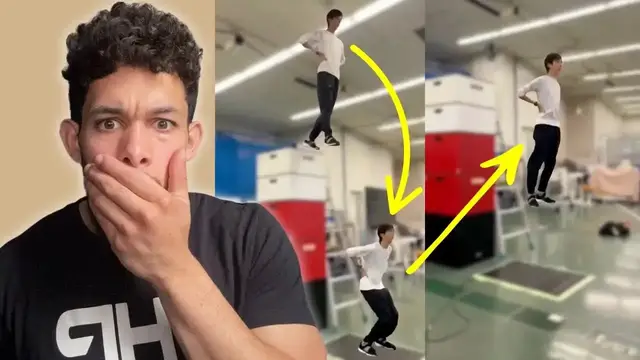
This is a depth jump, and I use depth jumps to increase my one foot vertical by three inches
0:04
in 30 days. Depth jumps are an exercise where you jump off a box and then you jump again as soon as
0:10
you hit the ground. However, I didn't just do regular depth jumps. I used a method called
0:15
shockloading. Shockloading is a phrase coined by Yuri Verkashansky, who is considered the father
0:20
of plyometrics. See, most people think of plyometrics as just jumping exercises. However
0:25
However, Yuri had a very specific definition for plyometrics. See he only considered a plyometric an actual plyometric if it contained shock loading
0:33
Before I explain what shock loading is and how you can use it in your training, first
0:38
let's understand why plyometrics even make you jump higher. Plyometrics train something called the stretch shortening cycle
0:44
The stretch shortening cycle is a fast eccentric action followed by a very fast concentric action
0:49
in the muscle and tendon. Think of eccentric as lengthening under load and concentric as shortening under load
0:56
For example, in a squat, when you're going down, your muscle is lengthening while it's
1:02
undergoing tension. And then on the way up, your muscle is shortening while it's undergoing tension
1:09
Another way to think about it is a bicep curl. As I'm lowering a weight, my muscle is lengthening
1:14
However, there's tension because I'm holding that weight. And then as I bring the weight up, my bicep is shortening under tension
1:23
Again, I'm holding the weight. However, when you do that fast lengthening and shortening under tension, something very special happens
1:31
You undergo a stretch shortening cycle. And the difference between a fast movement and a slow movement is that in the fast movement, you load the tendon a lot
1:40
Because eccentric muscle actions are way stronger than concentrate muscle actions. Think about how much weight you'd be able to lower versus how much weight you can raise up in a squat
1:50
This effect is magnified even more when we load eccentrically very quickly
1:56
Look at this force velocity curve. The force velocity curve shows the properties of a single muscle fiber in a movement
2:02
And the left side of the curve describes what happens to the muscle fiber in eccentric muscle action
2:07
The more quickly that muscle fiber is lengthening, the higher the force it will be generating
2:13
And this is important because the more force a muscle fiber is generating
2:17
eccentrically, the more the tendon is going to stretch. And a tendon stretching
2:22
is very very good for athletic performance whether that's running or jumping Because when you stretch the tendon it stores energy And the farther you stretch the tendon the more energy is stored And the more force that muscle fiber is producing eccentrically the farther you stretching the tendon And that is why we do plyometrics Plyometrics train the stretch shortening cycle And specifically
2:46
plyometrics overload the eccentric part of the stretch shortening cycle. Overload is very
2:53
very important because without an overload, there is no adaptation that can take place
2:57
That is the entire point of training is to induce an adaptation that's going to make you jump higher
3:03
So how do plyometric exactly induce an overload? Well, there's a few different ways that you can do that
3:07
You can move with more intent. You can use higher takeoff velocities
3:12
You can decrease or increase the range of motion. And you can use gravity to overload the eccentric portion of the plyometric
3:19
And you can decrease the ground contact time in the plyometric. Now, back to shock loading
3:25
Remember, Yuri only considered a plyometric if it had shock loading in the movement
3:30
And he defined shock loading as anytime the ground contact time in the plyometric is under 200 milliseconds
3:37
Now remember, Yuri was specifically training track and field athletes, specifically in the high jump and long jump
3:42
The ground contact times in those events is under 200 milliseconds. So if you're doing plyometrics and your ground contact time on that plyometric is above 200 milliseconds
3:52
it's not going to transfer over as well. However, the ground contact time is just one piece of the depth jump
3:58
You also want to be using a high enough box where you overload the movement eccentrically
4:03
We want it to be more intense than your actual jumps when you're going out and jumping off one foot
4:09
This is what the high jumper at the beginning of the video was doing. Now, he took this to an extreme, but he was a high jumper
4:15
I believe his PR was 2.28 meters. And they were getting an insane eccentric load from how high of a box he was dropping off of
4:22
and then he was minimizing ground contact time as much as he can. And this is very, very important
4:26
He was jumping as hard as he could. So to recap, if you wanna jump higher off one foot
4:30
use depth jumps. You wanna use a high enough box where there is an eccentric overload
4:35
You want to keep ground contact time under 200 milliseconds and you wanna jump as high as you can
4:40
If you want to know how to specifically implement this in your training with sets and reps
4:45
what days to do them, when in the workout to do them, you can sign up for my coaching at thpstrength.com
4:50
where it's currently 20% off your first month by using the code SPRING
4:54
Once you sign up, you're going to get on a call with a coach in under 24 hours
4:58
There, you're going to get a specific training program written for you. And if you want to use this shock training method specifically
5:05
text us in the group chat, and if it the right type of training for you we can program it in Remember this is a very advanced technique so you should only do this when you have a pretty high training age Or you can just play with fire and try it now
5:16
but the risk of injury is very, very high. So make sure that you train to train
5:22
and that your tissues can handle this. Having said that, you can also do this for two foot jumps
5:26
And fun fact, when I broke the approach vertical jump world record
5:30
I also did these specific plyometrics, but we didn't do it in the traditional shock-loading sense
5:36
See, Yuri was specifically training one footers, but two foot jumping is different
5:40
Most two footers are around 300 milliseconds in terms of the ground contact times
5:44
And they're also going through deeper ranges of motion at the knee
5:48
Just look at the knee angle on this one foot jump. And now look at the knee angle on this two foot jump
5:54
In the two foot jump, you're around a half squat position. And another law of adaptation is the law of specificity
5:59
There are specific adaptations when the body undergoes a training stimulus. The more similar that activity is to the thing that you're trying to improve, the more transfer it's going to have
6:10
So we can use these principles to modify our plyometric exercise. One, we want to do the depth jumps with a little bit longer ground contact time
6:19
And we want to do that by lowering a little more. However, you don't want to do this consciously
6:24
Instead, we're going to raise the box to a point where it forces you into a half squat
6:30
And you want to focus on getting off the ground as quickly as possible. This is going to take some experimentation. Specifically, you want to be right around 300 milliseconds
6:39
Then you want to set a target that's going to force you to jump as high as you can
6:43
It's going to take some experimentation to find the ideal height where you're at 300 milliseconds while jumping as high as you can
6:50
while spending as little time on the ground as possible, while trying to get off the ground as quickly as possible
6:55
For reference, me with a 50.5 inch vertical required a 60 inch box to hit a half squat position where I was trying to get off the ground as quickly as possible with that time being 300 milliseconds
7:07
Something that's important to note is that plyometrics aren't actually training your tendons
7:12
It's training your nervous system. Your nervous system is extremely important in its role in producing force
7:19
You're essentially teaching your nervous system to fire with more force and more quickly, which is exactly what you need for jumping
7:24
However, you don't want to just stick to doing plyometrics because you're going to reach a point
7:28
of diminishing returns very, very quickly, and there's going to be a pretty high risk of injury
7:34
The way we combat both of those things is by supporting the plyometrics with weight training
7:40
Weight training both trains your tendons to become stiffer and a stiffer tendon stores more energy when stretched the same length as a more compliant tendon Weight training also decreases your risk of injury There a direct correlation between how strong you are and your injury risk when jumping and sprinting And lifting can also
7:57
increase the size of your type 2 muscle fibers. Now remember, you train the nervous system and
8:03
your nervous system innervates your muscles. There's neurons that connect to your muscles
8:07
and when your brain decides it's time to contract, sends that signal down to the muscle and the muscle
8:11
contracts, but there's different types of muscle fibers. A neuron connected to a muscle is called
8:16
a motor unit. And some motor units are bigger than others, innervate more muscle fibers
8:22
and fire more quickly. And those are type two motor units. And those are the ones that we want
8:26
to train to be stronger and bigger. Now, everybody has a specific percentage of type one to type two
8:33
motor units, and you can't change that, but you can change the size of your type two motor units
8:39
essentially improving the ratio of your type two to type one units. And the best way to do that is
8:46
by lifting heavy with maximum intent. Keyword intent, how hard you are trying. So how do we put
8:52
all this together so that you get the maximum benefits from plyometrics while also training
8:57
your tendons to become stiffer and your type two motor units to become bigger while staying healthy
9:03
You do is earlier in the year, don't really want to be doing plyometrics. That stuff is too specific
9:08
and you're not gonna be able to handle it. So instead, you do general strength training exercises
9:12
focused on higher rep ranges, and you don't have to lift with maximum intent
9:16
Then, as the year goes on, you wanna transition to less volume and higher intensity
9:21
with the intent going up. Around this time is when you can start playing around with the plyometrics
9:27
And then you just repeat that process again. The percentage of time that you're doing the highly specific stuff should be lower
9:32
than the time you're doing the more general stuff, especially as you become a more advanced athlete
9:37
Now remember, I jumped three inches higher in those 30 days off one foot
9:42
What my training looked like there was a ton of quarter squats, a ton of depth jumps using
9:47
the shock method style of jumping, but the training leading up to those 30 days looked
9:51
completely different. The month prior to that, I was doing half squats instead of quarter squats, and I was
9:57
doing loaded standing jumps instead of the depth jumps. The ground contact times were longer, the jumps were less intense, and the range of motion
10:05
wasn't as specific to one foot. What's funny is that during those previous cycles, I was jumping super high off two feet because the stuff I was doing was specific to two foot
10:14
Then when I went to the quarter squat and depth jump cycle, my one foot skyrocketed, but my two foot plateaued very quickly
Sports
Track & Field
Sports Coaching & Training
Fitness Instruction & Personal Training
High Intensity Interval Training
Climbing & Mountaineering
Stunts & Dangerous Feats