Up next in 10

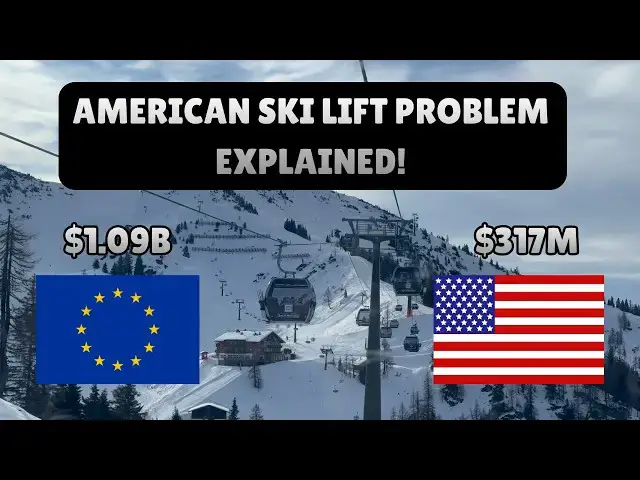
Every time you queue forty-five minutes for a fixed-grip quad at a major US resort on a $250 lift ticket, there's a number worth knowing. In the 2025/26 season, Italy, France, Austria, and Switzerland combined spent $1.09 billion installing new lifts.
The US and Canada combined spent $317 million. Europe invested 3.4 times more - in ski markets that are, in aggregate, smaller than America's.
This video is my attempt to properly explain why. And the answer is more complicated - and more interesting - than simply blaming corporate greed.
It involves publicly-listed governance structures returning $595 million to shareholders while spending $225 million on mountains. It involves French legal frameworks that guarantee 25-year operating concessions and generate €10.7 billion in infrastructure backlogs.
It involves Swiss gondolas that are classified as public transport, communities with no road access, and summer mountain tourism that has been running since the 1860s. And it involves a US Forest Service permit system that has, until very recently, legally prevented ski resorts from earning meaningful year-round revenue.
I also pulled together a full database of all 226 new lift installations across 32 countries for the 2025/26 season to see exactly what's being built, where, and at what cost. The breakdown by lift type tells its own story.
This video was inspired by a great piece from @SRGSkiing asking whether Colorado has a lift problem - link below. I'd suggest checking it out.
https://www.youtube.com/watch?v=OgEf6dpCeWs
The full database and supporting report referenced throughout this video are linked below.
https://docs.google.com/spreadsheets/d/e/2PACX-1vRcHh-kua__xeFfWQs2Lm0xpTTMcb6C5d338dBAWivgN67Zv4dAK_0wgyACrRlHHA/pubhtml
#skiresorts #chairlifts #europe #northamerica
🎬 Want more ski content? Subscribe! ► @snowstash
📱 Follow us on:
Instagram: @snow.stash
Twitter: @SnowsStash
Facebook: @snowstash
Website: www.snowstash.com
Show More Show Less View Video Transcript
0:00
I was watching a video the other week
0:02
from SRG skiing who asked the question,
0:05
does Colorado have a ski lift problem?
0:07
And it got me thinking, is it just
0:09
Colorado or is it the whole of North
0:11
America?
0:12
I've done month-long trips to Europe
0:14
over the last two seasons
0:16
and I was genuinely blown away by their
0:18
lift infrastructure.
0:19
Not just the hardware itself, but the
0:21
scale of investment, the ambition of the
0:23
projects, and the frequency with which
0:26
European resorts seem to be pulling out
0:28
old lifts and replacing them with
0:30
something significantly better.
0:32
I have also done a few decently sized
0:34
trips to North America, plus follow
0:36
along with all new lifts that open in
0:38
the region. The contrast is hard to
0:40
ignore.
0:42
So, I decided to take a wider lens to
0:43
the situation and do some proper
0:45
research.
0:46
What I found is quite an interesting
0:48
story.
0:49
And this is my look into why American
0:51
ski resorts don't reinvest like European
0:54
ones. The link to the original SRG
0:56
skiing video is in the description and I
0:58
suggest you check it out.
1:00
If you find this kind of content useful,
1:02
a like and a subscribe helps the channel
1:05
out.
1:06
Now, let's get into it.
1:11
Chapter 1, the question everyone is
1:14
asking.
1:15
So, I want to start with a number, just
1:17
one.
1:18
In the 2025/26
1:20
ski season, Italy, France, Austria, and
1:24
Switzerland combined spent approximately
1:26
1.09
1:28
billion US dollars installing new lifts.
1:31
In the same season, the entire continent
1:33
of North America, the United States and
1:36
Canada combined, spent 317 million
1:39
dollars, 3.4 times more.
1:42
In a group of countries with ski markets
1:44
that are in aggregate smaller than
1:46
America's.
1:47
And it's not just that Europe is
1:49
building more, they're building better.
1:51
Switzerland averages 16.75
1:54
million dollars per new lift
1:56
installation.
1:57
The US average is $6.85 million. The
2:01
Swiss are building lifts that cost
2:03
nearly two and a half times what
2:05
Americans build per unit.
2:07
Now, if you've ever queued 45 minutes
2:09
for a fixed-grip quad at a major US
2:12
resort that charges $250 for a lift
2:15
ticket, you've probably already had this
2:17
thought.
2:18
But, I want to go deeper than just Vail
2:20
is greedy.
2:21
Because the full explanation is more
2:22
interesting, more complicated, and
2:25
honestly, a bit more damning than simple
2:27
corporate greed.
2:29
This is a story about ownership
2:30
structures, regulatory frameworks, 150
2:34
years of European mountain history,
2:36
and what happens when the primary
2:38
purpose of a ski lift is not, in fact,
2:41
skiing.
2:43
I've pulled together a full database of
2:45
all 226 new lift installations across 32
2:49
countries for the 2025/26
2:52
season,
2:53
alongside a detailed financial
2:54
comparative report covering European and
2:57
North American operators.
2:59
What I found has changed the way I think
3:01
about this industry.
3:03
Chapter two,
3:05
who actually owns the mountain?
3:09
Before you can understand the
3:10
reinvestment gap, you need to understand
3:12
something fundamental.
3:14
The ownership structure of a ski resort
3:16
determines everything about how it
3:17
spends money.
3:19
In North America, the conversation
3:21
starts and ends with one company, Vail
3:23
Resorts.
3:25
They are publicly listed on the New York
3:26
Stock Exchange. They operate 42 resorts
3:29
globally.
3:30
In their 2025 financial year, they
3:33
posted $844 million in EBITDA on $2.96
3:37
billion in revenue. Those are genuinely
3:40
impressive numbers.
3:41
But, here's how Vail allocated that $844
3:44
million.
3:45
Mountain CapEx, meaning actual
3:47
investment in the physical resort
3:49
experience, came to approximately $225
3:52
million. That's about 7.5% of revenue.
3:56
Share buybacks, $265 million.
3:59
Annual dividend payouts, around $330
4:02
million.
4:03
So, total shareholder returns for the
4:05
year came to roughly $595 million.
4:09
Compare that to $225 million for the
4:11
mountains themselves.
4:13
In one financial year, Vail Resorts
4:15
returned 2.6 times more money to its
4:18
shareholders than it invested in its
4:20
mountains.
4:21
And I want to be absolutely clear. This
4:23
is not illegal. It's not even unusual
4:26
for a listed company.
4:27
And the people running Vail are not
4:29
idiots. They are operating rationally
4:32
within a publicly listed corporate
4:34
governance model that requires them to
4:36
maximize shareholder returns. That is
4:38
literally their fiduciary duty.
4:40
The problem isn't the people, it's the
4:42
structure. Now, compare that to Europe.
4:45
France's ski industry, through a model
4:47
I'll explain in a minute, invest 34% of
4:50
revenue in CapEx. Austria and
4:52
Switzerland are around 20%. CDA, which
4:56
is Compagnie des Alpes, the largest
4:58
publicly listed European ski operator,
5:00
spent 106 million euros in CapEx on 594
5:04
million euros of ski revenue last year.
5:07
That's an 18% reinvestment rate. Still
5:10
more than double Vail's.
5:12
So, where does European money come from?
5:14
And why doesn't the same pressure to
5:15
return it to shareholders apply?
5:18
The answer comes down to three different
5:20
ownership models. And none of them look
5:22
anything like the Vail model.
5:24
Model one, private and family-owned
5:26
resorts. In Austria, many of the major
5:29
resorts are private AGs or GmbHs.
5:33
Private limited companies owned by
5:35
families, local municipalities, or
5:38
combinations of both.
5:39
Kitzbühel's cable car company, Bergbahn
5:42
AG Kitzbühel, is 49.93%
5:45
owned by the Stadtgemeinde, the local
5:47
council.
5:49
Ischgl's Silvrettabahn
5:52
AG is owned by the surrounding Paznaun
5:54
Valley communities.
5:56
There are no external shareholders
5:57
demanding dividends. There is no
6:00
quarterly earnings call.
6:01
The equity exists for one purpose, to
6:04
fund the next generation of
6:05
infrastructure. That's it.
6:07
Model two, the French SEM structure.
6:11
In France, ski lifts are legally
6:13
classified as what translates roughly to
6:16
a public industrial and commercial
6:18
service.
6:19
The French legal framework, established
6:21
by the Loi Montagne in 1985, means that
6:24
the local council, the commune, is the
6:27
operating authority.
6:28
They either run lifts directly or grant
6:31
a concession, a DSP, to a private
6:33
operator.
6:34
These concessions run for 25 years,
6:37
which is the critical number.
6:39
When you're guaranteed a 25-year
6:40
operating contract, you can justify an
6:43
enormous capital investment that you'll
6:45
recoup over multiple ski seasons.
6:47
Compagnie des Alpes just won a new
6:49
25-year DSP for La Plagne,
6:53
with a concession backlog of 10.7
6:55
billion euros.
6:56
That kind of long-term visibility is
6:58
what enables 100 million euro plus lift
7:01
projects.
7:02
And at the end of the concession, all
7:04
the infrastructure reverts to the
7:06
commune. The private operator has no
7:08
incentive to sweat the assets and defer
7:10
maintenance. They have to give it all
7:12
back.
7:13
Model three, cooperatives and local
7:15
ownership in Switzerland. Zermatt
7:17
Bergbahnen is essentially owned by the
7:19
community that depends on it. Same with
7:21
the Aletsch Arena. Same with many of the
7:23
smaller Swiss operators.
7:25
And we'll come back to why community
7:27
ownership changes everything. Because in
7:29
Switzerland, the stakes are much higher
7:31
than skiing.
7:33
The North American private operators,
7:35
Alterra, Boyne, Powder, actually behave
7:38
more like European operators than Vail
7:40
does.
7:42
Alterra is spending an estimated $490
7:44
million
7:45
in annual CapEx, roughly 20 to 25% of
7:48
revenue, funded through debt rather than
7:51
equity.
7:52
They don't have a dividend obligation.
7:54
They don't run share buyback programs.
7:57
The Deer Valley East Village expansion,
7:59
a $3.2 billion total project, is the
8:02
largest capital project in North
8:04
American ski history. However, a large
8:07
part of the funding for the new lifts
8:09
comes from the real estate company and
8:11
not directly from Alterra.
8:13
And notably, Alterra's Ikon Pass at
8:15
$1,399
8:17
for 2026/27
8:20
is $310 more expensive than Vail's Epic
8:23
Pass.
8:24
And the market is absorbing that
8:25
premium.
8:26
People are choosing quality over network
8:28
scale.
8:29
So, when critics ask why American
8:31
resorts don't reinvest, it's worth being
8:33
precise about which American resorts
8:35
we're talking about. Vail Resorts is the
8:37
problem, not the entire industry.
8:41
Chapter 3
8:43
What the 2025/26
8:45
lift database actually tells us.
8:49
Right, let's get into the data because
8:51
the numbers from the 2025/26
8:54
new lift database are more revealing
8:56
than any financial report.
8:58
226 new lifts installed globally.
9:02
32 countries, roughly $1.7 billion in
9:05
total estimated investment worldwide.
9:09
Now, I will add here, I don't know the
9:11
exact figures the resort spent on their
9:12
lifts.
9:13
I took numerous reports of each lift
9:15
type from numerous regions to work out
9:17
the US dollars per meter cost and then
9:20
applied this to the total meter distance
9:22
per new lift per type.
9:24
Yes, I use per meter as I am Australian.
9:27
However, if I was to use per feet, the
9:29
driving USD value would be lower, but
9:32
total cost would have been the same.
9:34
Who Who
9:35
Maybe I have under-quoted some of these
9:37
costs. The major four in the Alps,
9:40
Italy, France, Austria, Switzerland,
9:43
installed 108 new lifts for $1.09
9:47
billion.
9:49
The US and Canada combined installed 49
9:51
lifts for $317 million. But
9:55
But the more interesting story is in the
9:57
type of lift being installed, because
9:59
this is where you really see the
10:00
divergence in ambition.
10:02
Europe installed 27 new 10-person
10:05
gondolas in 2025/26.
10:09
North America installed four. Europe
10:11
installed 12 new eight-seat high-speed
10:13
chairs.
10:14
North America installed zero. What did
10:16
North America install most of?
10:19
Fixed-grip quads, 14 of them,
10:21
representing 28% of all North American
10:24
installations.
10:25
A fixed-grip quad is, and I say this
10:27
with respect, the Toyota Corolla of ski
10:30
lifts. Reliable, functional, not
10:33
particularly exciting, and something
10:35
you'd find in a resort brochure from
10:37
1987.
10:39
Europe is buying Audis, and North
10:41
America is buying Corollas.
10:44
Now, let me give you some specific
10:45
examples from the database that put this
10:48
in perspective.
10:49
In Switzerland, the Schilthorn above
10:51
Mürren, yes, the James Bond one, yes,
10:54
the 29th largest resort in Switzerland,
10:57
installed a brand new 100-seat funifor
11:00
aerial tram. That's not a typo, 100
11:03
people. Wide-gauge cable, wind-stable
11:05
design, replacing the old cable car.
11:08
Estimated cost, $43.8 million. I
11:12
I actually rode this lift in January,
11:14
and it's incredible, but it's also part
11:16
of a multi-season 200 million euro
11:19
investment in their full valley to
11:21
summit lift experience.
11:23
In Italy's Dolomites, the Campitello Col
11:25
Rodella at Val di Fassa installed a 3S
11:29
tricable gondola, a three-cable system,
11:32
and essentially the most stable and
11:34
highest capacity gondola technology that
11:36
exists.
11:37
Estimated cost, $39.9 million for a
11:40
single lift installation.
11:43
In Switzerland's Hoch-Ybrig, they
11:45
installed the world's first tri-line, a
11:47
20-seat tri-cable system that has never
11:50
been built anywhere before. $32.2
11:52
million.
11:53
Now, look at the biggest US
11:55
installations in the same database.
11:57
Deer Valley East Village's two new
11:59
gondolas at $28.8 million and $23.6
12:03
million. Impressive by American
12:05
standards, plus Big Sky's Explorer
12:07
gondola at $27.6 million. These are good
12:11
investments. They really are. But,
12:13
they're also tellingly almost all are
12:16
Alterra or independent resort projects.
12:20
Deer Valley is Alterra. Snowmass, Aspen
12:23
Skiing Company, dropped $18.5 million
12:27
on a new six-seater high-speed at Elk
12:29
Camp.
12:30
Killington, which is owned by an
12:31
independent group, upgraded their famous
12:34
Superstar lift with a new six-pack.
12:36
And the most notable Vail Resorts
12:38
addition in the database,
12:41
Park City's Sunrise Gondola at $21.8
12:44
million. I think it might be the only
12:46
new lift Vail installed in the last
12:48
season. The manufacturer data from the
12:50
database is also worth a mention here.
12:53
Doppelmayr, the Austrian company,
12:55
supplies 40% of all lifts globally by
12:58
unit count and $779
13:01
million worth of contracts.
13:03
Garaventa, the Swiss manufacturer,
13:06
averages $17.5 million
13:09
per contract, the most expensive per
13:11
unit of any manufacturer, because they
13:14
specialize in the highest end Swiss
13:16
installations. The fact that Austria and
13:18
Switzerland both build and operate the
13:20
world's best gondola infrastructure is
13:22
not a coincidence.
13:24
The supply chain, the engineering
13:26
knowledge, the workforce, it's all
13:28
integrated into the local economy in a
13:30
way that has no American equivalent.
13:33
Chapter 4,
13:35
the year-round question and why it
13:37
changes everything.
13:40
Now we get to what I think is the most
13:42
important structural insight in this
13:44
entire comparison.
13:45
And it's one that, if you've only ever
13:47
thought about ski resorts as ski
13:49
resorts, might surprise you.
13:51
In Europe, many of the most expensive
13:53
new lift installations are not being
13:55
justified on the basis of skiing at all.
13:59
Let me put that another way.
14:00
When Jungfraubahn built the Eiger
14:02
Express 3S Gondola in 2020 at a cost of
14:06
470 million Swiss francs, about half a
14:09
billion dollars at current exchange
14:10
rates, they did not build it because
14:12
they needed to move more skiers from
14:14
Grindelwald to the Kleine Scheidegg.
14:16
They built it because it serves summer
14:18
sightseeing traffic and creates a faster
14:21
connection to the Jungfraujoch cog
14:23
railway and functions as year-round
14:25
regional transport infrastructure.
14:28
The ski season is almost a secondary
14:30
consideration.
14:31
The Matterhorn Alpine Crossing, opened
14:34
in July 2023 at an estimated cost of 140
14:38
to 200 million Swiss francs,
14:40
connects Zermatt and Cervinia at 3,883
14:45
m.
14:46
It operates year-round. Zermatt
14:48
Bergbahnen projects 40 million Swiss
14:50
francs in annual income from this
14:52
crossing alone.
14:54
At a $170 million construction cost,
14:57
that's roughly a 23% annual return on
14:59
capital for a ski lift because it also
15:02
runs in summer at premium prices to an
15:05
international sightseeing market that
15:07
will pay 156 Swiss francs for a one-way
15:10
crossing.
15:11
Compare that to some new chairlifts in
15:13
Colorado or Lake Tahoe.
15:15
Same capital cost, roughly, runs
15:17
December to April, four, maybe five
15:20
months,
15:21
carries skiers who already paid a pass
15:23
fee, and are not generating incremental
15:25
per ride revenue. The return on
15:27
investment calculation is fundamentally
15:29
different.
15:31
Switzerland's cable car industry pulled
15:33
in 1.8 billion Swiss francs in total
15:35
revenue in 2025.
15:38
And here's the growth story that should
15:39
be alarming if you're a North American
15:41
operator. Summer transport revenue has
15:44
grown 260%
15:45
since 2008.
15:47
Winter transport in the same period grew
15:50
23%.
15:51
The Swiss industry now earns roughly 360
15:54
million Swiss francs annually from
15:57
summer transport, about 20% of total
15:59
revenue, and growing.
16:01
Jungfrau Bahn's 2024 accounts tell the
16:04
story in the starkest possible terms.
16:07
Their summer experience mountains
16:09
segment generated 56.1 million Swiss
16:13
francs in revenue and 36.7 million Swiss
16:16
francs in EBITDA.
16:18
That's a 65% operating margin. Their ski
16:21
segment generated 42 million Swiss
16:23
francs in revenue and 4.8 million Swiss
16:25
francs in EBITDA, an 11% margin.
16:29
The summer business was 7.6 times more
16:31
profitable than the ski business on a
16:33
per revenue basis.
16:35
The ski product is almost a loss leader
16:37
for the sightseeing product. You ski in
16:40
January, you come back in July to visit
16:42
the Jungfraujoch.
16:44
Austria's summer mountain revenue is now
16:46
15% of total and growing, up from 8% a
16:50
decade ago.
16:52
205 of Austria's 253
16:55
cable car companies run summer programs.
16:58
Austrian summer tourism in 2024
17:01
generated 81.6 million overnight stays,
17:05
beating winter's 72.2 million.
17:08
The mountains are becoming year-round
17:10
economic engines.
17:11
The French are the interesting outlier
17:13
here.
17:14
France earns 95% of lift revenue in
17:17
winter, the only major Alpine country
17:20
that hasn't successfully diversified
17:21
into summer.
17:23
And there's a historical reason for
17:24
that. France's major purpose-built
17:26
resorts, Tignes, Les Arcs, Val Thorens,
17:30
La Plagne, were created in the 1960s and
17:33
70s as high-altitude winter machines.
17:36
There was no pre-existing summer
17:37
culture,
17:38
no 19th-century hiking railway, no
17:41
village that relied on a gondola for
17:43
daily life.
17:45
France reversed the sequence that
17:47
Switzerland and Austria followed. France
17:49
built the lift first, the summer market
17:51
never quite arrived. And yet France
17:54
still invests 34% of revenue in CapEx
17:57
because the SEM structure and 25-year
18:00
DSP concession model provides the
18:02
long-term certainty that justifies it,
18:05
even without the year-round revenue to
18:07
underpin it.
18:08
North America, meanwhile, is
18:10
structurally capped at around 11% summer
18:13
revenue.
18:14
And here's the thing. It's not because
18:16
American resort operators don't want
18:17
summer revenue, it's because their own
18:19
government won't let them have it.
18:23
Chapter 5
18:24
The regulatory handcuffs nobody talks
18:26
about.
18:29
About 60% of American ski terrain sits
18:31
on US Forest Service land. Ski resorts
18:34
operate under a USFS permit. And that
18:37
permit has, until very recently,
18:39
contained a critical constraint.
18:41
The primary purpose of the permit must
18:43
remain skiing.
18:44
The Ski Area Recreational Opportunity
18:46
Enhancement Act of 2011 allowed zip
18:49
lines, mountain bike parks, ropes
18:51
courses, and summer activities were
18:53
technically permitted.
18:55
But the USDA's own estimate for the
18:57
entire national impact of that
18:59
legislation was 600,000 extra visits and
19:02
$40 million in additional spending.
19:05
In an industry doing $4.6 billion in
19:08
annual revenue, that is a rounding
19:10
error.
19:11
Vail's own 10K filing, the annual report
19:14
lodged with the SEC, states explicitly
19:17
that approximately 82% of total mountain
19:20
and lodging net revenue is earned
19:22
between November and April, and they're
19:24
not hiding from this. It's the nature of
19:26
the permit.
19:27
As of March 2026, there is a proposed
19:30
federal register change that would
19:32
eliminate the Forest Services
19:34
preponderance of revenue test for ski
19:36
areas, essentially acknowledging that
19:38
the existing framework has actively
19:41
prevented meaningful summer
19:42
diversification for decades.
19:45
Whether that goes through or not, the
19:47
acknowledgement matters.
19:49
The US government is starting to admit
19:51
that its own regulatory architecture has
19:53
been holding ski resort investment back.
19:56
But, even if the regulatory constraint
19:59
disappeared tomorrow, the structural
20:00
problem would remain.
20:02
Because European summer mountain tourism
20:04
didn't appear because someone in an
20:06
office decided to allow it.
20:09
It exists because Switzerland, Austria,
20:11
and parts of Italy have had summer
20:13
Alpine tourism culture since the 1860s
20:16
and 1870s.
20:18
The Rigi Kulm Railway opened in 1871.
20:22
The Jungfraubahn opened in 1912, before
20:25
either World War, before commercial
20:27
aviation,
20:28
before most of the ski resorts that now
20:30
operate on the same infrastructure were
20:32
even conceived.
20:34
The Victorian English came to
20:35
Switzerland to climb mountains and
20:38
breathe the air and paint the scenery.
20:40
The network of hotels, restaurants,
20:43
trains, cog railways, and cable cars was
20:46
built for hikers, not skiers.
20:48
Skiing was grafted onto existing summer
20:50
infrastructure decades later.
20:53
When critics ask why Vail doesn't just
20:55
build summer mountain bike parks and
20:57
gondola sightseeing experiences,
20:59
Whistler is the answer to that question.
21:02
Whistler Blackcomb is North America's
21:03
most successful summer mountain
21:05
operation.
21:06
About 100 km of lift-served mountain
21:09
bike trails, the annual Crankworx
21:11
festival, genuine summer visitation.
21:14
And Whistler's summer visits are roughly
21:16
30% of winter.
21:18
Summer revenue is around 10 to 15% of
21:20
total because summer yield per visit,
21:23
what people actually spend, is far lower
21:25
than ski season.
21:26
They're riding bikes, not buying $250
21:29
lift tickets, plus $35 lunches, plus
21:32
equipment rental.
21:34
The gap between European and North
21:35
American summer revenue shares is not
21:37
closing.
21:39
By every measure available, it is
21:41
widening because Swiss and Austrian
21:43
operators are actively investing in
21:45
summer product, while North American
21:47
operators remain constrained by permit
21:49
law, geography, and the absence of 150
21:53
years of summer mountain culture.
21:56
Chapter 6
21:58
The lifts as roads, and why that matters
22:00
more than you think.
22:04
I want to spend a bit of time on
22:05
something that has no equivalent in
22:06
North American skiing at all because I
22:09
think it gets to the heart of why
22:10
European operators invest differently.
22:13
In Switzerland, a cable car is not a ski
22:15
lift. It is federally regulated public
22:17
transport infrastructure, sitting under
22:19
the same legal framework as SBB trains.
22:23
Switzerland's
22:23
Personenbeförderungsgesetz,
22:25
the Passenger Transport Act, requires a
22:28
federal concession for any regular
22:30
passenger service.
22:31
Concession holders are folded into the
22:33
Swiss Pass and Nova national ticketing
22:35
system.
22:37
Your Swiss Half Fare Card gets you 50%
22:39
of the Jungfraubahn, the Gornergrat
22:42
Railway, the Schilthorn. Your GA annual
22:45
travel card gets you free access to the
22:47
Wengernalpbahn, the Berner Oberlandbahn,
22:50
the Aletsch Arena gondolas. And for
22:53
infrastructure that serves as the only
22:55
access to a community, meaning there is
22:57
literally no road, Switzerland's federal
22:59
regional passenger transport system
23:01
channels public subsidies.
23:04
Under the ARPV ordinance, 50% of
23:07
qualifying cable car infrastructure
23:09
costs are paid by the public sector
23:12
outright, not as a loan, as a grant. The
23:15
Stoos funicular, the world's steepest at
23:18
47.7°,
23:20
opened in 2017 at a total cost of 50
23:23
million Swiss francs and received 10
23:26
million Swiss francs from federal and
23:28
cantonal funds plus regional policy
23:30
contributions.
23:32
That's a 24% public subsidy on a piece
23:34
of infrastructure that also happens to
23:36
be a tourist attraction and a ski access
23:39
lift.
23:40
North American operators receive no
23:42
equivalent public co-funding for lift
23:44
infrastructure. And the reason
23:45
Switzerland subsidizes cable cars is
23:48
because some of these aren't optional.
23:50
They are the road. Zermatt has 5,847
23:54
permanent residents.
23:56
The town has no road connection for
23:58
private vehicles.
23:59
You park your car in Täsch and take the
24:01
Matterhorn Gotthard Bahn, a fully SBB
24:04
integrated railway.
24:06
Every resident travels by train. Every
24:08
delivery arrives by train.
24:11
Emergency vehicles operate on internal
24:13
electric systems.
24:14
Saas-Fee, 1,559
24:17
permanent residents, banned cars by
24:19
municipal vote in 1951.
24:22
The gondola from Saas-Grund is the
24:24
community's transit system.
24:26
Wengen, Mürren, and Gimmelwald,
24:29
communities of 1,300,
24:31
450, and 130 residents, are accessible
24:35
only by cog railway and cable car.
24:38
The Aletsch Arena communities of
24:40
Bettmeralp and Riederalp, each around
24:43
450 residents, are cable car only.
24:46
Every loaf of bread, every school pupil,
24:49
every construction beam travels by
24:51
gondola.
24:52
And Stoos, 150 residents, rides the
24:55
world's steepest funicular from the
24:57
valley.
24:58
Italy's most extreme example, Chamois in
25:01
the Aosta Valley, population 111,
25:04
Italy's only car-free commune.
25:06
In a 1965 referendum, 95% of residents
25:10
voted against building a road.
25:12
They chose the cableway as their
25:14
permanent solution.
25:16
That cableway runs daily, every 15 to 30
25:19
minutes, from 7:00 a.m. to 10:30 p.m.
25:23
It is not a ski lift, it is a road.
25:26
So, when we talk about why Switzerland
25:28
builds lifts that cost $16.75 million on
25:31
average versus America's $6.85 million,
25:34
part of the answer is because a Swiss
25:37
gondola is sometimes the only piece of
25:39
transport infrastructure connecting a
25:41
community of permanent residents to the
25:42
outside world.
25:44
You build it to last, you build it
25:45
reliably, and you build it to carry
25:48
everyone, not just skiers.
25:50
Austria frames this similarly. The
25:52
Austrian Seilbahngesetz, the cableway
25:55
law, explicitly notes the role of cable
25:58
cars in supporting jobs in rural areas.
26:02
Austria has roughly 3,000 cableway
26:04
installations carrying about 600 million
26:06
passengers per year.
26:09
That is more than the Austrian National
26:10
Railway and public buses combined.
26:13
Mountain access as public interest isn't
26:15
a slogan in Austria, it's written into
26:18
federal law.
26:20
Chapter 7,
26:21
the financial consequences.
26:23
Is the market starting to notice?
26:27
Right. So, we've established the
26:29
structural gap. Let me talk about
26:31
whether any of this is starting to
26:32
matter commercially, because I think the
26:34
most interesting development in the past
26:36
12 months is that the market may be
26:37
starting to price in the reinvestment
26:39
differential.
26:41
Vail's Epic Pass hit its first-ever unit
26:43
decline in the 2024-25 season.
26:47
2% fewer passes sold compared to the
26:49
prior year.
26:50
For a product that had grown from
26:52
650,000 units in 2016-17
26:56
to 2.3 million in 2022-23.
26:59
That's a significant inflection point.
27:02
Vail's resort EBITDA has been
27:04
essentially flat for four consecutive
27:06
years.
27:07
$836.9 million,
27:10
$834.8 million, $
27:12
$825.1 million,
27:15
$844.1 million.
27:18
Revenue grew $79 million in that period.
27:21
The margin is getting squeezed.
27:23
Meanwhile, Alterra private investing at
27:26
European rates is posting stronger pass
27:28
growth.
27:29
The Icon Pass is now $310 more expensive
27:33
than the Epic Pass at the top tier, and
27:35
people are paying it. That premium is,
27:37
I'd argue, a revealed preference for
27:39
infrastructure quality.
27:41
Guests can feel the difference between a
27:43
resort that has been consistently
27:45
reinvested in versus one that hasn't,
27:48
even if they can't articulate why in a
27:50
financial report.
27:52
And there's a legal dimension now, too.
27:54
In March 2026, a class action antitrust
27:58
lawsuit was filed alleging that the Epic
28:00
Pass and Icon Pass together constitute
28:03
anti-competitive bundling that reduces
28:05
the competitive pressure on both
28:07
operators to invest in the guest
28:09
experience.
28:11
I'm not going to speculate on the legal
28:12
merits of that,
28:14
but the fact that it was filed at all
28:15
tells you something about the
28:16
temperature in the North American ski
28:18
industry.
28:20
On the European side, the 2024-25 season
28:23
set records across the board.
28:26
Austria hit 2.0 billion euros in lift
28:29
revenue on 51.9 million skier days, both
28:32
all-time records. France hit 54.8
28:35
million skier days and a record 568
28:38
million euros in CapEx.
28:40
Switzerland logged 26.3 million skier
28:43
days, the strongest in 15 years, and 1.8
28:47
billion Swiss francs in total cable car
28:49
revenue.
28:50
Zermatt Bergbahnen crossed 100 million
28:53
Swiss francs in revenue for the first
28:55
time with 56 million Swiss francs in
28:58
EBITDA and record summer first entries
29:00
of 674,000.
29:03
That last number, 674,000
29:06
summer entries at a ski resort, is
29:08
itself the whole story.
29:10
Record revenues being converted directly
29:12
into record infrastructure investment.
29:15
That is the European model working as
29:17
designed.
29:20
Chapter 8.
29:21
What would convergence actually require?
29:25
So, could North American resorts, could
29:27
Vail specifically, close this gap?
29:30
And what would that take?
29:31
Three things, I think, and none of them
29:33
are easy.
29:34
First, reduce shareholder return
29:36
obligations. Vail's $265 million FY25
29:41
buyback equaled its entire mountain
29:43
capex budget.
29:44
If the Epic Pass plateau persists, and
29:46
the first unit decline suggests it
29:48
might,
29:49
market pressure may eventually force a
29:51
rebalancing toward investment over
29:53
distribution.
29:55
Vail's board might find that reinvesting
29:57
in mountains is better for long-term
29:59
shareholder value than the current
30:01
allocation.
30:02
But that's a structural shift in capital
30:04
allocation that requires the board to
30:07
make a deliberate choice against
30:08
short-term shareholder preferences. It's
30:11
possible,
30:12
but it requires the board to have that
30:13
fight. Second,
30:15
regulatory flexibility on Forest Service
30:18
land.
30:19
The proposed 2026 change eliminating the
30:22
primary purpose constraint is the most
30:24
important potential policy unlock in
30:26
North American ski industry history.
30:29
Without it, roughly 60% of US ski
30:31
terrain remains legally constrained to
30:33
winter operations.
30:35
With it, resorts on federal land could
30:37
begin justifying lift investments on
30:39
year-round revenue bases, which, as
30:42
we've established, completely changes
30:44
the ROI calculation.
30:46
That's a genuine potential game-changer.
30:49
Third, and this is the hard one,
30:51
pre-existing summer culture.
30:53
Whistler works in summer because
30:55
Whistler Village existed before the ski
30:57
resort, because it's a 90-minute drive
30:59
from Vancouver through a coastal
31:01
mountain corridor that already draws
31:03
hikers and cyclists, and because it has
31:06
30 years of reputation building as a
31:08
summer destination.
31:10
Most US ski areas are town-size
31:12
communities that close, figuratively
31:14
speaking, in April.
31:17
Building summer mountain culture from
31:19
zero, no 19th-century hiking tradition,
31:22
no cultural memory of going to the
31:24
mountains in July, no existing non-ski
31:26
visitor base, that's a decade-plus
31:28
project at minimum.
31:30
Deer Valley's East Village expansion is
31:33
the most ambitious attempt to replicate
31:35
the European model in North America.
31:38
A $3.2 billion
31:39
mixed-use, year-round resort development
31:42
designed with the European integrated
31:44
destination concept in mind.
31:47
If it works, and the scale of Alterra's
31:49
bet suggests they believe it will,
31:51
it becomes the template.
31:54
Chapter 9, the honest verdict.
31:58
So, let me bring this together. The
32:00
question we started with was why don't
32:02
American ski resorts reinvest like
32:05
European ones?
32:06
The honest answer is because the
32:08
dominant listed American operator, Vail
32:11
Resorts, operates under a governance
32:13
model that prioritizes shareholder
32:15
returns over mountain investment in a
32:18
regulatory environment that caps
32:20
year-round revenue, in a cultural
32:22
context that never developed the
32:24
19th-century summer mountain tradition
32:27
that underpins European year-round
32:28
economics.
32:30
That is three separate structural
32:31
problems overlapping, not one.
32:34
The shareholder return piece is the most
32:36
fixable. It's a capital allocation
32:38
choice, and if the market pressure from
32:40
the Epic Pass Plateau continues, Vail's
32:43
board will have to revisit it.
32:45
The regulatory piece is actively being
32:47
addressed with the proposed 2026 Forest
32:50
Service change a meaningful step. The
32:52
cultural and geographic piece is the
32:54
hardest, and Deer Valley's East Village
32:57
is the most serious attempt to solve it.
32:59
But here's the thing that shouldn't get
33:01
lost in the structural analysis.
33:03
Europe isn't building better ski
33:05
infrastructure primarily because of
33:07
ownership models and regulatory
33:08
frameworks. Those are the mechanisms.
33:11
The underlying reason is that Europeans
33:14
decided a long time ago that mountain
33:16
infrastructure is for the mountain, for
33:19
the communities that depend on it, for
33:21
the hikers who've been coming since
33:22
before anyone strapped skis on, for the
33:25
tourists who take the train up to see
33:26
the view,
33:27
for the residents who have no other way
33:29
home.
33:30
When a gondola is the only road into
33:32
your town, you build it properly. You
33:34
replace it on schedule. You make it
33:37
reliable in all weather.
33:39
You don't defer the maintenance cycle
33:41
because your CFO wants a bigger buyback
33:43
program.
33:44
The ski product is, in many ways, a
33:47
secondary beneficiary of infrastructure
33:49
that exists for deeper reasons.
33:51
And that's why Europeans ski on better
33:54
lifts than Americans.
33:55
The 2025/26
33:57
database shows 3.4 times more investment
34:00
in the Alps than in North America.
34:03
The next time you're queuing for a
34:05
fixed-grip quad in Colorado, that's the
34:07
number to hold in your head. Not as a
34:09
complaint, but as a question worth
34:11
asking about where the money went.
34:13
If you want access to the database I
34:15
pulled together and reference a lot in
34:17
this video, a link is in the description
34:20
where it's published alongside my core
34:21
report, which was used to build the
34:23
script for this video. If you found this
34:26
fascinating, hit the like button, leave
34:28
a comment with your opinion, and
34:30
subscribe so I can keep doing more
34:32
in-depth reports. Thanks for watching.
34:34
Ciao.
Sports