0:00
It's so small that you can barely feel
0:04
Yet without it, speaking the way you do
0:06
right now would be almost impossible.
0:09
It helps control the muscles of the
0:11
tongue and throat, allowing us to
0:13
produce the enormous variety of sounds
0:16
that make up human speech. For years,
0:18
scientists believed this was the missing
0:22
If ancient humans had a modern-looking
0:24
hyoid bone, they could probably speak.
0:27
If they didn't, they probably couldn't.
0:30
The idea sounded convincing.
0:32
Then, archaeologists uncovered something
0:35
that turned the entire debate upside
0:38
A remarkably well-preserved hyoid bone
0:40
belonging to a Neanderthal looked almost
0:43
identical to our own.
0:45
That was unexpected. Neanderthals lived
0:48
alongside modern humans for thousands of
0:50
years. They survived brutal ice age
0:53
winters, hunted massive animals, cared
0:56
for injured members of their groups, and
0:58
even buried some of their dead.
1:01
But many researchers had assumed they
1:03
lacked the kind of speech we use today.
1:06
Now the evidence was telling a different
1:09
If their throat was capable of producing
1:13
why wasn't everyone convinced they had
1:15
language? Because the hyoid was only one
1:19
Speech isn't just about anatomy. It's
1:21
about control. You need precise
1:24
breathing. You need fine movements of
1:26
the tongue. You need the brain to
1:28
organize sounds into meaningful
1:31
And that's where things became even more
1:35
Scientists studying ancient DNA
1:37
discovered that Neanderthals carried a
1:39
version of a gene called FOXP2,
1:43
the same gene linked to the brain's
1:45
ability to learn and coordinate speech
1:49
Suddenly, two major pieces of the puzzle
1:51
seemed to line up. Modern throat, modern
1:57
The answer seemed obvious. Neanderthals
2:02
But once again, the evidence didn't
2:05
If they had language identical to ours,
2:08
why didn't they leave behind the same
2:09
explosion of art, symbols, and
2:12
long-distance cultural exchange that
2:14
appeared later with modern humans?
2:16
There had to be another difference.
2:18
And that's where researchers began
2:20
looking beyond words entirely.
2:23
What if the first truly powerful form of
2:25
communication wasn't speech,
2:29
Think about how easily people can move
2:31
together when they clap in time.
2:33
Soldiers march together. Rowers pull
2:36
together. Dancers synchronize without
2:38
saying a single word.
2:40
Rhythm creates coordination almost
2:44
Now imagine an ice age hunting party
2:46
creeping through tall grass toward a
2:50
Nobody wants to talk. Nobody wants to
2:52
shout. Yet everyone must stay together.
2:56
A quiet, repeated tapping on a spear
2:58
shaft, a soft clicking sound made with
3:01
the tongue, a steady breathing pattern
3:03
shared across the group.
3:05
These simple rhythms could keep everyone
3:09
Not because they explained a plan,
3:11
but because they became the plan.
3:15
And that's when scientists started
3:17
asking a remarkable question.
3:19
Could music actually be older than
3:23
At first, the idea sounded absurd.
3:26
Songs use words. Language comes first,
3:31
But infants respond to rhythm before
3:33
they understand sentences.
3:35
Parents everywhere instinctively calm
3:37
babies with melodies long before those
3:41
Even today, emotion is often carried
3:43
more by tone than by vocabulary.
3:47
That suggests something extraordinary.
3:50
Long before humans mastered grammar,
3:52
they may have mastered melody.
3:54
Not to entertain each other, to survive.
3:58
A rhythmic call could keep a group
3:59
together in a snowstorm. A soothing hum
4:02
could calm frightened children without
4:05
attracting predators.
4:06
A repeated chant could help dozens of
4:09
people work together to drag the carcass
4:11
of a mammoth back to camp.
4:14
Those weren't songs in the modern sense.
4:16
They were survival tools disguised as
4:20
And if that's true, then the first
4:22
voices of humanity may not have sounded
4:24
like a conversation at all.
4:26
They may have sounded more like the
4:30
But one final mystery remained.
4:33
If these forgotten sounds were so
4:35
effective helping humans hunt, protect
4:38
their families, and survive one of the
4:40
harshest periods in Earth's history,
4:42
how did they eventually transform into
4:44
the endless languages spoken across the
4:48
The answer may have begun with something
4:50
every human child still does.
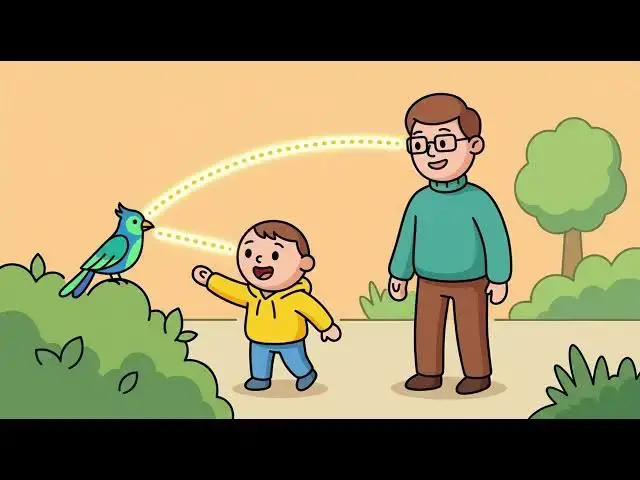
4:54
Long before children can form complete
4:56
sentences, they point at objects, look
4:59
into another person's eyes, and make
5:04
They aren't just making noise.
5:06
They're sharing attention.
5:08
Look at this. I want that. Did you see
5:12
That tiny moment changes everything.
5:14
Because the real power of language isn't
5:16
making sounds. Countless animals can do
5:20
The real power is getting another mind
5:23
to imagine the same thing you're
5:26
Now picture an Ice Age family gathered
5:28
around a fire after sunset.
5:31
The hunt is over. The immediate danger
5:35
For the first time all day, there is
5:37
time to do something different.
5:39
Instead of warning about a predator
5:43
someone imitates the growl of
5:44
yesterday's cave lion.
5:48
Another hunter acts out the chase.
5:51
Someone points toward the distant valley
5:54
Suddenly, the group isn't communicating
5:56
about the present. They're recreating
6:00
That may have been one of the greatest
6:02
breakthroughs in human history.
6:04
Because once you can describe yesterday,
6:06
you can prepare for tomorrow.
6:08
You can explain where the river floods.
6:11
You can warn children about the cliff
6:12
they haven't seen yet.
6:14
You can teach a hunting technique
6:16
without waiting for the next hunt.
6:19
Knowledge no longer dies with
6:20
experience. It can be passed on.
6:24
Generation after generation.
6:27
But this created a new advantage unlike
6:29
anything evolution had produced before.
6:32
Most animals adapt through changes in
6:34
their bodies over thousands of years.
6:36
Humans began adapting through shared
6:40
A child didn't have to learn every
6:43
They could inherit the experience of
6:45
grandparents they had never hunted
6:48
Every story became a survival shortcut.
6:51
Every sound carried invisible knowledge.
6:53
And over thousands of generations, those
6:56
sounds became more precise.
6:58
Simple calls turned into names. Names
7:01
became symbols. Symbols connected into
7:04
ideas. Ideas grew into stories.
7:07
Stories became cultures.
7:10
And cultures transformed the planet.
7:12
The strange whistles, clicks, hums,
7:15
rhythms, and gestures that once helped
7:17
frightened hunters survive another
7:19
freezing night slowly evolved into
7:21
something no other species had ever
7:26
Not overnight. Not in one sudden leap.
7:29
But through countless small
7:31
improvements, each one solving a
7:33
survival problem the generation before
7:37
Looking back, it's tempting to imagine
7:39
there was a single moment when the first
7:41
true sentence was spoken.
7:44
But that's probably not what happened.
7:46
There was no switch, no magical day when
7:48
silent ancestors suddenly began talking.
7:52
Instead, there were millions of tiny
7:54
conversations. A warning call that
7:56
became more specific.
7:58
A gesture paired with a new sound.
8:01
A rhythm that became a shared meaning.
8:03
A memory that became a story.
8:06
Each step was almost invisible.
8:09
Together, they changed the future of our
8:13
And perhaps the strangest part of all is
8:16
Those ancient sounds never completely
8:19
Every time you whisper to avoid danger,
8:22
every time you instinctively gasp in
8:26
every time you comfort someone with a
8:29
every time a crowd claps in perfect
8:32
you're using communication systems far
8:35
older than any spoken language.
8:37
Hidden beneath every conversation is an
8:40
echo of humanity's earliest voice.
8:43
A voice that once drifted across frozen
8:45
plains, echoed through dark caves, and
8:48
guided small bands of hunters through a
8:51
world filled with giants.
8:53
Those forgotten sounds didn't simply
8:55
help our ancestors survive.
8:58
They helped create the minds capable of
9:00
asking where we came from in the first
9:03
So the next time you speak, pause for
9:05
just a moment and imagine the countless
9:08
generations behind every word.
9:11
Before there were alphabets, before
9:13
there were kingdoms, before there was
9:16
there was only a sound in the darkness.
9:19
And another human who understood exactly