0:00
Around 430,000 years ago, deep inside a
0:03
dark cave in northern Spain, something
0:06
extraordinary was left behind. Not a
0:09
tool, not a painting, not even a fire
0:12
pit. It was the remains of nearly 30
0:15
ancient humans carefully placed in a
0:18
chamber so difficult to reach that even
0:20
modern archaeologists struggled to get
0:22
there. These people lived hundreds of
0:25
thousands of years before writing, long
0:27
before cities, and possibly before fully
0:30
developed language as we know it. But
0:33
one question refuses to go away. How did
0:36
they organize something this complex?
0:39
Imagine leading a group through twisting
0:41
tunnels in complete darkness. No maps,
0:44
no flashlights, no spoken sentences
0:47
like, "Turn left or watch your step."
0:50
One mistake could mean getting lost
0:52
forever. Yet somehow they succeeded
0:57
again and again. Whatever they used to
1:00
communicate wasn't written down. It left
1:02
no fossils. It made no permanent mark on
1:05
stone. It vanished the moment the sound
1:08
faded into the darkness. And that raises
1:11
a mystery far bigger than a single cave.
1:14
If our ancestors couldn't speak like we
1:16
do today, what exactly did they sound
1:20
It's easy to picture ancient humans
1:22
grunting at each other. Movies have
1:25
trained us to believe that our
1:26
prehistoric ancestors communicated with
1:28
little more than growls and gestures.
1:32
But the evidence tells a far stranger
1:34
story. The sounds that echoed across Ice
1:37
Age valleys may have been far more
1:39
sophisticated than anyone once imagined.
1:42
In fact, those forgotten sounds may have
1:45
helped humans hunt enormous animals,
1:47
survive brutal winters, avoid deadly
1:50
predators, and eventually build the
1:52
foundations of civilization itself.
1:55
The problem is sounds don't fossilize.
1:59
Bones survive, stone tools survive,
2:02
ancient camps survive, but voices
2:05
disappear forever. So, how can
2:08
scientists investigate a language that
2:10
was never recorded? For decades,
2:13
researchers believed the answer was
2:15
almost impossible to find. Without
2:18
ancient recordings, reconstructing
2:20
prehistoric communication seemed like
2:22
trying to solve a puzzle after someone
2:24
had burned all the pieces. Then
2:27
something unexpected happened.
2:29
Scientists stopped looking for words.
2:32
Instead, they started looking at
2:34
survival. Because every successful hunt,
2:37
every rescued child, every escape from
2:40
danger depended on one simple question.
2:43
How did people coordinate with each
2:45
other before language became fully
2:49
Suddenly, archaeology, biology, and
2:51
anthropology began pointing toward the
2:54
same mystery from completely different
2:56
directions, and the clues were
3:00
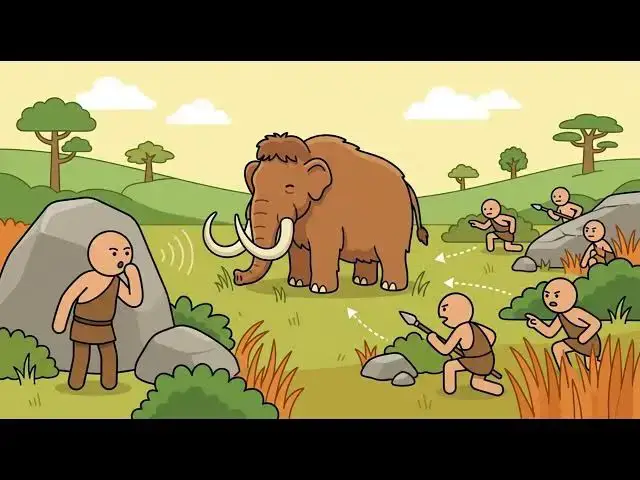
Take a mammoth hunt. A fully grown
3:02
woolly mammoth weighed as much as
3:04
several modern elephants. One wrong move
3:07
could crush an entire hunting group.
3:10
Charging too early meant disaster.
3:13
Waiting too long meant losing the animal
3:16
and possibly starving through the
3:18
winter. A hunt like that couldn't rely
3:21
on random shouting. It demanded timing,
3:27
So what did hunters actually do?
3:30
Many experts now believe they depended
3:32
on a combination of sounds so simple
3:34
that modern people barely think about
3:36
them. Sharp whistles, short clicks, low
3:43
Each sound carried a specific purpose.
3:46
One might mean freeze. Another might
3:49
signal danger. A different sound could
3:51
tell everyone to move without alerting
3:54
nearby prey. The surprising part is that
3:57
these sounds travel differently from
3:59
words. A whistle can cut through wind
4:02
across an open plane. A low hum can
4:05
remain difficult for distant animals to
4:07
detect. A click can bounce through
4:10
forests without revealing exactly where
4:12
it came from. That wasn't just
4:14
communication. It was survival
4:18
But there was a problem. If these sounds
4:21
were so effective, why didn't they
4:23
eventually become language? The answer
4:25
seemed obvious. They simply evolved into
4:28
speech. It sounds reasonable, except the
4:31
evidence didn't quite fit because some
4:34
of these ancient communication methods
4:36
are still hiding in plain sight today,
4:39
even among people who speak thousands of
4:43
The idea that these ancient sounds
4:45
simply transformed into modern speech
4:48
sounds neat, almost too neat, because
4:51
when scientists looked closer, they
4:53
found something surprising.
4:56
Across the world, people who speak
4:58
completely different languages still
5:00
rely on sounds that aren't really words
5:02
at all. Hunters in dense forests use
5:06
sharp whistles to signal direction
5:10
Shepherds communicate across mountain
5:12
valleys using melodies that can travel
5:16
Some communities even have entire
5:18
whistled versions of their language
5:20
because whistles carry much farther than
5:22
normal speech. At first, these
5:25
traditions seemed like clever
5:27
inventions. But then researchers asked a
5:30
different question. What if they were
5:32
also echoes of something much older?
5:35
Imagine standing on an open ice age
5:38
plane. A herd of reindeer is grazing
5:40
just ahead. The wind is blowing toward
5:42
them. One careless shout and hundreds of
5:46
kilograms of precious food disappear
5:48
over the horizon. Words would be too
5:51
loud, too long, too slow. Instead, a
5:55
single whistle cuts through the wind.
5:58
Everyone instantly understands. Move
6:00
left. A short click follows. Stop. Then
6:04
silence. No discussion, no debate, just
6:08
action. Every second matters because
6:11
hesitation doesn't just cost dinner, it
6:14
can cost lives. But hunting wasn't the
6:17
only challenge. Night brought an
6:19
entirely different kind of danger. Once
6:22
the sun disappeared, the world belonged
6:24
to predators. Cave lions, hyenas,
6:28
wolves, and massive bears could be
6:30
hiding just beyond the glow of a fire.
6:33
Vision became almost useless. Ancient
6:36
humans had to depend on hearing, and
6:38
that's where things get strange. Many
6:41
animals already communicate with simple
6:43
calls. Wolves howl to locate their pack.
6:47
Mircats use different alarm calls
6:49
depending on whether danger comes from
6:51
the sky or the ground. Even monkeys
6:54
produce distinct sounds for different
6:56
predators. For a long time, scientists
6:59
assumed early humans did something
7:01
similar. But humans faced a problem no
7:04
other animal did. Their survival
7:07
depended on cooperation at a completely
7:10
different scale. Building shelters,
7:13
sharing food, caring for injured group
7:15
members, planning migrations, teaching
7:18
children. These weren't tasks that could
7:21
be managed with only a handful of
7:23
warning calls. The evidence didn't fit.
7:26
Something more flexible had to exist.
7:29
Not full language, but something much
7:31
closer to it than simple grunts. One
7:34
clue came from a surprising place. Our
7:37
own bodies. Look at your hands. Without
7:40
thinking, you probably move them while
7:42
talking. You point, you wave, you raise
7:46
your eyebrows, you shrug your shoulders.
7:49
Now imagine trying to communicate
7:50
without speaking at all. Suddenly, those
7:53
movements become incredibly powerful.
7:56
Many researchers believe gesture came
7:59
first. A raised hand could mean stop. A
8:02
finger pointed toward the trees could
8:04
mean danger. An open palm could signal
8:07
peace. Combined with facial expressions
8:09
and simple vocal sounds, a surprisingly
8:12
rich system begins to appear. But there
8:15
was a problem. Gestures only work if
8:18
everyone can see each other. What
8:20
happens in thick fog or complete
8:22
darkness? or when hunters are spread
8:25
hundreds of meters apart. The moment
8:28
vision disappears, silent gestures
8:30
become useless. The group needed
8:32
something else. Something invisible.
8:35
Something that could travel around
8:37
rocks, through trees, and across
8:39
valleys. Sound solved that problem, but
8:43
not in the way most people imagine.
8:45
Scientists studying traditional
8:47
huntergatherer societies noticed that
8:50
many important messages are
8:53
Instead of long conversations during
8:55
dangerous situations, people often rely
8:58
on tiny bursts of information. One
9:01
sound, one meaning, one immediate
9:04
action. It is fast because it has to be.
9:08
Picture a child wandering too close to
9:10
the edge of an icy river. There's no
9:12
time for a sentence. A single sharp call
9:15
is enough. The child freezes. The danger
9:20
That tiny sound may have carried more
9:22
survival value than an entire
9:26
But this created a new mystery. If early
9:29
humans were already combining gestures,
9:31
facial expressions, rhythm, and
9:34
specialized calls into a sophisticated
9:36
communication system, what separated
9:39
them from true language? The answer,
9:42
scientists now believe, wasn't just
9:44
about making sounds. It was about
9:47
sharing ideas that weren't happening
9:49
right in front of them. And the first
9:51
clues to that ability may have been
9:53
hiding inside one small bone in the
9:56
human throat. That tiny bone is called