live_tv
Livestream Starting Soon
00
Hours
:
00
Minutes
:
00
Seconds
Up next in 10

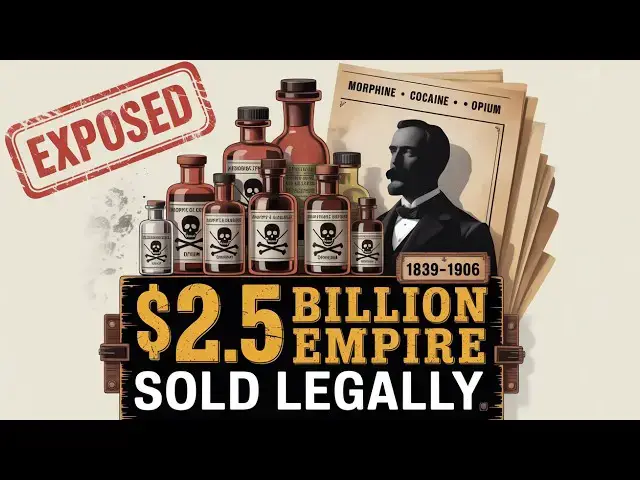
America's Forgotten Drug Lords: How They Built $2.5 Billion Empires Selling Morphine Legally
Nov 7, 2025
Boston, 1839. Inside elegant apothecaries, well-dressed merchants build fortunes selling bottles containing morphine, cocaine, and opium. Outside, church bells ring. Nobody questions it. Nobody stops it. These are America's first drug lords—and they died celebrated as heroes.
The Untold Story of America's Patent Medicine Empire:
🏭 Built industrial-scale distribution networks spanning continents
📰 Advertised morphine-laced "remedies" in family newspapers
👶 Sold cocaine and opium products marketed to children
🏛️ Operated completely legally until 1906
💰 Created multi-millionaire "kingpins" who became philanthropists
📊 Pioneered marketing tactics still used today
The Kingpins You Never Learned About:
Thomas W. Dyott - The "Glass King" who pioneered patent medicine branding
Samuel Hartman - Creator of Peruna, the empire built on "catarrh"
James C. Ayer - Physician turned medicine magnate
The Kilmer Family - Industrial-scale operation of Swamp Root
William Avery Rockefeller Sr. - Con artist father of John D. Rockefeller
What Made This Possible:
Show More Show Less View Video Transcript
0:00
Boston 1839. Gilded apothecary jars
0:04
gleam under gaslight as a wet merchant
0:06
measures drops of ldinum into an elegant
0:08
bottle. Outside, church bells ring.
0:10
Inside, fortunes are being built on
0:13
secrets no one dares to question. How
0:15
does an entire nation become addicted in
0:18
plain sight? And how do the men
0:20
profiting from it remain untouched,
0:22
celebrated even as American heroes?
0:25
Before the cartels, before the drug
0:27
wars, before the term drug lord even
0:30
existed, there were the patent medicine
0:32
kingpins. Men who operated massive
0:34
distribution networks spanning entire
0:37
continents. They moved product by the
0:39
ton, created sophisticated marketing
0:41
campaigns, exploited regulatory
0:44
loopholes, and built empires worth
0:46
millions. Their customers numbered in
0:48
the hundreds of thousands. Their
0:50
substances contained morphine, cocaine,
0:53
alcohol, and opium. Yet, they advertised
0:56
in family newspapers, sold through
0:58
respectablearmacies,
1:00
and died honored citizens. This is not
1:02
the history you learned in school. The
1:05
scale was staggering. By the 1890s, the
1:08
patent medicine industry generated over
1:10
$80 million annual equivalent to roughly
1:14
$2.5 billion today. These forgotten
1:17
kingpins created the template for every
1:19
drug empire that followed. Vertical
1:21
integration, brand loyalty, nationwide
1:24
distribution, and most critically, the
1:27
corruption of trust. So, get ready to
1:29
dive into the origin story of America's
1:31
drug trade. A time when addiction was
1:34
called medicine and dealers were called
1:36
doctors. The truth is, we don't know
1:38
exactly when it started, but we know
1:40
why. Colonial America inherited a
1:43
problem from the British Empire that
1:45
would shape its future in ways no one
1:47
anticipated. In the early 1800s, pain
1:50
was constant. Childbirth could kill you.
1:54
A tooth infection might end your life.
1:56
Surgery meant being held down while a
1:58
saw cut through bone. Anesthesia did not
2:01
exist. Into this world of unavoidable
2:03
suffering came something miraculous.
2:06
Relief in a bottle. Opium arrived on
2:08
merchant ships from Turkey and India
2:11
carried by the same East India Company
2:13
that sparked wars in China. But in
2:15
America, there was no war, no
2:18
resistance. There was only gratitude.
2:21
Doctors prescribed it. Mothers gave it
2:23
to crying infants. Workers took it for
2:26
back pain. It was sold as Lordum,
2:28
Paragoric, Dova's powder, and dozens of
2:31
other names. Nobody called it dangerous.
2:34
Yet something was shifting beneath the
2:36
surface as the Mangri a new breed of
2:39
entrepreneur emerged. These were not
2:41
physicians bound by the hypocratic oath
2:43
or apothecaries trained in traditional
2:45
methods. They were businessmen who
2:47
recognized an opportunity. They saw that
2:50
people would pay anything to stop
2:51
hurting and that neither laws nor
2:53
regulations stood in their way. One of
2:56
the earliest and most successful was a
2:58
man named Thomas W. Diet. Born in
3:01
England in 1771,
3:03
he arrived in America with nothing. By
3:06
1807, he owned a glass factory in
3:08
Philadelphia and had begun manufacturing
3:10
patent medicines. But diet was not just
3:13
selling bottles. He was pioneering the
3:16
business model. Diet understood
3:18
something revolutionary. Branding
3:20
mattered more than ingredients. He
3:22
created distinct bottle shapes that
3:24
customers would recognize instantly. He
3:27
flooded newspapers with advertisements
3:29
featuring testimonials from satisfied
3:31
customers, many of them fabricated. He
3:33
gave his medicines patriotic names and
3:36
wrapped them in the language of American
3:37
ex. When people bought Diet's remedies,
3:40
they were not just buying medicine. They
3:42
were buying an identity. Therefore,
3:44
sales exploded. By the 1830s, Diet was
3:48
operating one of the largest glass
3:49
factories in the nation, producing
3:51
millions of bottles annually. His
3:53
workforce lived in a company town he
3:55
controlled completely. Paid in script
3:58
that could only be spent at his stores,
4:00
he accumulated vast wealth and political
4:02
influence. Newspapers called him the
4:04
glass king. But there was a problem.
4:07
Diet's ambition outpaced his caution. In
4:10
1836, his private bank collapsed amid
4:14
accusations of fraud. Investigators
4:16
discovered he had been issuing his own
4:18
currency and manipulating financial
4:20
records. He was convicted and
4:22
imprisoned. His empire crumbled. Yet the
4:25
industry he helped create was just
4:27
beginning. Because while diet fell,
4:30
dozens of others had been watching,
4:32
learning, and preparing to do it better.
4:34
Enter the golden age of patent
4:36
medicines. The decades between 1850 and
4:39
1906, when America's first drug lords
4:41
built empires that would dwarf anything
4:43
diet had imagined, the key figures
4:45
emerged from unexpected places. There
4:47
was James C. AR Alo Massachusetts
4:51
physician who abandoned his practice to
4:53
manufacture AIRS cherry pectoral and air
4:58
is Saparia William Radam a German
5:02
immigrant gardener who claimed his micro
5:04
killer could cure everything from
5:06
consumption to cancer. Lydia Pinkham a
5:09
housewife whose vegetable compound
5:11
became the most recognized women's tonic
5:13
in America. Her face appearing on
5:15
millions of labels even after her death.
5:17
But perhaps no one embodied the patent
5:20
medicine kingpin more completely than a
5:21
man named William Avery Rockefeller
5:24
Senior, father of John D. Rockefeller.
5:27
William Avy was a con artist, a big and
5:30
a traveling salesman who sold bottles of
5:32
crude oil mixed with laxatives as a
5:34
cancer cure. He called himself Dr.
5:37
Livingston. Though he had no medical
5:40
training whatsoever, he would ride into
5:42
a town, set up a spectacle, sell his
5:44
worthless elixir for enormous sums, and
5:47
disappear before anyone realized they
5:50
had been deceived. He taught his
5:51
children that business was war and
5:53
morality was for the weak. Therefore,
5:56
when John D. Rockefeller built Standard
5:58
Oil into the most ruthless monopoly in
6:00
American history, he was simply applying
6:02
the lessons learned watching his father
6:04
operate outside the law. However, the
6:07
true kingpins were not loan operators.
6:10
They were empire builders who understood
6:12
distribution, marketing, and most
6:15
critically, the manipulation of public
6:17
trust. Consider the operation of the
6:19
Kilmer family and their flagship
6:21
product, Swamproot. Based in
6:24
Bingmpington, New York, the Kilmers
6:26
constructed a manufacturing facility
6:28
that covered entire city blocks. They
6:31
employed hundreds of workers who filled,
6:33
labeled, and shipped tens of thousands
6:35
of bottles daily. They owned forests to
6:38
supply wood for crates, rail cars, the
6:41
transport product, and warehouses in
6:44
every major city. They created a
6:45
pamphlet called the Swamproot Almanac
6:48
that was distributed to millions of
6:49
homes, filled with testimonials,
6:52
recipes, and advertisements disguised as
6:55
health advice. The scale was industrial.
6:58
The approach was modern. The supply
7:01
chain would be familiar to any
7:02
contemporary pharmaceutical executive.
7:05
Yet, the ingredients remained largely
7:07
unregulated and often dangerous.
7:10
Swamproot contained alcohol. Air's
7:13
cherry pal contained morphine. Mrs.
7:16
Winslow's soothing syrup, marketed
7:18
specifically for teething babies,
7:21
contained morphine sulfate. Cocaine was
7:24
a common ingredient in tonics marketed
7:26
to women and children. Nobody was
7:29
required to list ingredients. Nobody
7:31
verified health claims. Nobody tracked
7:34
addiction or overdose. Still, the
7:37
Kingpins refined their methods. They
7:40
hired chemists not to improve safety,
7:42
but to create dependency. Products were
7:45
formulated to provide immediate
7:47
noticeable relief. Ensuring repeat
7:49
customers. They pioneered direct mail
7:52
marketing, sending free samples that
7:54
would hook new users. They paid doctors
7:56
to endorse products and pharmacists to
7:58
recommend them over competitors. They
8:00
created emotional advertising that
8:02
exploited fear, vanity, and desperation.
8:05
Nevertheless, the most sophisticated
8:08
operation of all belonged to a man whose
8:10
name has been almost entirely forgotten.
8:12
Had a co-creator Dudley Jub
8:15
Leblanc came later in the 1940s. Let me
8:19
return to the proper era. The most
8:21
sophisticated operation of the patent
8:23
and medicine era belonged to a man named
8:25
Samuel Hopkins. Adams would later
8:28
expose. But before Adams, there was the
8:30
king himself, the man behind Peruna.
8:33
Samuel Bubaca Hartman was a physician
8:35
from Ohio who created Peruna in the
8:38
1880s. His genius was not in the
8:41
formula, which was essentially alcohol
8:43
with trace amounts of herbs, but in his
8:46
understanding of media and psychology.
8:48
Hartman targeted a specific demographic,
8:51
rural Americans who distrusted urban
8:53
doctors and preferred traditional
8:54
remedies. He advertised relentlessly in
8:57
agricultural newspapers and religious
8:59
publications. He offered free medical
9:01
advice by mail, diagnosing patients he
9:04
never met with a condition he
9:05
popularized, Qatar. Qatar was Hardman's
9:09
masterpiece. It was vague enough to
9:11
apply to almost any ailment, yet
9:14
specific enough to sound medical.
9:16
Headache Qatar
9:19
fatigue Qatar depression Qatar of the
9:24
brain Hartman claimed that 90% of all
9:26
diseases stemmed from Qatar and Peruna
9:29
was the only cure. Therefore, Peruna
9:32
became one of the bestselling patent
9:34
medicines in America. At its peak, the
9:36
Peruna company was producing hundreds of
9:39
thousands of bottles monthly, generating
9:41
millions in annual revenue. Hartman
9:43
built a sprawling factory complex in
9:46
Columbus, Ohio, employed a small army of
9:49
workers, and became one of the
9:50
wealthiest men in the state. But he had
9:52
not anticipated Samuel Hopkins Adams.
9:56
Adams was a journalist working for
9:57
Kier's Weekly, one of the most
9:59
influential magazines of the era. In
10:02
1905, he began an investigation into the
10:05
patent medicine industry that would
10:07
culminate in a series of articles titled
10:10
The Great American Fraud. Adams did
10:14
something revolutionary. He analyzed the
10:16
contents of popular patent medicines and
10:19
published the results.
10:22
What he found was damning. He revealed
10:24
that Peruna was 28% alcohol, more than
10:27
most beer or wine. He showed that
10:29
medicines marketed to children contained
10:31
morphine and cocaine. He documented
10:34
cases of addiction, overdose, and death.
10:37
He exposed the financial relationships
10:39
between manufacturers and doctors. He
10:41
traced the money. The articles caused a
10:43
sensation. Public outrage grew.
10:46
Reformers who had been fighting for
10:48
regulations finally had ammunition.
10:50
Therefore, in 1906, Congress passed the
10:54
Pure Food and Drug Act, the first
10:56
federal law regulating the sale of
10:58
medicines and food. It required
11:00
manufacturers to list certain dangerous
11:02
ingredients on labels. It gave the
11:04
government power to seize adulterated
11:06
products. It marked the beginning of the
11:08
end for the patent medicine kingpins.
11:11
However, the law was weaker than it
11:13
appeared. It did not require proof of
11:15
efficacy. It did not ban dangerous
11:18
ingredients, only required disclosure.
11:21
It relied on underfunded enforcement.
11:23
The kingpins adapted. Some reformulated
11:26
products to remove the most
11:28
controversial ingredients, replacing
11:30
morphine with slightly less addictive
11:32
substances. Others simply added warning
11:34
labels and continued selling. Many
11:37
pivoted into legitimate pharmaceuticals,
11:39
using their distribution networks and
11:41
brand recognition to dominate the
11:43
emerging regulated market. Yet the
11:45
golden age was over. The men who had
11:47
built empires on addiction and deception
11:50
faced a new reality. Some died wealthy
11:53
and respected. Their fortunes laundered
11:55
through philanthropy and political
11:56
donations. Others faded into obscurity.
12:00
Their brands discontinued, their
12:02
factories abandoned. But the question
12:04
remains, what happened to all that
12:07
infrastructure, all that expertise, all
12:10
those distribution networks? The answer
12:12
is they evolved. The patent medicine
12:15
kingpins did not disappear. They
12:18
transformed. Their companies became
12:20
pharmaceutical giants. Their marketing
12:22
tactics became standard industry
12:24
practice. Their understanding of
12:26
addiction became trade secrets. The line
12:29
between legitimate medicine and illicit
12:31
drug trade, already blurred, became
12:33
harder to see. Consider this. When
12:36
federal agents finally began cracking
12:38
down on heroin and cocaine in the 1920s
12:41
following the Harrison Narcotics Act,
12:43
where did the illegal supply come from?
12:46
Pharmaceutical companies. The same
12:48
corporations that had evolved from
12:49
patent medicine operations were
12:51
manufacturing narcotics legally for
12:53
medical use, then diverting supply to
12:56
illegal markets through corrupt
12:57
pharmacists and doctors. The template
12:59
was set. Create legal demand. Establish
13:03
distribution. Build brand loyalty. When
13:06
regulations come, adapt, but never
13:09
abandon the core business model, selling
13:12
relief to people in pain, regardless of
13:14
the cost. This pattern would repeat
13:16
throughout the 20th century.
13:19
Oxycontton, fentanyl, the opioid
13:21
epidemic of the 2000s, was not an
13:24
aberration. It was the patent medicine
13:26
era reborn with better chemistry and
13:29
more sophisticated marketing. The
13:31
forgotten kingpins of the 1800s were not
13:34
anomalies. They were pioneers. They
13:37
proved that you could addict a nation,
13:39
profit enormously, and escape
13:41
consequences if you controlled the
13:43
narrative, corrupted the right
13:45
officials, and wrapped your operation in
13:47
the language of healing. To this day,
13:49
nobody has faced accountability
13:51
proportional to the harm caused. The
13:53
Sackler family, owners of Purdue Pharma,
13:56
are the direct descendants of the patent
13:58
medicine kingpins. They used the same
14:00
playbook. Aggressive marketing,
14:03
manipulation of medical professionals,
14:05
exploitation of regulatory gaps, and
14:08
when caught, legal maneuvering to
14:10
preserve wealth while accepting minimal
14:13
personal responsibility. The original
14:15
kingpins died in men. Their children
14:17
inherited fortunes. Their names appeared
14:20
on libraries, hospitals, and
14:22
universities. History forgot their
14:24
crimes and remembered only their
14:26
philanthropy.
14:28
So, what do you think? Were the patent
14:29
medicine kingpins criminals who escaped
14:31
justice? Or were they simply businessmen
14:34
operating within the laws of their time?
14:37
Drop your theory in the comments. I read
14:39
every single one. The story of America's
14:42
first drug lords is not a tale of
14:45
violence and cartels. It is something
14:47
more disturbing. A demonstration that
14:49
the most successful drug empires operate
14:51
in plain sight with social approval
14:54
until the bodies pile high enough that
14:56
denial becomes impossible. and the
14:58
Ventin. The empires do not fall, they
15:02
simply rebrand.
#Public Health
#Substance Abuse
#Law & Government