Up next in 10

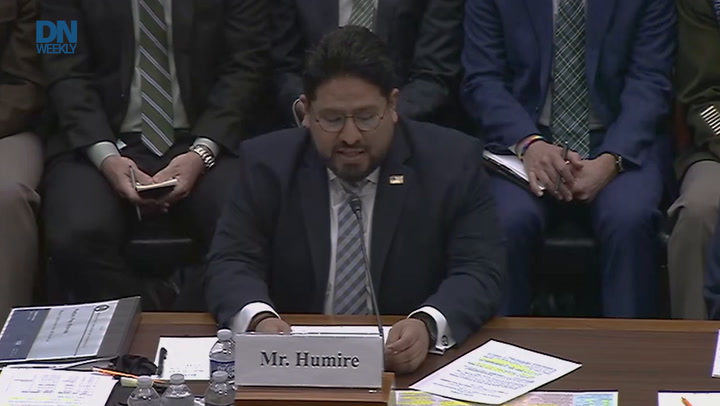
While Iran war continues, Pentagon officials map out defense priorities back home
Mar 23, 2026


Leaders from the Defense Department said they were still targeting suspected drug traffickers and addressed potential terrestrial strikes on cartels.
Show More Show Less View Video Transcript
0:00
We are in historic times in the United States
0:03
Under President Trump and Secretary Hegsaid's leadership, we are doing something that has never been done before
0:08
In the past, previous U.S. presidents prioritized every region in the world
0:12
except the one in which we live. Today, we have corrected that mistake
0:16
We are prioritizing the Western Hemisphere by making hemispheric defense integral to U.S. homeland defense
0:22
And in just 14 months, we have achieved historic accomplishments that put America first
0:27
Americans first, and the Americas first in U.S. national security. Today, the Department maintains over 12,000 service members along our southern border
0:35
and has established six national defense areas covering 845 miles, or 42 percent
0:41
of the border across Arizona, California, New Mexico, and Texas. For the first time in history, the Department is going on offense against designated terrorist organizations
0:50
and other major cartels in our hemisphere. Operation Southern Spear is restoring deterrence against narco-terrorism threats in the Americas
0:59
And since this operation began, there has seen a 30% reduction of drug vessel movements in the Caribbean
1:04
and a 25% reduction in the Eastern Pacific. Mr. Humeyer, I'm very encouraged by the formation of this Americans' counter-cartel coalition
1:14
But what specifically are we looking for from those partner countries? Is it intelligent sharing, partner led operation
1:24
What are you looking for from those partners? And what are they looking for from us
1:27
I've been able to visit about 16 countries in the last year in the Western Hemisphere, the majority that in Latin America and the Caribbean
1:33
And the number one response I get from all our partners is how long, why did it take you so long
1:37
So they looking primarily at capacity building They have capacity building on border security on domain awareness on ISR intelligence surveillance reconnaissance So there a lot of areas that we can help our
1:48
partners. But fundamentally what we're looking for them is a serious commitment to use not just
1:53
interdiction but also use deterrence to go after the cartels that are in their sovereign territories
1:57
So if you look at the drug flows that are going from south to north, it's like a four-lane highway
2:02
So OSS focused on looking at the eastern lane in the eastern Caribbean and the western lane in the
2:07
Eastern Pacific. We're looking at our partners to do more on the Central Caribbean and the Western
2:11
Caribbean, as well as on land. So when it comes to land-based strikes, Ecuador, I think, has set
2:16
the pace. We've been able to help Ecuador become much more aggressive at going after their cartel
2:20
threats, providing them capabilities that they otherwise would not have. Do you get the impression
2:25
that any of them are concerned about us intruding on their sovereignty as a part of this process
2:29
Members of the coalition specifically signed a joint security declaration mentioning that they
2:34
want this support. And most of them all are looking for this. They have the threat of
2:39
transnational organized crime is a threat that's permeated all countries in the Western Hemisphere
2:43
for decades. So all of them have been looking to go after this. Some of them have limited
2:47
capabilities. Some of them don't even really have a military, and they're looking to use the United
2:52
States military to augment them. And that also includes non-kinetic effects on cyber information
2:56
operations and others. So how would you measure successes at this point? Do you have any measurable
3:02
facts that show fewer drugs, less drugs however you would put that, are getting into the U.S
3:08
Is this something that we're measuring in some way? What we've measured
3:13
ranking member, is the decrease in the movements of the vessels. So there's been a 20
3:17
decrease in the Eastern Caribbean on the movement of those vessels But that a no in terms of the drugs actually getting into the U I don disagree necessarily with the effort to stop this I think figuring out whether or not this is working bottom line is
3:33
are drugs getting into the U.S. or aren't they? Well, we went 45 days, ranking member, without having a vessel move through the eastern Caribbean
3:41
I think when you don't have any movement, there's likely not going to be any type of drugs or any other commodities
3:45
Sure, unless there's four, like you just said, there's four lanes on that highway
3:49
So not necessarily is my point. I mean, the true measure of this would be, you know, which four lanes
3:55
The true measure is how many drugs are getting into the U.S. So I think we need to, and you obviously, you know, work with domestic agencies that have more oversight on that than you do
4:04
That's the measure of whether or not you're hitting that four-lane highway in the right way, isn't it
4:09
Correct. But it's also the measurement of how many drug overdoses that we have inside the United States
4:13
And that obviously goes beyond to the interagency. But we have seen record drops
4:18
That's an answer. Now, it's not necessarily a controlling answer because there's a lot of different things that could contribute to overdose deaths
4:25
But that's what we're sort of looking for. And if you're really going to measure this, that's where you need to focus
4:31
And that's the next portion of the question is, so you're doing the boat strikes primarily in international waters, Caribbean, Pacific
4:39
Is there a feeling that you're going to be moving to a lot more terrestrial strikes
4:45
Sorry, land strikes, however one would put that. Yes, Reckie members. So the purpose of the coalition is to look at where our partners are looking at the primary
4:55
threats that are facing narco terrorism. In many cases, it is on land
4:59
It is inside within the many times on their borders. But those efforts are doing in partnership with these host nation governments and with their permission So in the case of Ecuador for instance they gave us both their consent So you do not intend to take any unilateral strikes on the sovereign territory of other nations
5:16
I reserve the right in the space of the White House and the president to make those decisions
5:21
I know at the Department of War. Is that part of the plan at the moment? In the Department of War, we are prepared to give all options to the president
5:28
I understand that's not an answer to the question. So is it part of it's not I think you're saying it's not part of the plan at the moment
5:35
but it might be. Currently we are focused on partner-led deterrence-focused operation
5:39
And how many strikes are being made on land against the cartels and the narcotics groups
5:46
right now, either in coordination or by one of these 17 partner nations? So I don't have an exact
5:52
number. I know Ecuador carried out a recent strike in the last couple weeks, and I know they're
5:57
beginning an operation that began yesterday or two days ago now. That's going to carry out for 15
6:01
days inside their country, but I don't have a specific number of strikes. Is there any particular
6:06
endpoint that you see to U.S. kinetic action in this regard? Because as you point out
6:14
we've been battling cartels for a long time. This seems like a forever conflict, is it not
6:20
I mean, what would be the level of achievement that would be necessary for you to say
6:25
okay, we can stop kinetic action? So the center of gravity of the cartel threat or
6:31
anarcho-terrorist threat has always been border security. We kind of showed that with sealing our U.S
6:36
Southwest border and the reduction of movements, both of drugs, but also of all kinds of illicit activity
6:41
Sure, and that's good, but the boat strikes are continuing. No, correct, but what I'm saying, ranking members
6:45
that the extension of having border security throughout the hemisphere is a big focus
6:49
And as we be able to advance on countries securing their border
Military
news
World News
War & Conflict