Up next in 10



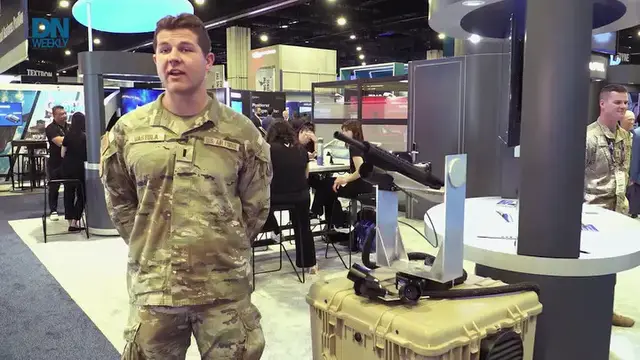
Check out a pair of new projects in development from the AFRL: an autonomous shotgun for drone defense, and a blood recirculation machine.
Show More Show Less View Video Transcript
0:00
Here's more of our coverage from the recent Air, Space, and Cyber Conference in Washington, D.C
0:07
About a year ago, General Bartolomé, the previous AFRL commander, sent out an email
0:11
saying that anyone who wanted to participate in the challenge to build something
0:15
that could detect or defeat fiber-optic drones, he would give $50,000 in six months to work on that problem
0:22
If you've paid any attention to the news recently, whether that be in Russia and Ukraine or over in Iran in the Middle East, you know that low-cost drones, whether that be Group 1 drones
0:31
or other drones, they're causing a lot of issues. The fact that they are low-cost disposable drones
0:37
capable of asymmetric warfare, they are very capable of causing a lot of damage asymmetrically
0:46
Mantis is a low-cost autonomous shotgun turret. It can complete the full kill chain autonomously
0:51
and independently for group one FPV drones. The whole system is $25,000 per unit and only a few
0:59
dollars per engagement. The whole point of this system is to take the enemy playbook of low cost
1:05
distributed systems, which is what small FPV drones are, and to take that playbook and build a counter
1:12
system that has that same approach. So low costs, only $25,000 per unit. It is a system that can be
1:21
distributed so we can produce this at scale we can distribute them put them where we need to
1:25
it's really point defense so it's your last line of defense zero to 100 meters it is either the
1:32
first layer in your layer defense system or the last line of defense depending on how you want
1:36
to look at it the way i like to think about it and the simplest explanation i have for mantis is
1:40
it's a robot it's an autonomous robot that shoots drones of the sky it's highly effective
1:44
fully autonomous it does the full kill chain and all of everything you see here so every piece of
1:50
hardware, every line of code, every AI model that's been developed has been
1:55
developed by our group of government people. So it's government owned, government developed, and all the intellectual
2:01
property is owned by our team, which is really cool. I'm the team's drone pilot
2:09
So you know you see in media of pilots flying drones with goggles on their head controllers in hand Mantis is trained up on 1 million images of all types of drones
2:21
So we're talking FPV drones. We're talking DJIs. We're talking larger drones, JHADs, MQ-9s, etc
2:27
It's also trained up on images of people, vehicles, helicopters, planes, things that you want to shoot and things that you definitely don't want to engage
2:36
The reason why we need to do that is because we need to be able to discriminate between targets that we want to kill and targets that we don't
2:41
My job is to fly against the system every single day. I tailor my sorties based off of real-world operational sorties and flight profiles that we're seeing both adversaries and partner forces use around the world
2:52
So these are drones that are flying in at 70-plus miles per hour. They're extremely maneuverable
2:58
They're extremely stealthy. They're hard to hear. They're very hard to detect visually, very hard to detect with radar
3:03
so this system being completely reliant on visual you know visual recognition and the fact that the
3:10
turret can slew at 120 degrees per second it makes my job as the red team pilot extremely extremely
3:15
difficult i mean we're talking 90 plus percent of the time it is shooting me out of the sky
3:20
i'm watching my screen go black time after time day after day um it's extremely hard to see through
3:26
the goggles due to its small form factor the fact that it can all fit inside one pelican case you know all it has is a shotgun on top i mean half the time i can't even see where the shot came
3:35
from or or what hit me um it's an extremely difficult problem as as you know an offensive
3:40
small uas pilot to fly against and to try to defeat in the next six months the direction we're
3:45
trying to go in is we want to build 10 of these systems have them ready to operationally deploy
3:49
and we're looking for the right operational partner to take this put it in the right place
3:54
so we can get real reps and we want to deploy with it uh embed with real operational units
3:59
and make sure we're actually building something that's addressing the warfighter needs
4:03
We're also, over the next six months, like one of the things I think is really cool about this project is it's a rapid innovation project
4:09
We're moving incredibly fast. Like I said, we have a group of eight government people
4:13
We're on the range six days a week, 12 hours a day. We're testing constantly
4:18
We're failing fast. We're iterating and we're building the system that needs to be built
4:22
We're getting ahead of the game of cat and mouse by having our own red team that studying what the enemy doing We getting ahead of it and we building what we need to do One of the things that we also looking to do in the next six months is we looking to have fellow military units that are on the offensive side come and fly against this
4:39
system. Again, trying to get ahead of the game of cat and mouse and make sure what we're building
4:44
is operationally relevant. A project like this, a project that's entirely government-developed
4:48
government-owned, from my experience, this is pretty atypical, right? And I think that General
4:53
Bartolome, General Wickert, our previous and current AFRL commander, Mr. Paul Littke, the
4:58
director for the Center for Rapid Innovation. They've done a really cool thing by giving
5:02
lieutenants and A1C and a civilian the opportunity to build something that actually is addressing
5:09
a real concern in the military. And I think this is a testament to the talent we have in the lab
5:15
to the dedication we have in the lab, and to the hunger that we have from the folks we have here
5:22
internally in the government to build something that needs to be built, build something that our
5:26
warfighters need and build something that's truly addressing a need. And it could this could be a
5:31
technology that, you know, it was it was born under a year ago. And in the next six months
5:35
it could be saving real lives. And I think that is what keeps us motivated. It keeps us hungry
5:40
It keeps us on the range day in and day out. And that's what we're after
5:45
I'm Jody Cantu. I'm with the Air Force Research Laboratory. I'm the product area lead for the
5:50
non-root care section. So what we have here is a hemorrhage control and life-saving device
5:54
So essentially this gentleman, this airman, has sustained a gunshot wound in the field
5:59
We've been able to get him to a royalty field hospital, so a far-forward hospital. These
6:04
hospitals are resource constrained, so obviously we're limited on blood. He's going to require
6:10
surgery to contain the bleeding and to stop his wound. We can't just put compression on this
6:15
we can't pack it. So he's going to require a lot of blood pre-surgery. So in order to give him a
6:21
fighting chance to get into the surgeon to repair the wound, what we're doing is collecting the
6:26
blood that's collecting his chest. We're conditioning it. We're filtering it first
6:30
We're conditioning it and then we're returning his own blood back to him. For the purposes of
6:35
the demonstration, we're going into the neck. However, anywhere you can get ID access. So arm
6:40
hand IO you can retire his blood because we only returning it at the rate that he hemorrhaging So what you seeing is the blood coming out Obviously when you suctioning through a wound
6:50
you have a lot of air built up. Air is not good in arteries and veins, so you want to remove the
6:55
air. That's what the first filter is for. Also, because you're going out of your vessels
7:00
you're bleeding into the chest, you're picking up more fluids than what you would want. So the first
7:05
The first filter is really to get out a lot of the air and the big, gross, nasty things that would be in the chest
7:12
The conditioning piece prepares it for return. We also have a warmer, so we can warm the blood as we return it
7:19
But if you look at the tubing going in, you can see there's no air on the return
7:28
So currently, it would be pre-deployed and free positioned at a roll-to field hospital in its current embodiment
7:34
Future development and iterations, our goal is to go farther forward, but based on the current size and power requirements, this would be specifically for a field hospital
7:45
So it's designed for a field of a paravest, so a medical, a medic, but not necessarily a doctor
7:53
You wouldn't be a full practitioner could do this. So this is a prototype development
7:57
This embodiment from development through testing in animal models was nine months
8:03
So this is still prototyped, but we have completed small animal testing
8:08
Sorry, large animal testing. So the next stage would be commercialization. We had two folks that are part of the development team
8:15
So our rapid prototyping cell that's based out of Wright-Patterton Air Force case, did all of the engineering and the technical development
8:20
We also worked through a cooperative agreement with the folks at Baltimore Shock Trauma
8:24
University of Maryland at Baltimore Shock Trauma. So the clinician, our clinical subject matter expert that's working on this
8:30
is actually an Air Force reservist. Her name is Dr. Elizabeth Howell. She has seen people lose their lives in this space due to hemorrhage
8:39
So hemorrhage takes more of our warfighters than anything, and it's completely controllable in certain circumstances
8:45
So this essentially, she brought the idea to the rapid prototyping cell
8:49
The engineers and the clinicians work very well together to make sure that we're developing technologies that are going to be fieldable
8:56
and that there's somebody on the other end that this is going to save and make a difference for
news