Up next in 10

‘Our task is to adapt right now’: Air Force leaders gather to plot future of warfare
Sep 18, 2026


Looking into a future filled with drones and AI, the Air and Space Forces prepare for a battlespace radically changed by emerging tech.
Show More Show Less View Video Transcript
0:00
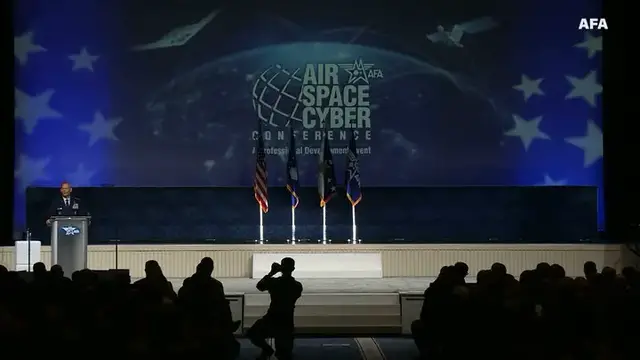
Looking to plot new ways forward for the U.S. military, top leaders from around the Air Force and Space Force gathered recently at the Air Force Association's Air, Space, and Cyber Conference just outside of Washington, D.C
0:14
Among them, Joint Chiefs of Staff Chairman General Dan Cain, who talked about adapting to a world of drones and AI-enhanced fighting systems
0:22
Today, my brothers and sisters, we must be clear-eyed about the environment ahead
0:28
Future conflicts will demand that we operate without the assumptions of uncontested access, secure rare areas, or uninterrupted or uncontested sustainment
0:40
Our task, my friends, is to adapt right now so the joint force is prepared to fight, endure, and win in global contested environments from the seabed to cislunar space
0:56
You and I are living and leading in complex and dynamic times
1:03
I often say that Tom Clancy on his most inspired day could not have come up with the situation that we are living and leading in right now
1:13
And the challenges are not isolated from one another. Our adversaries may be geographically distributed and dispersed, but they're increasingly connected
1:24
They share technology, intelligence, weapons, and economic support. They're studying our battlefields of the past and our battlefields currently, and they're adapting quickly and seeking new ways to challenge our advantages
1:40
As I said before, today's modern battlefield operates from the seabed to cislunar space, and I highlight the announcements this week by the CSO
1:50
through cyberspace and across the information environment. Information moves so fast that leader decision times has compressed from weeks down to days, down to seconds
2:06
In the future fight, advantage will go to the side who can see first, who can understand first
2:14
decide first and act first and along the way be a learning organization And no factor is accelerating change as fast as artificial intelligence and advancing cyber capabilities AI is here now and it already changing the way militaries see sense decide and act
2:40
And across the joint force, we're putting AI to work every single day to move faster
2:45
to make better decisions through active adaptation on every single battlefield by leaders in your
2:54
joint force. Our joint force needs to do two things at one time. First, we need to prepare
3:01
the joint force to win in this kind of conflict. We have to assume from now on that our formations
3:08
will be hunted by autonomous systems, jammed across the spectrum, and tracked in real time
3:14
And we have to transition the joint force to be prepared to fight and win our future wars by generating and delivering lethality at scale with an agile, optimized, high-low mix of combat capabilities to give the young members of the 2.8 million member all-volunteer joint force the tools that they need before they need them
3:43
Up next, Secretary of the Air Force Troy Mink made several announcements at the event, including the first ever acknowledgement that the U.S. has weapons in space, and the renaming of new combat collaborative aircraft platforms
3:56
We've made great progress despite our high ops tempo. Launch capacity is one of the areas where we've seen tremendous progress
4:06
Space Force launch sites have already hosted 116 orbital launches this year
4:11
I think it was actually 117 after yesterday and there will be 118 tomorrow
4:16
Nearly 60% of all launches on the planet. This is allowing us to maintain and build our commercial and military space advantage
4:25
I actually think this is an area where the U.S. advantage will increase over the coming
4:31
five to ten years, not decrease. Today, we continue to ensure we remain ready to meet the challenges of evolving threats
4:40
wherever they exist. This is why the United States now has on space control weapons capable of defending the joint force against hostile adversary action When we pair manned aircraft with lower cost autonomous systems
5:00
we will be able to unlock combat power at scale. So we will be dramatically increasing our combat power
5:07
by adding large numbers of highly autonomous systems. We are using novel concepts such as open systems architecture
5:16
to accelerate procurement, which has also increased competition from industry, resulting in better choices, better prices, and in the end, more combat power
5:25
Because of the steps we are taking today, we will have a significantly different force
5:30
by 2032. By then, our special operators will have the ability to employ thousands of autonomous
5:37
one-way attack systems, and we will have autonomous fighters like the Collaborative
5:42
Combat Aircraft, or CCAs. We intend to have at least 500 of these in service by 2032
5:49
And they'll be performing many of the same missions that we do with manfighters today
5:54
Today, the first FQ-42 and FQ-44 increments are already rolling off the assembly line
6:01
And I'm excited to name them here for the first time. I'm allowed to do that, right, Dale
6:07
I can do that? I'm still good? All right. Fury and vengeance
6:25
So these aircraft went from contract award to first flight in 18 months or under
6:33
18 months or under. That's almost unheard of in aircraft development. And this is not the only class of autonomous aircraft we are aggressively pursuing
6:49
As we saw in Epic Fury, ISR strike platforms have been essential
6:55
We have used MQ-9 and even now the Ultra aircraft to great effect
7:00
Building on these lessons, we are developing a family of low-cost multi-role strike platforms called the Mass Modular Aircraft, or MMAs
7:09
MMA will provide affordable attributable long strike and we will be able to field them at scale Our intent is to field 100 MMA in 2029 at even a lower cost than the CCA
7:27
and a fraction of cost of manned aircraft we build today. Finally, in another announcement at the event, Chief of Staff of the Air Force General Ken Wilsbach
7:37
said the U.S. Air Force will stand up a new career field to defend American air bases worldwide
7:43
For decades, American air and space power has often operated from a position of sanctuary
7:50
Those days are over. We can no longer treat point defense as a side hustle
7:57
We must make it a core function of air and space power
8:01
That is why today I am announcing two major initiatives that will advance the Department of the Air Force's point defense mission
8:09
First, we will establish the point defense weapon system, bringing together kinetic and
8:15
non-kinetic capabilities to secure our air bases. Second, we have established a new career field of point defense airmen
8:25
This new career field will be operational in two years. We have already welcomed our first two career field managers, Senior Master Sergeant Andrew
8:34
Lewis and Senior Master Sergeant Brandon Spears. Senior Lewis is in the audience today
8:41
Can you stand up, Senior Lewis, and let's give him a round of applause
8:48
Together, these two new initiatives will strengthen our defenses, reinforce our ability to generate
9:03
air and space power under fire and protect our greatest advantage, our airmen and guardians
9:11
Protecting the force and generating combat power are inseparable. We need our airmen trained, equipped and ready to fight from the opening moments of a conflict
9:23
That brings me to our second imperative, built to endure. During epic fury, bomber crews launched from home station
9:32
crossed oceans, struck military objectives, and returned from sorties lasting over 30 hours
9:39
Long before those jets left the Chalks, another group of airmen prepared the ordinance
9:44
they would deliver to targets in Iran
news