Up next in 10


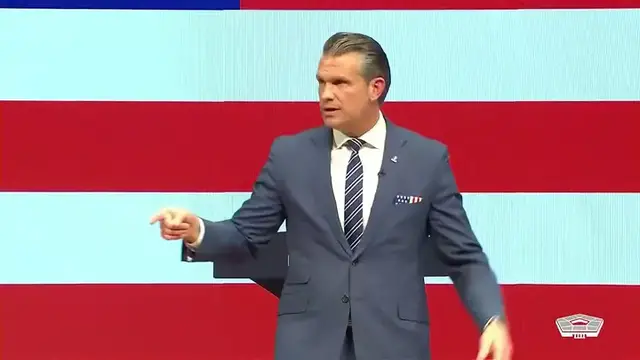
The Autonomous Warfare Command, or AutoWarCom, aims to address an acquisition system that doesn’t keep pace with technological change.
Show More Show Less View Video Transcript
0:00
We have the most powerful and the most prepared military on the planet
0:04
Nobody can touch us. It's not even close. My job, your job, our job is to keep it that way
0:11
Which brings us to today's six announcements, which taken together with historic efforts already underway
0:20
like the Golden Dome for America or the Golden Fleet to protect the seas
0:24
and the F-47 will ensure our military stays on top. for generations to come. So let's go. First, today at my direction, we are announcing the creation of
0:38
Autonomous Warfare Command, or Auto Warcom, a new four-star combatant command with service-like
0:47
authorities built to scale autonomous and robotic capabilities across the joint force
0:52
in the fastest peacetime shift in modern military history. Drone warfare supercharged by SI-enabled targeting
1:02
is the biggest battlefield revolution in generations. You already know that. Yet when I was sworn in at the Department of Defense
1:10
there was scant urgency in this domain. That changed as soon as we took the helm
1:16
We immediately launched the drone dominance program to cut through red tape and move authorities out of the Pentagon
1:21
and place it with commands. We established Task Force 401, led by Army Brigadier General Matt Ross, a phenomenal leader
1:30
now the leading counter-drone unit across the entire government. To accelerate purchasing and fielding of these technologies
1:39
we fused the Defense Innovation Unit, DIU, with a direct report program manager called Adirpam
1:47
That team has shipped thousands of autonomous systems of drones to the Middle East and around the world delivering lethal capabilities and outcomes in days and weeks rather than months or years That the normal speed of the Pentagon months or years
2:01
It's a good start, but it's certainly not enough. The pace of war is changing faster than the process to support it
2:08
Cheap compute, super intelligence, and advanced commercial manufacturing have enabled the proliferation of low-cost, high-precision strike
2:18
You see, for 40 years, the United States relied on inexpensive weapons, not only, but primarily
2:27
on expensive weapons that placed quality over quantity. Now, that approach gave us a lot of enormous advantages, and we need to preserve those capabilities
2:36
But today, we need both quality and quantity. The term, you know, is high-low mix
2:42
An ogy is a thunderstorm. We need bolts of lightning high, our existing high-end kill chains capable of striking unexpectedly and decisively
2:54
We also need steady wind and rain, mass drones and other autonomous
2:59
attributable systems that flip the cost exchange and impose unrelenting pressure on an adversary on the battlefield
3:07
Ukraine's lesson is not that one type of drone wins wars, but rather the need for a purpose-built system that maximizes the ability to adapt
3:16
We will fuse procurement with operations at scale and then allow warfighters and engineers and entrepreneurs
3:24
to learn, adapt, and rapidly iterate on their domain and their mission
3:30
And that's why I'm directing an interim step as well. Today, the unmanned systems derpum becomes Project Agincourt
3:40
Project Agincourt. Now the name means something. In 1415 many moons ago the outnumbered English army defeated a numerically superior French force in their legacy armor with a new technology the longbow
4:01
The English had to look outside their traditional recruitment pools to find skilled archers
4:08
Now, to maximize the rate of fire that you need to be effective, they integrated Fletchers, the craftsmen who made and repaired the arrows for the longbows
4:17
and they move them close to the front lines to sustain the rate of fire
4:22
We face a very similar moment. Project Agincourt is not just a procurement vehicle
4:29
It's applying our commercial-first drone dominance playbook to DIU. And now it gets two brief additional missions
4:37
First, it will prototype a new construct called warfighting acquisition, not just acquisition that happens at the Pentagon
4:44
This model fuses operators with entrepreneurs in rapid adaptation cycles while distributing decisions and dollars closer to frontline units, to combatant commands
4:56
Realistic training exercises and, when possible, the crucible of combat will be used to compress innovation timelines and scale what works
5:07
Now, this audience of any across the country understands why this formula unlocks advantage for the United States
5:15
You know the single greatest comparative advantage of the U.S. military. It's not a program. It's not a platform. And it's certainly not a program office
5:24
It is our frontline combat leaders. By removing unnecessary layers, reducing the distance between our warfighters and our world leading innovators
5:34
and then giving the right people the authority to act, Project Agincourt will pilot innovation at the edge in a way that only Americans can do
5:46
And second the culminating mission of Agincourt will take place over the course of months clearing the path for autonomous warfare command
5:56
The autonomous and robotic revolution has enormous implications for equipment, doctrine, organization
6:04
and the assumptions that have governed warfare for decades. civilian leaders can provide direction and urgency but lasting change must be anchored in military
6:14
command structures and operationalized by leaders across our joint force now any major institutional
6:23
change like this one it is a major institutional change has always met resistance goldwater nickels
6:30
faced opposition from the secretary of defense the chairman of the joint chiefs and the military
6:34
services. U.S. Special Operations Command, SOCOM, triggered a Pentagon revolt. Secretary Defense Bob Gates had to fight his own building to fast-track MRAPs to the front lines. And
6:49
President Trump's Space Force was opposed by the then Secretary, the Air Force, and
6:55
the Chairman. Yet when the final order was given, the military executed and the force
7:02
was better off as a result. Today, I am giving a similar order with the full support of President
7:10
Trump, a man that understands leading from the front and on the edge. We will soon have a four
7:17
star commander to raise the auto war comm flag. And to prepare the way, I'm appointing two leaders
7:23
to guide Project Agincourt during the next year. Owen West and Navy SEAL senior chief Max
7:30
Strazer. Theirs is going to be a CEO-COO partnership. Owen focused on strategic risk
7:38
resources, and scale, and Max focused on operational problem solving and the realities of employment in combat
news