Up next in 10



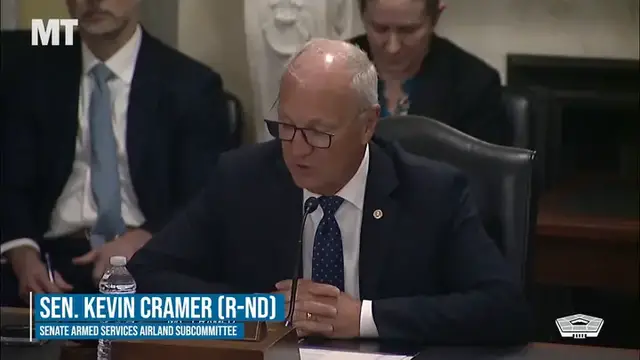
"We didn't put enough parts and pieces on the shelf," Lt. Gen. Gregory L. Masiello told a Senate subcommittee in a recent hearing.
Show More Show Less View Video Transcript
0:00
The F-35 is a strategic asset that strengthens deterrence, enhances interoperability, and reinforces the alliances and partnerships that underpin global security
0:13
Its success among our allies and partners is a testament to both its unmatched capabilities and its ability to enable seamless operations alongside United States forces
0:23
The F-35 remains a cornerstone of American air power and a critical capability for the Air Force, the Navy, the Marine Corps
0:31
I've seen this firsthand. I had the opportunity a couple of years ago to fly an F-16 against an F-35
0:39
And it was informative, to say the least. Could not see it on radar, even when I'm looking right at it, which was impressive
0:48
Today's hearing, though, is about how do we field the F-35 and get the airplanes out into the fleet and get them fully mission capable with the challenges that remain
1:06
And I think it's fair to say that some of these challenges are significant
1:10
What problems do you see in the deployment pipeline that are most readily fixable to achieve the goal to get up to speed as you describe it
1:24
Yes, sir. Well, I will tell you, I'll talk about sustainment first
1:28
I think in my job, I think I work for the aviation maintainers, and I think if I look at it, our job is to deliver combat readiness
1:38
It is sustainment first of our existing fleet and the ability to maintain the fleet that we get
1:44
So we looked and did a very detailed ysis across our whole sustainment system
1:49
came across five areas that we now call in our global GSS reset, and that's sustainment system
1:57
And we're going to go through and start executing that. That is not just solely about buying spare parts
2:03
It is inclusive of that, making a catch-up on the investment that we have failed to make in the past, and then a keep-up in that
2:10
But it is also relooking at our entire maintenance plan. All the way through from the very O-level, all the way to the depot level, with a million-plus flight hours we have learned on the aircraft, we can make some adjustments
2:24
With over 13 countries operating the aircraft, we have lessons learned from people that are from different countries
2:31
and why they have time on wing and some components that we don have and we can apply that So we will go through and do that and the optimization of the entirety of our maintenance system So the GAO FMC rate is they said 25
2:46
Your office claims it's 56%. So let's say it's somewhere between, or maybe we'll go with your number, 50%
2:56
So half of the airplanes are not fully mission capable. And I think it's the Marine Corps that has been accepting airplanes with no radar in it
3:08
Is that correct? We have accepted six aircraft for the Marine Corps that do not have a radar installed
3:15
That is correct. And because they want to wait for the APG-85 is my assumption
3:19
They do. Yeah. So, and I get it. And we could talk downstairs some more about the capability of the radar and what the challenges are going forward
3:29
so I assume that those airplanes can't count as fully mission capable with no radar
3:37
I don't think I would count them as fully mission capable, but in your early statement on the numbers 2556 is what we say for the mission capability
3:47
as opposed to FMC full mission capability and I know you understand the differences Sustainment system out there is sized I think you said for 700 to 800 aircraft That means the parts and other depot level maintenance and other things
4:06
But there's 1,300 operational airplanes. How do you get to a sustainment system that is
4:15
for 1,300, and how long will that take? Yes, sir. So that is part of our GSS reset
4:22
and I will tell you what we have done about that. We went back and looked at the modeling that we had
4:27
for the spares that we were asking folks to buy, and we have remodeled and baselined
4:33
It's not JAPO math. We have made sure you mentioned both of the other services
4:38
as far as the Air Force and the Navy and gone through to make sure it's the same thing
4:42
And that is now what we're putting forth as a requirement, which is the reason why in this generational investment of the 27 budget will help us
4:52
So we will fill up the available parts. I think that is the main driver
4:57
It's not a systemic issue with the system having the ability. It's the fact that we didn't put enough parts and pieces on the shelf, and we've increased the demand exponentially with the number of aircraft fielded
5:10
and we didn't do the same thing with the spare parts and the system
news