Up next in 10



Resilient and trusted cyber networks are essential to accelerating defense innovation and strengthening Indo-Pacific strategy
Show More Show Less View Video Transcript
0:00
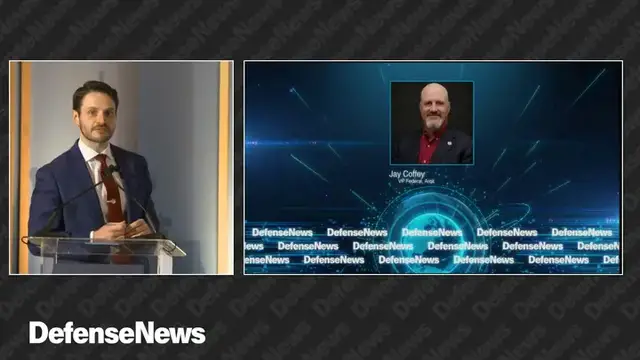
Joining me now here on stage is Jay Coffey. He is the Vice President Federal at ARKIT for our next one-on-one industry interview
0:07
And as Jay comes out, I believe we have a video we're going to take a look at from the team at ARKIT as well
0:30
All right, there we go. All right, Jay Coffey, Vice President of Federal at ARCID
0:35
Thanks a lot for being here. Yeah, you're welcome. So first, a bit of an introduction to you and your work at ARCID for anyone watching at home who might be a bit unfamiliar
0:44
Yeah, so Vice President of ARCID. ARCID is a post-quantum cryptography company
0:50
We're basically looking to solve the challenges of the next generation of encryption
0:57
And again, we do that with software-based dynamic capabilities. And my role is to make sure that we're driving that capability within the U.S. government
1:07
and the federal and defense departments in the United States here. What are some of the lessons specifically throughout the day
1:15
We've been talking about the Indo-Pacific region. I wonder lessons from that region or Ukraine, among others
1:21
that are shaping the way that mobile tech is being used in warfare. Yeah, I mean, the way I kind of view this is I kind of take a script from MITRE's attack framework, you know, the tactic techniques and procedures, right
1:37
These adversaries that we have, they're advanced threats, right? I mean, they're constantly what you're discussing right there, right
1:45
Those are the most outward facing and visible signs that we see that are these threats, right
1:52
But the threat is global in its landscape. And with regards to like how we look at that and, you know, for example, MITRE, we have to start looking at ways that we treat these as real time incidents and making sure that we have solutions technologies that are able to be resilient, dynamic and sort of take the first hit, if you will
2:19
Right. I mean, that's what a lot of the government is focused on right now
2:23
They're they have a lot of these older systems, legacy systems. And when they try to maneuver or try to change and shift, that's where a lot of the issues kind of come in
2:34
So, you know, our roles within industry is to try to start making those kind of capabilities much more robust
2:41
much more dynamic so that they can support these real-world situations in Ukraine and
2:49
Indo-PACOM as well as within everyday civilian life. Can you talk to me a bit about quantum-safe
2:55
cryptography? That is a phrase that sounds awesome, and I got to admit, I don't know a lot
3:02
about it, and I'm going to assume there's at least one person out there that might not also know a lot about it. So what is it, and what does it mean to your work that you do at ARCA
3:09
So it is a loaded word, right, or a loaded. Quantum means a lot of things to a lot of different people
3:16
For us specifically, PQC, the post-quantum cryptography, right, that is the threat eventually of a quantum-relevant computer
3:25
to be able to undermine and break all of the existing public key infrastructure today
3:33
So when we look at this from an exchange of any data from public to private
3:38
over the Internet or any kind of other communications that all uses public key infrastructure
3:44
And NIST has been working on this for the last eight or nine years around some new advancements and algorithms
3:51
that will hopefully be able to support that next generation of encryption
3:56
so that we don't have something that can, an adversary that can come in and break all of our existing public key infrastructure
4:03
So from that aspect, those are the kind of challenges that we're working on
4:08
NIST as well as others. There's an asymmetric versus symmetric. So there's a lot of things
4:15
to kind of get in the weeds. But again, the good thing is that there are companies focused on this
4:20
now. There are a lot of initiatives and mandates out there, and we're just happy to be part of it
4:25
What are the top risks that keep you up at night? The thing that keeps me up at night is that there's a lot of talk and there's a lot of rhetoric
4:33
around, hey, we're doing things quicker, faster. But there's still a lot of the old regime in terms
4:41
of the specific policies and processes and other things that I don't believe are changing quick
4:49
enough. We need to be able to kind of do things to adopt at speed and scale. And a lot of this is
4:58
not really a technology issue. It's definitely more of a people and process issue. So the thing
5:03
that keeps me up at night is the fact that, you know, we continue to sort of look at the old ways
5:09
in which we've done things and not really kind of taking these paradigm shifts and looking at it in
5:16
a whole new way of how to make something that less complexity, right? Make it just easier to
5:23
execute and adopt. How would you say our allies are approaching quantum safe or zero trust defenses
5:29
and are there key lessons to be learned from them? Yeah, so our allied nations are rallying around us
5:39
They are definitely looking at this, again, from an investment and priority perspective
5:45
I still think we a little bit behind but definitely over in the UK they take this quite a bit more seriously They trying to drive a lot of the initiatives around PQC and some of those other dynamics that are kind of happening in play here
6:05
But I think there's a situation where we need to come together a little bit better and kind of create these alignments around some of these larger issues
6:19
You know, similar to kind of like what we do back in the 50s and 60s around the atomic bomb and things like that
6:24
I'm not saying this is maybe that kind of situation, but again, kind of rallying how the people look at a problem and, you know, support that or meet those challenges
6:35
What do you see as being some of the biggest gaps between policy and technology right now
6:40
the biggest gaps between policy and technology i would say that right now the the gap really is in
6:50
you know back to the the process and procedures right like they they keep kind of creating these
6:56
uh you know artificial um ways in which we have to like kind of jump through hoops and i just
7:05
I see that as very difficult because all that does is increase complexity
7:10
We need to find ways to strip that away and to make it much more easy because a lot of this technology, it can be easily assumed and adopted and it helps support the stuff that's happening today
7:25
But again, everybody sees the priorities and the focus and I think that's what kind of like AI, everything is AI today, right
7:34
So that is what dictates a lot of the policy, right? So it's being more forward thinking and having more of the coalition of the willing is a way to kind of prevent that from happening
7:48
Jag, about less than a minute or so with you left, some of the single biggest changes you would expect to see in the information warfare space, even in just the next few years
7:59
Yeah. So, again, war is changing us, right? And again, the way that we perceive what war is, is also changing us
8:10
Understanding the threat, a lot of people have said it, just being aware. I think that is a big factor in all this
8:17
Having some of the awareness and the ability, that is going to help drive the change that we need from an adoption standpoint with some of these newer and emerging technologies
8:27
And again, I'm just glad that ARCID is a part of that
8:31
and we're leaning forward to protect this nation. All right, Jay Coffey of ARCA
8:37
really grateful for your time and perspective. Thanks a lot for joining us. One more time here for our special guest
8:41
Thank you. Appreciate your time. I appreciate it. Great to have you. Thank you
9:31
Thank you
10:01
Thank you
10:31
Thank you
11:01
Thank you
12:15
Thank you
12:45
Thank you
13:15
Thank you
13:45
Thank you
14:15
Thank you
14:45
Thank you
15:15
Thank you
15:45
Thank you
16:15
Thank you
16:45
Thank you
17:45
Thank you
18:10
Thank you
18:40
Thank you
19:10
Thank you
20:10
Thank you
20:40
Thank you
21:10
Thank you
21:40
Thank you
22:10
Thank you
22:40
Thank you
23:10
Thank you
23:40
Thank you
#Military
#news
#Aerospace & Defense