Up next in 10



The religious violence of the Protestant Reformation and legacy of political strife between Queen Elizabeth I and Mary, Queen of Scots loomed over the reign of King James I. Both issues influenced him to keep a firm hold on the political, but fear the supernatural.
Show More Show Less View Video Transcript
0:00
James, the only son of Mary, Queen of Scots, and Henry Stewart, was born in 1566 during an ongoing conflict between Scotland and England
0:09
When he was one year old, he ascended the Scottish throne as King James VI, after his mother abdicated her position, and was crowned King James I of England some years later
0:19
Some of his accomplishments as king were achieving an eventual peace between Scotland and England, and also rewriting the Bible, and burning a whole lot of people alive
0:30
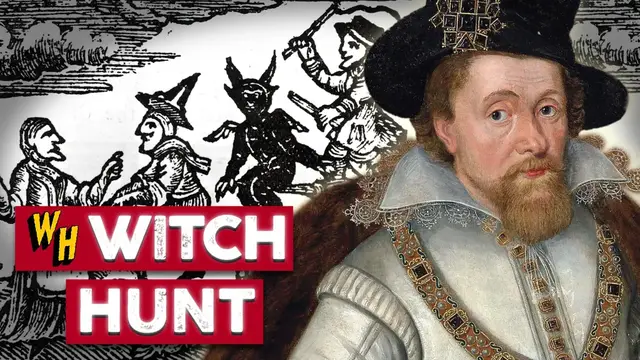
Modest goals, really. So, today we're taking a look at James I, the witch-burning son of Mary, Queen of Scots
0:38
Okay, time to crack this kingly nut. The religious violence of the Protestant Reformation and the history of bad blood between Queen Elizabeth I and Mary, Queen of Scots
0:52
loomed over the reign of King James I. First. Both issues influenced him to keep a firm hold on the political, but fear the supernatural
1:01
despite the fact that ghosts are not real. Um, hopefully. After inheriting the throne of Scotland
1:06
as an infant, the dual-threat king was crowned King James I of England after the passing of his
1:11
cousin, Queen Elizabeth I, in 1603. During James' reign, witch hunts, trials, and executions swept
1:19
through the British Isles, and he remained fixated on their religious and spiritual consequences
1:23
Whether it was by commissioning a new English language translation of the Bible in 1604
1:28
or obsessing over alleged cases of witchcraft, James believed himself to be an instrument of divine authority and justice
1:35
Ultimately, he unified the warring kingdoms of Scotland and England, but it was a long and difficult path to peace
1:41
All that witch-burning probably didn't help. Or maybe it did? James was born a king in a world heavily divided between Catholics and Protestants
1:56
His mother was an avowed Catholic, and when James was an infant, she wanted him to become one too
2:01
She gave baby James a Catholic baptism, proclaiming her intention to continue a tradition of Catholic
2:06
monarchs ruling over Protestant Scotland. But when Mary abdicated in 1567, she gave up her right to
2:13
raise her son, which is a weird rule. James was subsequently raised by his tutor
2:18
George Buchanan, as a Protestant, and he was encouraged to despise his mother and her religion
2:24
James interest in witchcraft was well throughout his two kingdoms to the point that it likely inspired William Shakespeare Macbeth And if you ever read Shakespeare Macbeth you know that nobody should feel good about inspiring Shakespeare Macbeth The representations of witches in the play conforms to James descriptions from
2:41
demonology. His obsession was a bit like being afraid of ghosts because you saw one in a movie
2:46
one time. James's supposition that supernatural storms delayed his wife's arrival in Scotland
2:51
and nearly cost him his life correlate to Shakespeare's portrayal of witches brewing
2:56
up storms. Additionally, Shakespeare probably wrote Macbeth as a short play because he knew
3:00
James didn't have the patience to sit through a long performance. Maybe he should get on TikTok
3:08
The North Berwick Trials of 1590 marks one of the first and largest witch hunts in Scottish history
3:14
and James played a significant role in them. After he married Princess Anne of Denmark
3:19
they set sail for Scotland but were met with a series of storms that nearly put an end to the
3:24
young couple and delayed their arrival. Think the parents in Frozen if they had squeaked through
3:29
The ordeal was so traumatic that James suspected foul play. In other words, he wanted to blame
3:34
someone for the weather. He felt the only reasonable explanation was someone or a group
3:40
of people had tried to sabotage his marriage and target his life. In response, James initiated a
3:46
witch hunt that rapidly expanded as the accused made confessions and further allegations under
3:51
torture. Turns out, torture is nothing like Jack Bauer makes it look. Mostly, people just tell you
3:56
what you want to hear. In total, at least 70 people were accused of witchcraft, and most were
4:01
sentenced to death. Europe's witch hysteria predominantly victimized women, which you probably knew if you ever saw Hocus Pocus. Historian Susanna Lipscomb estimates around
4:10
70-80% of accusations in this period were directed at women. James believed women were
4:15
naturally more likely to be witches, since they were frailer than men, making them, quote
4:20
easier to be entrapped in those gross snares of the devil. Apparently, the devil sets traps, like the Predator
4:27
though both men and women stood trial for witchcraft in North Berwick. Far more of the accused were women
4:33
Scholar Deborah Willis even theorized James primarily targeted women in the North Berwick witch trials
4:38
to rid himself of an overbearing, malevolent female gaze left by Queen Elizabeth and his mother
4:44
thus reasserting his own power. Talk about mommy issues. James considered witchcraft a serious crime, so he tailored the punishments to match what
4:57
he believed to be the severity of the offense In 1604 only a year into his reign in England he passed a new Witchcraft Act Though other witchcraft laws had already been enacted by Henry VIII and Elizabeth I
5:09
James' act took a hardline approach. For instance, convicted witches were hanged
5:15
regardless of whether the accused had allegedly caused bodily harm to others
5:19
During the North Berwick Trials of 1590, James believed he had been a target of magical mischief
5:24
Accused witches testified the devil hated James because The king is the greatest enemy he hath in the world
5:31
Testimonies like this were political gifts for James. According to author Donald Tyson, he used them to position himself as
5:38
an avenging knight of the Christian faith. Oh, so kind of like the doom guy
5:43
James claimed divine authority in his crusade against the dark magic Satan had allegedly
5:47
unleashed throughout his kingdom. James wanted to get the word out about the dangers of witchcraft in the wake of the North
5:53
Berwick trials. In 1591, he sponsored the publication of News from Scotland, a pamphlet that further sensationalized reports about the trials, stoking fear and paranoia about witches
6:05
This helped James position himself as a defender of demon-destroying law and order within his realms
6:10
Like the Doomguy, if he also sold Bibles. The North Berwick Witch Trial stirred James' imagination and convinced him witches were a clear and present danger
6:19
The events influenced him to write a text about witchcraft and how to deal with those who practice it
6:24
Demonology was first published in Scotland in 1597, then in England six years later
6:30
The text thoroughly identified different kinds of supernatural activities and occurrences. James involved himself in witchcraft trials because of his fascination with the supernatural
6:43
and his self-affirmed role as guardian against the occult. In this position, he was said to be able to uncover, by his own skill, notorious impostures
6:53
One of the highest-profile cases involved Anne Gunter, a woman who claimed to be possessed by demons in the early 1600s
7:00
James became interested in the case after Gunter made allegations against people she claimed had bewitched her
7:06
and he met with her to get the full story. During their conversation, James compelled the woman to confess it was a hoax
7:12
It was a ruse hatched between Anne and her father to exact revenge on people they believed
7:16
had wronged them. There was no shortage of darkness in the life of young King James, and it might have also
7:21
helped inspire his fascination with witchcraft. When James ascended to the throne at just 13 months, his mother had been ousted
7:29
Not long after his father died in an explosion By the time of the North Berwick Witch Trials Mary Queen of Scots had been executed by Queen Elizabeth I of England In fairness we might start believing in curses too after all that
7:45
Religion and politics were inseparable in early modern Europe. In England, the crown was the head of the Anglican Church
7:53
Moreover, ministers and rebels sometimes used biblical passages to question the authority of kings and queens
7:58
Since there were many unofficial English translations of the Bible, they weren't all the same
8:03
The Geneva Bible, for example, was politically subversive, since it included annotations and marginalia that criticized royalty
8:11
That's the fun Bible! By commissioning a new Bible, James hoped that he could justify his monarchical authority in the religious text
8:17
by standardizing the language and making it free from subversive commentary. Furthermore, James hoped the newly translated text would become the single Bible
8:25
to unify different schools of Protestantism in England and Scotland, and strengthen his political legitimacy
8:30
And thus, the King James Bible was created, one of the most widely known versions of the text to this day
8:36
Contrary to what the name may suggest, the King James Bible was not created solely by King James
8:41
Rather, James brought together a diverse group of language scholars to create the new translation
8:46
The translators, however, did not have the final word. That's what happens when you work for a king
8:51
After they created a suitable version, committees made up of religious and royal officials had to approve it
8:56
and final approval was granted by the monarch himself. All in all, the new translation took seven years to complete
9:03
Rewriting religion to suit your kingly needs is a long and storied tradition
9:07
Just look at Hank. James' reign may have divided subjects by labels like Catholic
9:16
Protestant, Witch, and Sorcerer, but his greatest legacy was unity. He brought together the Scottish and English monarchies
9:22
by ascending to both thrones in relatively quick succession. Even prior to the Scottish Wars of Independence in the 13th and 14th centuries
9:30
England and Scotland were completely separate countries with their own monarchies, churches, and systems of law and education. Moreover, the two kingdoms shared a history
9:38
marked by warfare. Though he became King James VI of Scotland in 1567, James also had a strong
9:44
claim to the English throne through the royal ancestry of his mother and father
9:48
When Queen Elizabeth I of England passed on in 1603, she named her cousin James as her heir
9:53
the Union of Crowns was a major step towards political unification. Sure, he may have only achieved peace by ruling both countries simultaneously
10:02
and he may have executed a whole lot of people based on his own superstition
10:06
but you can't argue with the results