Up next in 10



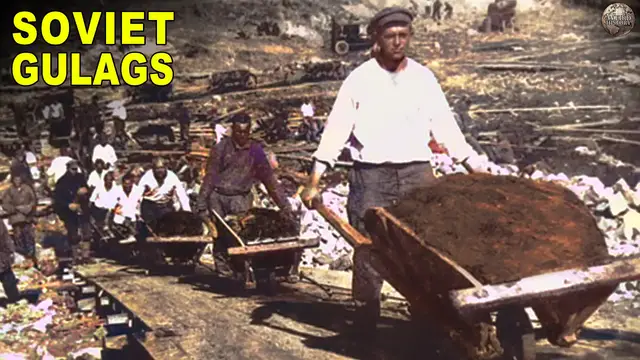
What are Soviet Gulags? What happened in Gulags? And what did they accomplish? The word "Gulag" is actually an acronym of its official bureaucratic name, Glavnoe Upravlenie Ispravitel'no-trudovykh LAGerei. When translated from Russian, it roughly means "the Main Administration of Corrective Labor Camps."
Show More Show Less View Video Transcript
0:00
Lurking within the shadows of Joseph Stalin's Soviet Union was a system of forced labor camps known as the Gulag
0:07
Gulags were nightmarish prisons containing anywhere from 2,000 to 10,000 prisoners apiece
0:13
If you were unlucky enough to find yourself as one of those prisoners, you would be subjected to backbreaking labor, brutality, extreme weather, starvation, and disease
0:23
Today on Weird History, we're exploring what life was like for a prisoner in the Soviet Gulag
0:28
OK, time to take a disturbing trip back to the USSR. And we don't mean we're taking a drive in a mosque each
0:37
The Gulag was notorious for imprisoning people based on false or even non-existent charges
0:42
including treason, spying, and anti-revolutionary activity. Sympathy toward anyone perceived to be enemy of this state
0:49
could also be punished with a trip to the camps. That means if Rocky had lost Ivan Drago
0:54
not only would he have been shipped off to the Gulag, But so would Polly, and probably the robot as well
0:59
The Soviet Union relied on these flimsy pretexts to incarcerate anyone they pleased
1:04
But the real reason was the economic value of prisoners as slave labor
1:08
Stalin's aggressive five-year plan, an effort to quickly bring industrialization to the Soviet Union, required a huge amount of labor
1:15
for its massive construction projects. The only problem, a lack of knowledgeable and skilled
1:20
specialists who could do the work. So Stalin's plan created enormous labor camps
1:25
to get the job done. A guy who has sketchy facial hair with an ambitious business model that relies on unpaid labor
1:31
Sounds like a tech startup CEO to me. Millions of people were arrested, deported to the Gulag, and forced to become the builders of Stalin's dream
1:39
Camp survivors shared chilling stories of being picked up by secret police and shipped off to the Gulag without a trial
1:46
Unsuspecting citizens could be snatched up while at work, in the middle of having a meal at a restaurant, walking down the street, or even asleep in their beds
1:54
And Stalin had another steady source of workers that was even more disturbing
1:58
The Russian Civil War claimed the lives of over 8 million civilians and 800,000 soldiers
2:03
leaving millions of children homeless throughout the 1920s and 30s. Desperate to live, some of these children turned to crime to survive
2:11
and were often rounded up and sent to the Gulag to bolster Stalin's workforce
2:15
You are never too young to swing a hammer for the motherland. Following a terrible interrogation, prisoners would be loaded onto a cattle car with others
2:23
sometimes waiting days for the train to depart for the Gulag. Conditions on the train were subhuman
2:29
Prisoners were given nothing but salted fish to eat, and the only toilet was a hole in the floor
2:34
Many succumbed to dehydration and extreme heat or cold before they even arrived at the Gulag
2:39
World War II proved to be another boon for the Gulag, and not in the way you might expect
2:44
After the Germans invaded the Western Soviet Union in the summer of 1941, the Red Army
2:49
beat a hasty, chaotic retreat as Hitler's forces swarmed over the land. Eventually, the Soviets regained control, prompting Stalin to issue
2:57
Order No. 270 in 1941, which stated that any Red Army soldier who was captured or retreated would
3:04
face a terrible punishment Not only would they have to deal with the consequences of their actions which in some cases would mean being shipped off to a German POW camp but in addition their families would be denied food and potentially be sent straight to the Gulag
3:17
Basically, your options were either win or be slain on the battlefield
3:21
Otherwise, your family would be breaking rocks in the labor camp. As if that wasn't bad enough, Gulag prisoners were assigned to special penal battalions
3:29
and sent to the front lines of the war. Some would cross minefields, clearing them for other soldiers to cross
3:35
Others were effectively used as human shields to protect the good soldiers
3:39
Anyone who tried to make a run for it would be gunned down by special blocking units
3:43
with strict orders to fire upon deserting prisoners. Still, getting blown up by a mine or shot by Germans and or your fellow countrymen
3:51
might have been a better deal than actually having to live in the Gulag
3:57
Following the hellish train ride to the Gulag, inmates had to contend with the harsh reality of daily life in the prison
4:04
where countless lives were claimed by disease, accidents, violence, and exposure. Food was always in short supply, and most camps provided almost no clothing or shelter
4:13
The barracks were often nothing more than ramshackle wooden shacks, offering scant protection from the elements
4:19
When you consider the fact that some camps were located north of the Arctic Circle
4:23
having nothing but a rickety lean-to to shield you from the cold spelled certain doom for a number of prisoners
4:28
The only clothing prisoners might receive were padded jackets with the occasional hat or set of mittens
4:34
And what little food they were given lacked nutrition. Guards basically controlled every part of a person's life in the gulag
4:40
And their mood could determine how much food, clothing, or water a prisoner would get each day
4:45
And the camp's administrators often dangled food in front of desperate prisoners to incentivize them to work harder
4:51
It was like being sentenced to an endless team-building exercise where you're encouraged to die so your boss has less paperwork
4:56
The severe lack of resources led to hoarding. Tobacco, food, shoes, and even sewing needles essentially became a form of currency
5:05
Gambling and bartering and fights occurred over these basic items, with prisoners sometimes killing for them
5:10
Even though Stalin's regime regularly invented charges to send innocent people to supply their workforces at the Gulag, the camps were also home to actual criminals
5:19
including bandits, thieves, and murderers. These real criminals were the elites of the camp
5:24
often sporting specific tattoos related to Russian orthodoxy and culture, and terrorizing other
5:29
inmates. The gangs controlled virtually every aspect of social life, including who slept where
5:35
and how food was rationed, and challenging their authority could mean beatings, stabbings
5:39
additional hard labor, or worse. Consequently, many prisoners feared the gangs more than the
5:45
actual guards. Stalin's bold vision of jail, but worse than outside, was no walk in the park for
5:51
anyone. But women had things especially rough. Many of the female inmates were initially arrested
5:56
as daughters of enemies of state, meaning they weren't even guilty of any direct offense
6:00
real or invented. When they were arrested, mothers were separated from their children
6:04
and in the camps, they were expected to perform the same hard labor as men. And even though male and female prisoners were separated, women in the gulag still faced the
6:12
threat of being assaulted by guards and male prisoners Some women were forced to take on Gulag husbands exchanging sexual favors for protection and better treatment And there weren exactly safe birth control methods either
6:24
When a woman gave birth in the gulag, the baby stayed with the mother until the age of two
6:29
The combination of poor nutrition, lousy sanitary conditions, and lack of basic necessities
6:34
tragically cut short many of these infant lives. And some of those who survived
6:39
developed serious mental and physical ailments. But despite all these abominable conditions
6:44
some people managed to find romance in the gulag, and many accounts of these personal experiences still survive today
6:50
In one account, published in Orlando Fijas, Just Send Me Word, A True Story of Love and Survival in the Gulag
6:56
the story of inmate Svjeta and her lost love, Lef, unfold through their letters to each other
7:01
When the author interviewed them, he found their love got her through her incarceration
7:06
Fijas writes, Svjeta had much less to say, but she sat with Lef and held his hand
7:11
And when I asked her what had made her fall in love with him, she replied, I knew he was my future. When he was not there, I would look for him, and he would always appear by my side
7:20
That is love. Exposure to the elements and harsh conditions weren't the only terrible things the gulag had in store for its prisoners
7:30
Out of the 18 million unfortunate souls incarcerated in the gulag, many came from diverse professional backgrounds
7:37
Doctors, writers, educators, farmers, students, and other people from all walks of life were
7:42
constantly arrested and shipped off to do hard physical labor, for which they had neither
7:46
the skill nor the conditioning to safely perform. There's a reason you don't generally hire art students to build a railroad or fix a power line
7:54
But Stalin wasn't particularly interested in anyone's well-being. And like most dictators, he'd had the foresight to make it illegal for him to be held accountable
8:02
for any of his actions. Some inmates cut down trees, while others mined for minerals or did other menial tasks
8:08
depending on the camp's location. And since this was years before OSHA was invented
8:12
and also Stalinist Russia, safety precautions and personal protective gear weren't given a second
8:18
thought. Prisoners often worked with no more protection than the clothing they had on their
8:21
backs, and used primitive hand tools instead of quality equipment, all while working grueling
8:26
hours in extreme conditions. As a result, thousands of lives were claimed by accidents
8:31
freezing, and sheer exhaustion. It wasn't uncommon for a prisoner to be literally worked to death
8:37
But with a constant supply of new laborers in the form of criminals, orphans, and dissidents
8:41
being fed into the camps, Stalin and his inner circle hardly noticed
8:45
They had bigger fish to fry. One of those bigger fish? The creation of shipping channels and a Russian navy
8:51
To make this a reality, two new cs needed to be constructed. The cs would run north and south
8:56
requiring extensive labor in a short period of time. Huh, an impossible amount of work with an equally impossible time frame
9:04
Sounds like a job for the unfortunate prisoners of the Gulag. In 1931, thousands of inmates were transported to the construction zones
9:12
There, prisoners dug a 30-mile addition to the White Sea Baltic C
9:16
The project took almost two years and was mostly dug by hand. An estimated 12 prisoners lost their lives building the c although the actual toll is probably higher Between 1933 and 1937 the same project unfolded in much the same way along the Moscow C This time however it took twice as long
9:35
and covered 80 miles. The thousands who perished digging the Moscow-Volga addition were buried in
9:41
the soil before the c was flooded over. Today, tourists traveling down the Moscow-Volga C
9:46
are actually sailing over a mass underwater grave. But it was a small price to pay for
9:51
Stalin to get his Amazon deliveries on time. As you may imagine, escaping the gulag was a
9:59
difficult feat. Even if you managed to get past the guards and the dangerous gulag gangs
10:04
you still had to contend with the harsh Russian wilderness and find your way to a country that
10:09
wouldn't immediately turn you right back over to Stalin. The only two options were Finland and
10:14
China. For those who actually succeeded in making a great escape, those countries became a safe haven
10:19
One notable escape involved a Polish army official named Slavomir Ravich, who crossed the Himalayas to India on foot
10:26
Ravich dictated the details of his adventure in a 1956 book titled The Long Walk
10:32
Despite being somewhat disputed, the story inspired the 2010 film The Way Back, starring Jim Sturgis
10:39
a fact which is either a tribute or an indictment of Ravich, depending on how you feel about across the universe
10:44
A verified escape did happen in 1933 involving a man named Vladimir Chernaivin
10:50
When he was transferred to Karelia, near the Finnish border, Chernaivin befriended a local
10:54
peasant who supplied valuable information about the habits of the camp's guards
10:59
Chernaivin used this information to find an escape opportunity. Because of his good behavior, guards allowed his wife and son to visit him in the prison
11:07
He and his wife established a code to discuss their escape plan. And in the summer of 1933, the family put their plan into motion
11:14
During a scheduled visit, Chernaivan and his family managed to give the Gulag Guard the slip
11:19
Per Chernaivan's account, the family crossed rivers, forests, and mountains on their journey
11:24
By traveling on foot and camping in the wilderness with few provisions, they managed to elude detection and make it to a hidden boat, which they used to sail to Finland
11:33
After establishing their safety in Finland, Chernaivan and his family emigrated to England to live out the rest of their lives
11:39
Man, that's a family story that beats the time we got banned from the theme park
11:46
At the time of Stalin's death in 1953, the Gulag held over three million prisoners
11:52
On paper, it had been a comparatively normal work camp administration. But with Stalin gone, the horrors of the camps became publicly known
11:59
Not only was it a cruel and inhumane system, but despite Stalin's insistence that it was necessary to complete his five-year plan, the Gulag was economically useless
12:08
The ends didn't even justify the means. Turns out, you just couldn't trust Uncle Joe
12:13
Russia's new premier, Nikita Khrushchev, began a process of de-Stalinization known as the Thaw
12:19
which included the immediate release of millions of gulag inmates. But even after surviving the gulag
12:25
many were so traumatized by their imprisonment that they remained fearful of discussing it for the rest of their days
12:30
The grim legacy of the gulag is well known to history, but for those who lived through it and their descendants
12:36
the wounds may never fully heal