Up next in 10



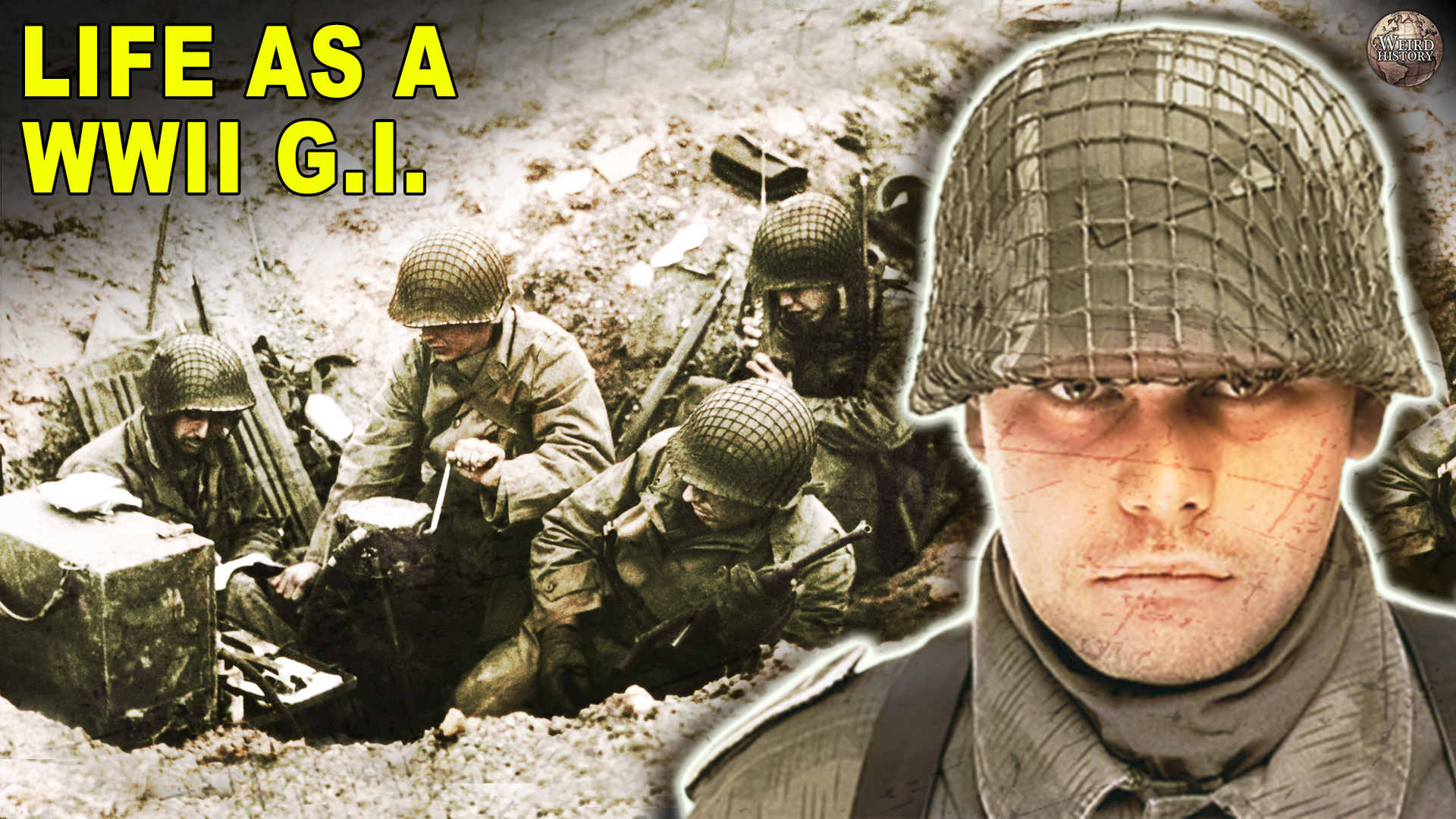
France fell to Germany in June of 1940. The United States hadn’t yet entered World War 2, and while isolationism remained politically popular, the country was growing wary. The prospect of being drawn into the European conflict was starting to feel inevitable, and Americans sensed they would soon have to send their army to fight.
Show More Show Less View Video Transcript
0:00
France fell to Germany in June of 1940
0:03
The United States hadn't yet entered World War II. And while isolationism remained politically popular
0:09
the country was growing wary. The prospect of being drawn into the European conflict
0:14
was starting to feel inevitable, and Americans since they would soon have to send their army to fight
0:19
So today, we're going to take a look at what it was like to be a World War II GI
0:25
OK, grab your rifle and a dry pair of socks and get ready to storm the beaches of some weird history
0:34
Even from all the way across the Atlantic, Great Britain's ability to defeat the Nazis alone
0:39
looked questionable. Concerned that the US Army wasn't prepared for what lay ahead
0:44
Americans began to support the idea of instituting a draft. So on September 16, 1940, the United States Congress
0:51
passed the Selective Training and Service Act, also known as the Burke-Wadsworth Act
0:56
restoring the military draft previously in effect during World War I. The new law ordered all males between the ages of 21 and 35 to register for service
1:05
Draftees would then be selected by a national lottery. Seriously, the Secretary of War would draw numbers out of a bowl
1:12
and the President would read them aloud, like a raffle ticket at a school carnival. Each of the over 6,000 draft boards would look up what local man in their area had been assigned that number
1:21
and that person was then officially drafted. Those men who were selected were expected to serve for at least one year
1:28
But once the US officially entered World War II, the period of service was extended to encompass the duration of the conflict
1:34
And the average duration of service would ultimately turn out to be 33 months
1:39
As the war dragged on, the draft age was lowered to 18. And by 1944, deferments for men younger than 26 were nearly non-existent
1:47
And while the law passed did define a draft system that was racially blind
1:51
the military at the time was segregated, and through delaying the assignment of drafted
1:56
black men to their limited options in the military, blacks were underrepresented in the war effort
2:01
In 1943, however, a racial quota system was introduced to gain more complete participation
2:06
of the nation's manpower. To make sure the military's needs were always being met
2:10
the draft board got to decide to which military branch draftees would be assigned
2:14
and more often than not, that was army infantry. By the time the war ended
2:19
50 million men had registered, and 10 million had been inducted into the armed forces
2:24
Turning those civilians into an effective army was no small task. Most of the recruits were young and had never left their home state
2:31
much less traveled across the world to fight a war. Making them into soldiers started with several months of basic training known as boot camp
2:38
To get the trainees to start thinking of themselves as part of a unit the men all received standardized uniforms and equipment had their heads shaved and were assigned serial numbers Platoons would then eat sleep and train together
2:50
The training was overseen by drill instructors, tough-as-nails officers who forced their trainees
2:55
to be attentive to protocol. Think of Arlie Emery's character in Full Metal Jacket
2:59
That movie was about the Marines, but you get the picture. Recruits who made mistakes would be punished
3:04
with extra kitchen duty or other physical tasks. And if a mistake were bad enough
3:09
the whole platoon might be punished for it. It was a grueling experience, but many veterans
3:13
remember boot camp as a transformative experience that left them ready to fight anything, including
3:19
long lines at the barbershop. After basic training, most recruits were given more specialized training
3:24
in their specific duties, including how to use special weapons, operator radio, or master particular
3:29
invasion techniques. Specialties were assigned based on past experience and the results of the
3:35
AGCT, or Army General Classification Test. The test purported to identify a recruit's skills or trainability
3:42
though how well it worked is still up for debate. Once specialties were assigned, recruits
3:47
might train at over a half dozen different locations before being shipped out. And sometimes they even received additional training
3:52
after arriving at their destination. Despite being just a small fraction of the army
3:59
infantrymen incurred the vast majority of the casualties and typically faced the harshest conditions
4:05
and they were paid less than their counterparts in other services and occupations
4:09
That doesn't sound right. Seems like you should at least get a good job for not dying bonus
4:13
As you might imagine, the state of affairs didn't sit so well with the men and led to a deterioration of morale
4:19
To combat those bad vibes, the top brass employed a multi-pronged strategy
4:23
that included awarding badges for proficiency in training and performance in combat
4:27
as well as an increased rate of promotion. Famous American war correspondent Ernie Pyle led the political battle
4:33
to get infantrymen a financial reward for the risks they were taking by using his column to dramatize the conditions they faced
4:40
His advocacy helped bring about the institution of Badge Pay in June of 1944
4:46
Badge Pay awarded $5 per month to anyone who achieved the Expert Infantryman Badge
4:52
roughly $85 today, and $10 per month for the Combat Infantryman Badge
4:57
which equals about $175 in 2022. It's not the kind of money that was going to make anyone rich
5:03
but it was better than nothing. An infantryman had to be prepared to move through any terrain
5:11
not to mention any weather. Troops had to deal with snow, rain, blistering heat, freezing cold
5:15
and every other conceivable condition and climate. This meant that along with his M1 rifle
5:20
which weighed over 10 pounds when loaded every man had to carry over 20 pounds of clothing including underwear long johns woolen pants a wool shirt at least one heavy sweater several pairs of socks boots galoshes a rain poncho an overcoat a cap and a helmet
5:38
and a swimsuit, you know, just in case. Then there was the additional 60 pounds of equipment
5:43
including a backpack, an ammunition bandolier, grenades, rations, a canteen, a blanket
5:49
and assorted personal items, among other things. Most important among all these items were the
5:54
Clean socks. No, really. Marching through mud and snow caused blisters and trench foot
5:59
And wearing waterproof boots caused the feet to sweat, which led to the same ailments
6:04
These were serious problems because in addition to being painful, blisters also created a risk of infection
6:10
Given the dangers of infection in the field, soldiers were known to take every opportunity
6:14
to change and clean their socks. Speaking of which, for soldiers in the field
6:21
bathing was an extremely rare luxury. and they sometimes went over a month without showering or changing their clothes
6:27
So sort of like being a freshman in college. If a GI was given the chance to shower, it was usually by means of a lister bag
6:35
which was a canvas sack with a showerhead attached at the bottom. Lister bags, which would be suspended about five feet off the ground
6:41
held roughly 36 gallons of water. So forget about the idea of a long, luxurious shower
6:46
If he moved quickly, a soldier could just about lather himself up and rinse the soap off before the water ran out
6:52
And it was usually in his best interest to hurry anyway, since the Lister bag had to
6:56
be used outdoors, often in the freezing cold. Then if he was lucky, he'd be issued some new, clean clothes, usually using water heated
7:03
in a helmet above a camp stove, or with government-issued heating packs
7:07
Soldiers could shave themselves during lulls in the fighting. The government also issued them toothbrushes and tooth powder, which could be used with
7:14
water from a canteen. That is, assuming it wasn't so cold the canteens had frozen, which was a regular occurrence
7:22
Despite the existence of military news services, infantrymen, and even their immediate supervisors
7:28
typically had little knowledge about how the overall war effort was going
7:32
Newspapers like Stars and Stripes rarely made it all the way to the front, and issues that did
7:37
were usually long out of date. This meant there was no real way to know what the significance of
7:41
any given mission or battle was. Soldiers were expected to risk their lives defending seemingly
7:46
unimportant villages or taking some particular hill, even if they didn't understand why they
7:51
were doing it. As Lord Alfred Tennyson wrote in his 1854 poem, The Charge of the Light Brigade
7:56
theirs was not to reason why, but merely to do or die. You know, that quote from Saving Private Ryan
8:04
On May 8 1945 Germany surrendered to the Allied forces The war was over but the work wasn not by a long shot The army in Europe would now have to transition into being an occupational force At the same time the US was preparing for an invasion of Japan which would require some troops
8:22
to travel to a new theater of war. And of course, some troops were ready to be discharged
8:27
and sent home. Recalling some of the difficulties the US faced demobilizing
8:31
after World War I, US Army Chief of Staff General George C
8:35
Marshall set out to devise a system to decide who would stay, who would head to Japan, and who would go home. The system he came up with was the Adjusted Service
8:43
Rating Score, or the point system, as it was called by the GIs. Announced in September of 1944
8:49
the system awarded soldiers one point for each month in service in the Army, one additional point
8:54
for each month in service overseas, five points for each campaign, five points for a Medal of
8:59
Merit or Valor, five points for a Purple Heart, and 12 points for each dependent child, up to
9:05
three dependent children. A soldier needed 85 points to be sent back to the states
9:10
so it was kind of like a timeshare program, only way less pressure. The men were generally
9:14
unhappy with the system, which was perceived to be unfair in more than a few ways
9:19
Equally frustrating for many was that due to the ongoing war in the Pacific, even those who achieved the 85-point total sometimes had to wait months to catch a ride home
9:28
Eventually, the point total was lowered to 50, and just four days after Japan surrendered
9:32
the U.S.-initiated Operation Magic Carpet, presumably under the command of Brigadier General Steppenwolf
9:39
Magic Carpet used battleships, carriers, and every other available vessel to bring the boys back home
9:44
and demobilization officially ended on June 30, 1947. Back in the States, the returning soldiers were treated as heroes
9:55
Celebrations were routinely held in their honor, and a general state of euphoria spread throughout the nation
10:00
But for many of the returning troops themselves, readjustment to normal life was difficult
10:05
After fighting on the front lines, many veterans feared they would never be able to adjust back to civilian life
10:11
Still others worried they wouldn't be able to find jobs or make up for lost time in their former professions
10:16
Even worse, many believed their families would resent their return. To alleviate some of these concerns
10:22
the government passed the Servicemen's Readjustment Act, also known as the GI Bill
10:27
Under the new law, all honorably discharged veterans who had seen active duty were eligible to receive
10:32
a year's worth of unemployment compensation. The bill also encouraged the former soldiers
10:37
to pursue an education by paying for tuition at a college or vocational school
10:42
and providing a stipend to live on while they completed their degrees. This caused a dramatic increase in college enrollments
10:48
across the country. While the original bill expired in 1956, a new version of the bill, the Post 9-11 Veterans Educational
10:56
Assistance Act, was passed in 2008