Up next in 10



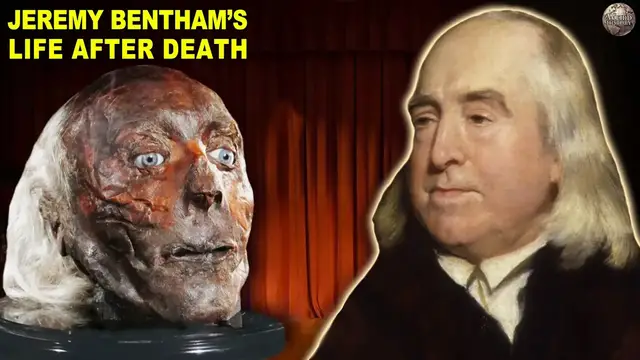
Born in 1748, Jeremy Bentham was a 19th-century English philosopher, economist, and social reformer. Bentham had interesting ideas about mortality and mourning, which shaped how he wanted his remains handled after his passing. By Bentham's request, his preserved body was on public display and used for instruction.
Show More Show Less View Video Transcript
0:00
Born in 1748, Jeremy Bentham was a 19th century English
0:04
philosopher, economist, and social reformer. After his death in 1832, his preserved body
0:10
was placed on public display and used for instruction. While this was done at Bentham's own request
0:16
the reality of what happened to his body wasn't quite what he had intended
0:20
So today, we're going to take a look at how Jeremy Bentham's body had one
0:24
of the strangest afterlives in history. Everyone loves a good party, and Jeremy Bentham was no exception
0:33
That being the case, and having already decided he didn't want to remain, as he put it
0:38
altogether useless after his passing, he came up with the concept of the auto-icon
0:43
Bentham envisioned the auto-icon as an accessible body, ready for someone to wheel out at parties upon request
0:49
It sounds like a sequel to Weekend at Bernie's, but Bentham was completely serious about the whole thing
0:55
He could see the auto icon as something of a replica of the deceased person
0:59
It was to be made from their skeleton, stuffed with hay, and topped off with their mummified head
1:04
Cool, yeah, yeah, sit the head next to the hummus, please. Bentham hoped by preserving his body, his friends could still see him
1:10
and may feel inspired to donate their bodies for similar purposes. Spoiler alert, it did not work
1:16
In many ancient cultures, mummification was a legitimate method for disposing of mortal remains
1:27
But in modern times, cremation and burial are, for the most part, the only real two options
1:31
available. Jeremy Bentham, however, wasn't really into either of those, and he knew exactly what he
1:37
wanted to happen to his body after he passed. He wished for someone to dissect, embalm, and display
1:43
his body as a model for the whole world to see. As he came closer to his end, Bentham grew increasingly
1:49
focused on the specifics of his impending mummification. He even allegedly carried a pair of glass eyes with him
1:55
during his final decade of life for easy insertion into his head when his body was on display
2:00
You've got to give it to Jeremy. He was prepared. Well, Bentham finally perished on June 6, 1832
2:07
at the age of 84. And he tasked Dr. Thomas Southwood Smith
2:11
with fulfilling his unique post-mortem wishes. Three days after Bentham's passing, Dr. Smith dissected his body, as instructed
2:19
during an anatomy lecture. Knowing that pretty much everyone enjoys watching a dissection
2:23
Bentham's closest friends received invitations the day before. They read, it was the earnest desire
2:29
of the late Jeremy Bentham that his body should be appropriated to an illustration of the structure and functions of the human frame In compliance with this wish Dr Smith will deliver a lecture over the body
2:40
on the usefulness of the knowledge of this kind to the community. But Bentham didn't just want his
2:45
friends to see it, he wanted their friends to watch too. As such, the invitation continued on
2:50
to say, the lecture will be delivered tomorrow at three o'clock, at which the honor of your presence
2:56
and that of any two friends who may wish to accompany you is requested
3:00
Hey, you want to come to a dissection party? Sure, sure, that sounds fun. What is that
3:05
Uh, yeah, just come. You'll see. Despite the fact that autopsies in the study of anatomy were controversial at the time
3:17
Bentham's dissection turned out to be a fairly popular event. In addition to his friends and friends of friends
3:23
the dissection audience also included noted medical professionals, philanthropists, and several members of the government. Dr. Smith was mindful of the socially questionable nature
3:33
of the event. He said to the onlookers, if I can promote the happiness of the living
3:37
then it is my duty to conquer the reluctance I may feel to such a disposition of the dead
3:43
however well-founded or strong that reluctance may be. Ah, yes. As the saying goes, a friend in
3:48
need is a friend who's willing to dissect you even if he's mildly uncomfortable with it
3:53
Once the job was complete, Dr. Smith stripped Bentham of his flesh
3:57
He reassembled the skeleton but left the head detached. The preservation had unexpected results, though
4:02
Namely, Bentham's head looked leathery and gaunt rather than maintaining its form
4:07
Dr. Smith wrote about the process, I endeavored to preserve the head untouched
4:11
merely drawing away from the fluids by placing it under an air pump over sulfuric acid
4:15
By this means, the head was rendered as hard as the skulls of the New Zealanders
4:19
but all expression was, of course, gone. For the record, the part about the skulls of the New Zealanders
4:25
is a reference to the skull preservation practices of the Maori culture
4:29
known as mukamakai. This entailed taking out the brain and eyes, sealing the orifices with flax fiber and gum
4:36
boiling the head, and then steaming it over a fire and drying it in the sun for several days
4:41
Kind of like slow roasting a brisket, but not nearly as delicious
4:45
Dr. Smith tried his best to keep Bentham's dome well-preserved, but ultimately, his methods proved ineffective
4:55
To try to make up for the mistake, Dr. Smith commissioned a likeness of his friend in wax
5:00
French artist Jacques Talriche used a bust of Bentham, a portrait by Henry Pickersgill
5:05
and a mourning ring adorned with Bentham profile as guides while sculpting the new head Telriche was known for his anatomical models and according to Smith created one of the most admirable likenesses ever seen The finished wax head rested on top
5:20
of Bentham's skeleton, and Dr. Smith arranged Bentham's body, adorned in a black suit
5:24
inside a glass and mahogany case. Smith must have been fond of what he created because
5:29
at first, Bentham, who was posed seated in the chair and holding the walking stick
5:34
which was his constant companion when he was out, was placed at Dr. Smith's own house
5:38
But the display was too big for the doctor's home, or it just creeped him out too much
5:43
So he donated Bentham's body to University College London. The university, possibly looking to set a new standard
5:49
for nightmare fuel, accepted the display and had Bentham's disfigured head placed
5:53
between the body's feet, where it remained until 1975. You'd hope the remains of such a famous
5:59
and respected philosopher would be well-respected. But college kids are going to be college kids
6:05
In 1975, a group of students at University College London stole Bentham's head and demanded
6:10
the university donate £100 to charity to ensure its safe return. The school seemed to have wanted to haggle over the price and instead made only a £10 donation
6:20
Luckily for Bentham, the students caved and returned the head to the school unharmed
6:24
In a series of continued pranks, students pilfered the head for various purposes
6:28
It was purportedly used as a soccer ball on one occasion. and later students from the school's rival King's College stole it
6:34
Probably not what Bentham had in mind. The university eventually removed the head from the case to prevent further theft
6:46
Because it showed signs of deterioration, researchers transferred Bentham's head to the UCL Institute of Archaeology's
6:52
climate-controlled storeroom in 2002. The department pulls the head out for special occasions
6:58
and checks on it regularly to make sure more hair has not fallen off
7:02
While there's no word on whether they still like to use it as a soccer ball, the researchers at the Institute are coming up with some more valuable things to do with the head
7:10
For example, Philip Lucas and Ann Sheeran are proponents of using the head to investigate
7:15
Bentham's DNA. During his life, writings described Bentham as eccentric, reclusive, and difficult to get hold of. Lucas and Sheeran plan to test Bentham's DNA for autism and
7:26
Asperger's syndrome. The DNA samples are weak, given the age, and ideal samples should come
7:31
from bacteria in Bentham's mouth. However, scientists are hopeful they'll be able to
7:35
better understand Bentham after the studies are complete. Bentham was an atheist and considered
7:39
the religious practices surrounding the deceased as against utilitarian principles He rejected the idea of resurrection and the continuation of one soul He was critical of organized religion as an instrument of intimidation corruption and delusion
7:53
He also believed society should face the realities of mortality instead of being afraid of or avoiding the topic entirely
8:00
I am death. It's a Mr. Death or something. He's come about the reaping
8:05
Do come in. Come along in. Come and have a drink. Do. Bentham embraced mortality and aimed to find usefulness while alleviating the social pressures around it
8:13
According to Bentham, the creation of auto-icons meant there would no longer be needed monuments of stone or marble
8:20
There would be no danger to health from the accumulating of corpses, and the use of churchyards would gradually be done away
8:27
Auto-icons could reside in museums and other common areas, diminishing the fear of mortality by getting rid of its deformities
8:33
it would leave the agreeable associations and disperse the disagreeable. Of course
8:38
when he said that, he didn't know his head would be used as a soccer ball. Both Bentham and Dr. Smith were supporters of the Anatomy Act, a parliamentary action of 1832
8:50
making it easier for doctors to dissect human bodies for medical purposes. Bentham himself may
8:55
have helped author the initial versions of the act, which made their way through Parliament during the
8:59
1820s, and he also supported the mission financially. The goal of Bentham and others
9:03
was to make it less taboo for non-criminal offenders to serve as subjects for dissection
9:08
which was common in the early 19th century. Bentham's passing in 1832 served as an opportunity
9:13
for him to match his body to his ideas. In the months following Bentham's demise
9:18
Dr. Smith lobbied hard for the law, which made it legal for unclaimed bodies from workhouses to
9:24
undergo dissection. The act was less than perfect, and critics claimed it unfairly targeted the
9:29
poor, but it also helped bring an end to grave robbing and body snatching, both of which were
9:34
actually big problems at the time. In 2018, Bentham's auto icon left London for the first time
9:40
in 180 years. The reason for the excursion was that Bentham was part of the Lifelike Sculpture
9:46
Color, and the Body exhibition at the Metropolitan Museum of Art in New York City
9:51
Moving Bentham required exhaustive efforts, while simultaneously revealing more about the body to
9:57
the public. According to Jane Dunn, head of collections management at University College London
10:02
Bentham is wearing the original underwear, which has not got infested, and two sets of stockings
10:07
one over the other. That might have been the fashion then. Over the top, he has a vest
10:12
which is the original. While there were no signs of infestation, Bentham's stuffing shifted around with time. Bentham's head, the real one, didn't make the trip