Up next in 10



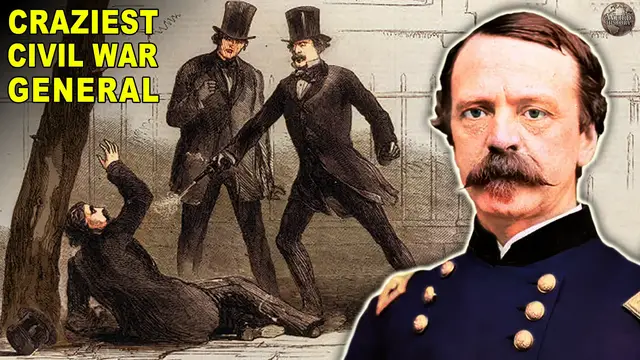
In 1859, Congressman Daniel Sickles shot and killed the man sleeping with his wife. After escaping a prison sentence, Sickles disobeyed orders in the Civil War and lost a leg. After the war, General Dan Sickles donated the leg to the Army Medical Museum. And that's just the start when it comes to the wildest general in the Civil War.
Show More Show Less View Video Transcript
0:00
Dan Sickles became a Union general during the Civil War
0:03
Despite his total lack of experience, he lost his leg at the Battle of Gettysburg
0:08
and donated it to the Army Medical Museum. He also murdered a man in broad daylight
0:13
And that's just the tip of the iceberg. Today, we're going to talk about the wildest general
0:17
from the Civil War. Dan Sickles was born to Susan Marsh and George Garrett Sickles
0:24
a New York patent lawyer and politician, in 1819. although Daniel would later claim to have been born in 1825
0:31
We'll get to that in a moment. Sickles studied at what is now New York University
0:34
and followed in his father's footsteps, passing the bar in 1846. But his ambition soon turned towards politics
0:42
and with the help of his close friends at Tammany Hall in 1847, Sickles was elected to the New York State Assembly
0:48
Sickles had known Teresa Bagioli for years. He was a close friend of her family
0:52
and had even lived with them for a year while preparing for college. Of course, at that point, Teresa was only a baby
0:59
But as the pedophiles say, love knows no age. So despite the objections from both their families, in the summer of 1852, Daniel Sickles and Teresa Bejoli were wed
1:09
He was 32. She was, oh boy, 15. Sickles apparently preferred people to believe he was younger, hence the lying about his birth year
1:17
Yet despite her youth, or perhaps because of it, Teresa was extremely well-received within Washington society
1:22
The Sickles hosted formal dinners every Thursday, and by all accounts, Teresa was a warm and welcoming host
1:28
She even became good friends with Mary Todd Lincoln, the wife of Abraham Lincoln, with whom she would often attend a séance
1:34
While Sickles led his child bride to believe they had a perfect marriage, he was in fact sleeping with multiple other women
1:40
including the notorious courtesan Fanny White, whom he famously brought on a diplomatic mission instead of his wife
1:47
After years of neglect at the hands of her husband, Teresa, then 21, began an affair of her own with Philip Barton Key, a U.S. district attorney, and the son of Francis Scott Key, the author of The Star-Spangled Banner
2:00
After receiving a mysterious poison pen letter detailing his wife's affair, Daniel Sickles armed himself with three different pistols and tracked down his wife's lover
2:08
Key, you scoundrel, said Sickles. You have dishonored my house. You must die
2:14
Then in broad daylight directly across from the White House Sickles shot the unarmed Key twice with one shot directed at his groin Well that sending a message Philip Barton Key died a few hours later
2:25
and Sickles was booked for murder. Daniel Sickles received so many visitors
2:34
that he was allowed the use of the head jailer's apartment to greet all his guests
2:38
This was not a common practice for prisoners, but Daniel Sickles was no ordinary prisoner
2:43
He was a U.S. congressman, and despite the fact that he had confessed to the murder
2:47
Washington was on his side. Several leading politicians jumped at the chance to represent one of their own
2:52
Among Sickles' legal dream team was Edwin M. Stanton, who would later go on to become
2:57
President Lincoln's Secretary of War. Sickles' lawyers put forth a novel defense, temporary insanity
3:03
They managed to get a former U.S. senator to describe Sickles' unnatural and unearthly
3:08
sounds moments before the murder. But it wasn't all about Sickles' state of mind
3:12
His team also followed the world's oldest legal playbook. Unfortunately, it's still often used today, blaming the victim
3:19
It may be tragical to shed human blood, said one of Sickles' seven lawyers, but I will always maintain that there is no tragedy about slaying the adulterer
3:27
His transgression takes away the catcher of the occurrence. The press was also on Sickles' side
3:33
Harper's Magazine hailed him as a hero, claiming the only thing Daniel Sickles was guilty of
3:37
was saving all the ladies of Washington from this rogue named he
3:41
After 20 days of testimony, the jurors went into deliberation. Not once in the history of the United States had anyone before claimed innocence by way of temporary insanity
3:52
Nevertheless, seven of the jurors were convinced that Sickles should go free. But there were two religious jurors who had moral qualms about letting a murderer off the hook
4:00
But after much prayer and debate, the two holdouts relented, and Daniel Sickles walked out of the courthouse to a hero's welcome
4:07
Washington was elated. So was the public and the press. But the love affair didn't last long
4:13
They turned on Sickles after he had the audacity to publicly forgive his wife of her infidelity
4:23
Sickles was expected to lose his next congressional race. So rather than run, he decided to return to New York
4:29
to spend more time with his wife and family and mistresses. Obviously he wanted to spend more time with them as well Daniel Sickles left Congress at the dawn of the Civil War Back in New York Sickles found a new way to get into the good graces with his friends in Washington by recruiting soldiers to fight for the Union Despite having no military service under his belt
4:48
Sickles was an amazing recruiter. He had so many men willing to fight under his leadership that
4:53
with the help of none other than Abraham Lincoln, Daniel Sickles became a military officer. Again
4:58
this was a man with literally no military experience leading a large group of soldiers
5:03
most of whom with as much experience as their leader. What could possibly go wrong
5:08
The Battle of Gettysburg was the bloodiest battle of the Civil War. It was also the decisive victory for the Union
5:13
leading to the surrender of General Lee and to the collapse of the Confederacy. It was also the battle where a bumbling general with no military experience
5:21
thought he was smarter than his superior, disobeyed direct orders, got his men killed, his legs shot off
5:27
and very nearly changed the course of history for the worse. General Daniel Sickles was ordered by his commander
5:33
Major General George Meade, to hold his men of the 3rd Army Corps at Little Round Top
5:38
but Sickles was unhappy with this post and wanted to move his soldiers to higher ground
5:43
So, disobeying direct orders, Sickles marched his men a mile out to the Peach Orchard
5:47
which was virtually indefensible, but did have a slightly higher terrain. General Meade had seen Sickles' movement, as had all the other Union troops stationed
5:56
at Gettysburg awaiting the Confederates' arrival, and called a meeting of the generals
5:59
to discuss Sickles' insubordination. Sickles arrived at the meeting after it was already over
6:04
And while Sickles offered to pull his corps back to their original post, the Confederate Army attacked, completely decimating Sickles' men
6:11
Sickles himself suffered a serious loss when a cannonball struck his leg
6:15
The leg was amputated that afternoon. After the battle, Sickles insisted on being transported back to Washington
6:21
where he brought the first news of the great Union victory at Gettysburg to the White House
6:25
He then embarked on a lifetime campaign to paint himself as a war hero
6:29
and launched a vicious attack on the character of Major General Meade, even going so far as
6:34
to falsely state that Meade had a secret plan to retreat. A few historians have claimed that
6:39
Sickles' ill-advised move actually helped the Union by spreading the Confederates' forces thin
6:44
but most just think he was a jerk who almost handed the war to the Confederacy
6:48
Sickles had heard of a new directive from the Army Surgeon General to collect and forward
6:52
specimens of morbid anatomy to the newly founded Army Medical Museum in Washington Having preserved the bones from his leg Sickles donated them to the museum in a small coffin box Sickles reportedly used to visit the leg every year
7:06
on the anniversary of its amputation. He would usually bring a date because nothing is more romantic
7:12
than gazing through a thick pane of glass and staring off into some well-preserved human remains
7:17
If you would like to test this theory, the leg in question is still on display
7:26
After the Civil War, Sickles returned to politics, where he pursued reconstruction on a basis of fair treatment for African Americans and respect for the rights of employees
7:36
He also halted foreclosures on properties and barred the production of whiskey, so he was complicated
7:41
In 1869, Sickles was appointed as the U.S. ambassador to Mexico and Spain
7:47
In Madrid, Sickles was rumored to have had an affair with the deposed Queen Isabella II
7:51
Four years after his wife Teresa's untimely death from tuberculosis, Sickles married Carmina Cray
7:57
one of Queen Isabella's attendants. The presumably happy couple went on to have two children
8:02
In addition to his record in the Civil War and his temporary insanity defense
8:06
Sickles is also remembered for helping create Central Park. As he put it, Sickles set out to
8:11
form a consulting committee of 24 gentlemen, prominent in our municipal social life
8:16
with whom I was in the habit of conferring upon all questions of importance. Led by Sickles
8:20
the committee selected the site of Central Park and pushed for the current location over a much
8:25
smaller site in a different area. The growing city needed a larger park, Sickles argued
8:30
The choice also benefited Sickles himself. He'd bought building lots near the new site
8:35
which would skyrocket in value once the park opened. Later, after Central Park had been built
8:40
Sickles donated exotic animals to the Central Park Zoo because it felt good to give back
8:45
As head of the New York State Monuments Commission, Sickles oversaw the process of
8:48
building Civil War monuments in New York. Sickles held the position for the final two decades of his life
8:54
until 1912 when officials found $27,000 missing from the commission's funds. Sickles was apprehended at the age of 93
9:01
But once again, Sickles managed to avoid prison. His supporters raised enough money to pay back the misappropriated funds
9:08
Two years later, he passed away. He is buried at Arlington National Cemetery
9:13
Before his death, Daniel Sickles was awarded the Medal of Honor, something for which he had personally lobbied for over 34 years