Up next in 10



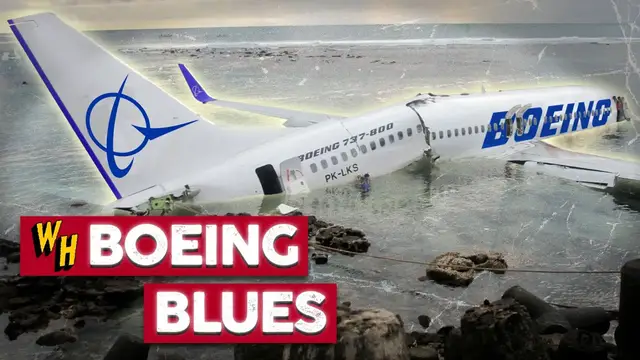
It's no secret that flying can be stressful, but some travel stories sound like nightmares compared to minor inconveniences like long lines and delayed flights. Over the years, multiple airlines have found themselves in hot water for how they treated passengers, especially in the age of social media and viral videos. These incidents include a senior citizen being dragged off a United flight, Delta kicking an entire family off a plane, and Boeing's CEO stepping down after a series of accidents, some of which resulted in human fatalities.
Show More Show Less View Video Transcript
0:00
If you've been paying attention to current events, you've probably noticed there's been a lot of news
0:04
about the world's largest aircraft manufacturer, Boeing. And if you've really been paying attention
0:10
you've noticed that the news is not good. In fact, it may even be criminal. So today
0:17
we're going to take a look at the turbulent history of Boeing. Okay, please remain seated with your seatbelt fastened until the end of the video
0:24
Boeing was founded in 1916 by American lumber tycoon and yachtsman William E. Boeing
0:33
Lumber and yachts, apparently not holding the fascination for him they once did
0:37
he became interested in airplanes after seeing one at an expo in Seattle
0:41
His first two planes were built in partnership with U.S. Navy Lieutenant George Conrad Westervelt
0:47
who was also an engineer. In what must have been a massive bummer
0:51
Westervelt was transferred away before either plane got the chance to fly. Nonetheless, the test must have gone well enough
0:58
Boeing pretty much immediately started up the Pacific Aero Products Company, which would change its name to the Boeing Airplane Company just a year later
1:06
Boeing's first big client was exactly who you probably think it was, the U.S. military
1:11
Thanks to a minor little dust-up called World War I, the old red, white, and blue found itself badly in need of naval training planes
1:19
Sensing an opportunity, Boeing sent them two free samples of his latest model
1:24
and sure enough, they bought 50. It would kick off a long, prosperous relationship
1:29
and Boeing would continue to manufacture military aircraft, such as patrol bombers, throughout the 20s and 30s
1:35
But right after the war, a surplus of planes built for the conflict meant
1:39
no one really needed to buy new ones. Obviously, for people in the airplane business, that was bad
1:45
While their competitors folded, Boeing turned to the manufacturer of alternative products
1:50
including everything from high-powered flat-bottom boats called sea sleds, to bedroom furniture
1:55
They also began selling small planes to far-flung U.S. cities for the purposes of mail delivery
2:00
At the same time, Boeing's founder wanted his company to continue innovating
2:05
To that end, he was open to hearing new ideas from pretty much any of his employees
2:10
Adaptability got them through the lean years, but they were only too happy to start building planes for the emerging commercial airline industry
2:16
again when that market bounced back. In fact, that industry seemed to be the way forward
2:22
So in 1929, Boeing changed its name to the United Aircraft and Transport Corporation
2:27
and bought up a whole bunch of other air travel-related companies. In 1934, that company was broken up for legal reasons, becoming three separate entities
2:37
the Boeing Airplane Company United Aircraft and United Airlines Yes that United Airlines Don worry there not going to be a quiz at the end Okay there is but it multiple choice World War II was a pretty bad time for just about everyone
2:55
unless you happen to be in the business selling airplanes to the Allied military. Once the war kicked into gear, the airplane industry shifted from making commercial planes
3:04
to making military ones. Boeing, for their part, produced three now iconic military aircraft of the
3:10
era, including the B-17 Flying Fortress, the B-29 Super Fortress, and Cadet Trainer Aircraft
3:16
They even have the dubious distinction of being the company that built the plane that dropped the
3:21
atomic bombs on Hiroshima and Nagasaki. After the Axis powers were defeated, Boeing got back
3:26
into producing commercial planes. But thanks to technologies developed for the war, the world
3:31
would soon be entering the era of commercial jets, and Boeing would lead the way in 1958
3:35
with the first successful commercial jet airplane, the 707-120. At the request of Pan Am Airlines, the 707-120 design was then developed into the 707-320
3:46
which was capable of flying non-stop between New York and London, the only two places in the world that had airports back then
3:52
During the 60s, they would also branch out into making things like helicopters
3:56
missiles, and space vehicles for NASA. Though disappointingly, they never made a space helicopter armed with missiles
4:03
That we know of. Despite increasing competition, Boeing would continue to be a leader and innovator in its field for decades to come
4:13
In 1967, for example, they developed the 737 for short-range travel. And in 1969, they developed the famous 747 for people who like to get the jumbo version of everything
4:25
The company was so incredibly successful in its field, one of its chief American competitors, Lockheed, gave up on the commercial airplane business in 1981
4:32
and the other, McDonnell Douglas, merged with Boeing in 1997. Though it still faced heavy
4:38
competition from the consortium of European plane manufacturers known as Airbus, Boeing was about as
4:43
dominant as a company could hope to be. But the other thing to note is that Boeing wasn't just the
4:48
biggest player in its industry. It was also highly respected, enjoying an almost NASA-like reputation
4:53
for quality and safety. It was the kind of reputation that made everyone feel safe flying
4:57
on their planes, which made airlines feel safe buying those planes. However, that trusted
5:03
reputation wouldn't last much longer. On October 29, 2018, Lion Air Flight 610 from
5:14
Tangerang to Indonesia crashed into the Java Sea just 13 minutes after takeoff, killing all 189
5:20
people on board. The crash would be the first major accident and the first loss of the then
5:26
relatively new Boeing 737 MAX An investigation would reveal the crash was caused by a miscalibrated sensor that sent incorrect information to the MCAS or Maneuvering Characteristics Augmentation System
5:39
In response, the MCAS angled the plane down. The pilots attempted to save the plane by steering it
5:45
manually, but the MCAS overrode them and crashed the plane into the sea. Among other factors
5:51
Boeing's design would be partially blamed for the crash in the final report by the National
5:55
Transportation Safety Committee of Indonesia. Boeing and the FAA would issue warnings about
6:00
the MCAS to other flight crews. If that response strikes you as a little too laid-back for a design
6:05
flaw that can crash an airplane, then you're apparently smarter than Boeing and the FAA
6:14
On March 10, 2019, roughly five months after the crash on Lion Air Flight 610
6:20
It happened again. This time, it was Ethiopian Airlines Flight 302. The plane was headed from
6:27
Ethiopia to Kenya when it crashed just six minutes after takeoff. And once again, all 157 people on
6:34
board were lost. An investigation revealed that the plane had met the same fate as Lion Air 610
6:40
Despite attempting to use Boeing's recommended procedure to disable the MCAS, the pilots were
6:45
unable to regain control and the plane locked into a terminal dive. The investigation concluded
6:51
that among other causes, repetitive and uncommanded airplane nose-down inputs from the MCAS
6:56
was the most probable cause of the accident. The FAA took action this time, because fool me once
7:03
and all that. All 737 MAXs worldwide were grounded the day of the crash and would remain so for two
7:09
years while authorities tried to figure out how the heck it was ever approved for passenger service
7:15
After their 737 MAX jets took 346 lives in two crashes, you might assume Boeing would
7:25
go over the airplane's design with a fine-toothed comb, but that's not exactly Boeing's style
7:29
As recently as January 2024, the door plug on an Alaska Airlines Boeing 737 MAX fell
7:37
off during a flight, causing an uncontrolled decompression of the plane, although thankfully
7:42
no one was seriously injured. The incident sparked a massive investigation by the FAA
7:47
who found numerous non-compliance issues with Boeing jets and grounded multiple planes out
7:52
of growing safety concerns. And the FAA weren't the only ones noticing some problems. For example
7:59
Ryanair Airlines conducted a 48-hour inspection of its Boeing jets, and while no major defects
8:04
were found, they found several minor problems that called Boeing's quality control into question
8:09
But the hits kept coming. On March 7th a wheel fell off of a United Airlines Flight 35 taking off from San Francisco Luckily it was able to land without incident as was United Airlines Flight 1118 which had one of its engines spew flames
8:25
while flying from Houston to Fort Myers that same day. And on March 12th, Latim Airlines Flight 800
8:31
suffered an equipment failure that caused the plane to drop 500 feet
8:36
hurling passengers without seatbelts through the air. At least 50 people were injured
8:41
And there's more. On March 15, United Flight 433 lost a fuel panel sometime between takeoff and landing
8:48
And on March 29, United Flight 99 had to be diverted due to engine trouble
8:53
And every single one of these flights was a Boeing airplane. The growing safety concerns over Boeing jets eventually got so loud that Boeing CEO Dave
9:05
Calhoun announced in 2024 he would step down at the end of the year
9:09
Board chairman Larry Kellner also adopted to leave his post, and the issues facing Boeing resulted in $31 billion in losses
9:18
So if the problems were so widespread, why didn't anyone notice? In fact, numerous employees noticed and tried to blow the whistle
9:26
But as it happens, Boeing isn't terribly nice to whistleblowers. Calhoun was recently called before Congress where he admitted
9:33
Boeing routinely retaliated against employees who tried to expose their reckless safety and engineering practices
9:40
Meanwhile, the sudden deaths of two Boeing whistleblowers, John Barnett and Joshua Dean
9:44
occurred within two months of each other in 2024. Despite igniting some internet conspiracy theories, the timing of their deaths was just a staggering coincidence
9:53
and was unrelated to their roles in exposing the company's negligence. While Boeing's indifference to safety standards is shocking, it isn't entirely surprising
10:05
After all, Boeing has been doing shady stuff for a long time
10:09
The company has a long history of hiding safety problems and then failing to fix them even after
10:14
they get caught. For example, in 2006, a study showed that Boeing's Santa Susana Field Laboratory
10:20
in California was left awash in toxic and radioactive waste, a problem Boeing only agreed
10:26
to clean up after the EPA took action against them in 2017. That same year, they paid a $615
10:32
million settlement over their illegal hiring of government officials and improper use of
10:37
proprietary information, but that was just a drop in the bucket compared to the $4.3 billion they
10:43
paid out to settle 84 different charges of misconduct between 1995 and 2021. Boeing has
10:50
also been credibly accused of supplying arms to countries known to commit war crimes and human
10:55
rights violations. So, yeah, they haven't exactly been flying the friendly skies
11:02
even back when their planes still stayed in the air