Up next in 10



For over a century, European men refused to go outside without first donning an enormous wig. At the time, the headpiece was better known as a peruke or periwig, and just like other bizarre fashion trends, the peruke wig has a fascinating history. It turns out that powdered wigs weren't as innocent as they look - there's a surprising secret hidden in peruke history.
Show More Show Less View Video Transcript
0:00
For over a century, European men refused to go outside without first donning an enormous wig
0:07
The headpiece, better known as a peruke or periwig, has a fascinating history, including a surprising secret about their use
0:15
So, today we're going to take a look at the real reasons people wore huge powdered wigs
0:22
Okay, try not to wig out, because this gets a little gross
0:25
Syphilis began to spread in Europe in the 1490s, which might explain why guys like Christopher Columbus were so desperate to get out of there
0:36
Known as the pox, or the French disease, ouch, syphilis was spread by sexual contact
0:42
But because this was before the development of antibiotics, there was no cure, or even any real treatment
0:48
During the late stages of the disease, the afflicted could lose eyes, noses, and hands
0:54
Syphilis also attacked the brain, causing insanity. But the early symptoms were more minor things
0:59
that included open sores and patchy hair loss. Those were minor? Oh my, the olden days were rough
1:06
This last symptom was an especially big problem. Having long hair was an extremely important status
1:11
symbol at the time. So syphilis was more than just an incurable STD
1:16
It was also a social disaster. For these folks, being bald was almost as bad
1:21
as being diseased. English diarist and naval administrator Samuel Pepys perfectly summed up that attitude in a
1:27
diary entry he wrote after learning that his brother had syphilis. If my brother lives
1:32
he will not be able to show his head, which will be a very great shame to me. 16th century Europe
1:38
is apparently no place with the likes of Stanley Tucci. And while Pepys' diary entry does make him
1:42
sound like a terrible brother at the very least, unfortunately, baldness truly was a black eye on
1:48
any man's reputation. Given that, syphilis sufferers weren't in a rush to telegraph their
1:53
condition to the community at large. So Europeans devised a new way to hide the early evidence of
2:00
their venereal diseases, wigs. Long hair was an important status symbol, and rather than show off
2:05
a piebald head, wealthy Europeans turned to wigs to hide the symptoms of syphilis
2:10
The 18th century publication Encyclopédie, largely written by French philosopher Denis Diderot
2:19
had a lot to say about hair. In it, Diderot claimed that long hair was the mark of royal blood
2:25
dating back to the beginnings of France. So Motley Crue were all French kings? Makes sense
2:31
Maybe. I guess. Probably not. Diderot was so into long hair, he argued that the length of one's hair
2:38
determined their social rank. To quote the man himself haircuts were more or less short depending on the degree of inferiority in the ranks In such a way that the monarch head of hair became so to speak the yardstick of social rank
2:54
When wigs rose in popularity during the late 17th century, men struggled to pile as much hair as possible onto their heads
3:01
In fact, some of the most elaborate wigs included full heads of hair from 10 different people
3:06
If they'd seen a Wookiee, they would have lost their minds. Concealing the bald patches and bloody sores of a syphilis infection, which rivaled the Black Plague
3:14
and how quickly it spread across Europe, was one reason why wigs became a popular fashion item
3:19
But it wasn't the only reason. An insecure monarch was also responsible. France's Louis XIV
3:25
became king when he was only five years old, and he started going bald when he was still a teenager
3:31
Like a Kardashian, Louis was obsessed with his reputation, hiring artists to paint his portraits
3:37
sculpt statues in his honor, and create coins commemorating his greatness. But being as bald
3:43
as a newborn Walter White didn't fit with the proper image of the Sun King. So the king hired
3:48
48 wig makers, which sounds like enough. Louis wasn't shy about piling on the hair, and as an
3:54
added bonus, any of the wigs added several inches to the king's height. But even though the wigs
4:00
covered up Louis' baldness, they couldn't hide the rumor that the king had syphilis. Regardless
4:05
of whether that rumor was true, the king's penchant for wigs had a big effect on the market
4:10
Suddenly, everyone was clamoring for wigs to hide their bald heads. Originally made from horse
4:15
goat, or human hair, wigs quickly became expensive accessories, although inexpensive versions made from wool were also available. Wigs became a big business, so big that in 1673
4:27
France created an Independent Wigmakers Guild for master wigmakers. A century later, in 1771
4:33
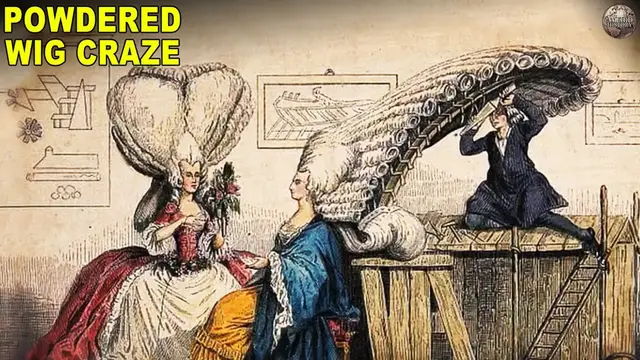
there were nearly 1,000 wig makers in the country. By the latter half of the 18th century, wigs weren't just for men. They were also popular
4:43
for women. However, as is often the case, women's styles weren't the same as men's
4:49
Many aristocratic and royal women had hairdressers style their natural hair with
4:53
hairpieces or hair extensions. Colorful hair powder was also very popular among the ladies
4:58
who used gray, blue, and even violet in their hair. Scented hair powder, carrying an air of lavender or orange
5:05
also helped cover the general musk of the era. Pretty much everyone smelled like old milk back then
5:11
Women's wigs could be extremely heavy, ornamented with jewelry, precious stones, and other adornments
5:17
And just as men did, women would use a peruke to cover up symptoms of syphilis
5:22
Because again, the only real treatment available at the time was to pretend you didn have it starting to understand how it spread through Europe so fast Even though syphilis made wigs popular it would be a mistake to assume that every bewigged person in history was afflicted with an STD In fact they were generally considered a shameful
5:40
necessity. But once kings like Louis XIV and Charles II started wearing wigs, the fashion
5:45
quickly spread to aristocrats and even common people. Wigs could also cover a number of other
5:51
sins. In addition to the hair loss caused by syphilis, wigs could hide open sores or rashes
5:56
on the head, which could occur from several different diseases. Wigs were also quite adept
6:01
at concealing rodent chefs. So basically, no matter what strange affliction was going on atop
6:06
your head, the answer to your troubles was a wig. According to men who wore wigs, like the
6:13
aforementioned Samuel Pepys, one benefit was that the fashion saved time. In 1663
6:20
Peeps was driven to the wig shop by the pains of keeping his hair clean
6:24
which is both lazy and practical. He reports trying on several wigs at his barbers in his diary
6:30
Wig makers and barbers often worked together, because even then commercial synergy was a thing
6:35
But in this case, after trying on two or three wigs, Peeps declared, I have no stomach for it
6:40
In other words, wigs, not for me. The wealthy, for their part, could buy wigs
6:46
and even hire wig makers to clean the headpieces, saving time on styling their hair
6:51
But as wig fashion evolved, cleaning the enormous and costly wigs, which had to be almost architecturally designed with support structures
6:58
became more time-consuming. On top of that, the process of powdering a wig that size
7:03
certainly added to the daily work. Lice have a long history of infesting human hair
7:08
You do have to admire their stick-to-itiveness. In the medieval period, head lice were a major problem
7:14
But the new fashion of wearing wigs actually helped, in a sense
7:18
As wigs became an everyday accessory, people shaved their natural hair in order to get a better fit
7:23
The shaved heads solved the head lice problem, which was good. But soon, the lice infested the wigs instead, which was less good
7:31
Still, it was much easier to delouse a wig rather than pick them off a person's head
7:36
which could be time-consuming and painful and kind of gross. Wig makers specialized in removing lice by tossing dirty wigs into boiling water
7:43
and cooking them like tiny little lobsters. The term big wig is still used today to refer to an important person
7:53
And by this point, it should come as no surprise that the word dates back to the literal height of wig fashion in the late 1600s
8:00
when wig wearers prioritized size over all else. Unless you're wearing a three-foot muppet on your head, you're not really wearing a wig
8:08
Since wigs became required accessories for noblemen during the reigns of Louis XIV of France and Charles II of England the term bigwig came to indicate a powerful and wealthy person As in you could actually judge a person importance by the size of their powdered
8:22
wig. Aristocrats saw the wig as a marker of status. And why wouldn't they? Wigs certainly
8:28
weren't cheap. An everyday wig could cost 25 shillings, which was the equivalent of a week's
8:33
pay for a commoner. And highly elaborate wigs could easily cost upwards of 800 shillings
8:38
Must be a Bjork wig. So, as you can imagine, aristocrats weren't happy when common folk took up the fashion
8:45
like if Walmart started selling affordable Ferraris. In the mid-18th century, the Marquis de Mirabeau reported
8:52
On Sunday, a man came up to me wearing black silk clothes and a well-powdered wig
8:57
and as I fell over myself offering him compliments, he introduced himself as the oldest son of my blacksmith or saddler
9:04
The depressed aristocrat lamented, Everyone has become a monsieur. Everyone has become a monsieur
9:10
Yeah, what's the point of owning something if a poor person can own it too
9:14
But instead of falling out of fashion when wigs spread to the masses, the wealthy simply adopted more and more elaborate styles
9:21
That'll show them. The fashion trend was even duplicated in strange ways by some notable figures
9:26
In his well-known portraits, America's most important founding father sure looks like he's wearing a wig, but he's not
9:33
George Washington actually wore his own hair, styled to look like a wig
9:37
Yeah, he had real hair that he arranged to look like the fake hair that others passed off as real hair
9:43
That is the kind of cunning that wins revolutions. In truth, Washington's hairstyle was considered a common military style at the time
9:51
the 18th century equivalent of a high and tight. Washington's hair was long in the back and curled at the sides, smoothed down with oil to show his forehead
10:00
And to add a distinguished touch, Washington wore his hair powdered. The powder may have been talcum powder, starch, rice powder, chalk, or even plaster of Paris
10:09
Washington's daily routine involved applying a cloud of powder to his naturally reddish-brown hair, turning it white
10:17
The French Revolution wasn't just a disaster for the French upper classes
10:22
It also completely changed fashion trends, driving out the aristocratic imitation of the ancient regime in favor of a more egalitarian look
10:31
Enormous powdered wigs simply didn't fit with the new, simpler trends, and wigs quickly went out of fashion
10:37
And that's the real disaster. Over in England, the fashion for wigs met a decidedly less bloody, but still fairly abrupt ending
10:44
In 1795, William Pitt pushed for a heavy tax on hair powder
10:48
The added fee kiboshed the trend. And by the dawn of the 19th century, short, natural hair was the new craze
10:55
That new style would be cemented roughly until the Beatles popularized the mop top
11:00
But that's another story
#Offbeat
#Online Media