Up next in 10



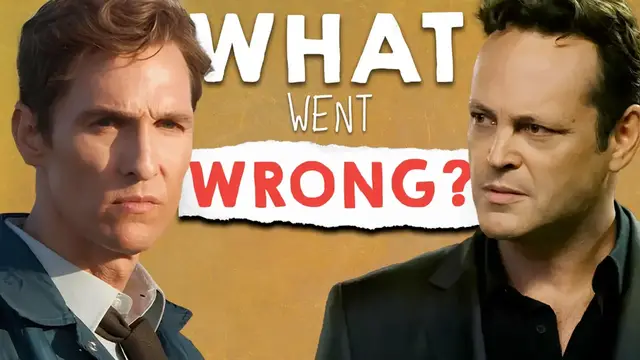
When True Detective Season 1 first aired, it was a game-changer. With Matthew McConaughey and Woody Harrelson delivering career-defining performances, and a haunting mystery that kept audiences hooked, it was lightning in a bottle. But as the series continued into Seasons 2 and 3, the show struggled to recapture that same brilliance.
Show More Show Less View Video Transcript
0:00
Someone once told me time is a flat circle
0:03
Everything we've ever done or will do, we're going to do over and over and over again forever
0:09
If what Cole is saying is true, then we're all going to get to watch season one of True Detective
0:14
over and over and over again. And that's just fine by us
0:18
because it was nothing short of lightning in a bottle. The same, however, cannot be said of the show's second or even third seasons
0:25
which were, to put it kindly, not as good. It's a track record that's caused more than a few fans and critics to quite reasonably wonder
0:32
why is it impossible to make another good season of True Detective? It's my bad, boys
0:38
Maybe we got started on the wrong foot there. True Detective was a crime anthology series that debuted on HBO in January of 2014
0:47
But interest was sky high before the first episode even aired. That's because at a time when it was still pretty rare for major film actors to appear on TV
0:55
producers had managed to assemble a cast worthy of a major theatrical release
1:00
including Matthew McConaughey, Woody Harrelson, and Michelle Monaghan. Set in 2012, the first season follows the story of McConaughey's detective Rustin Rust Cole
1:08
and Harrelson's Martin Marty Hart. The two are Louisiana State Police homicide detectives
1:14
who are reinvestigating the murder of a prostitute, which they had failed to solve 17 years earlier
1:18
Along the way, Hart struggles with his marital infidelity and Cole with his dark past
1:23
The series was subversive, compelling, and full of zeitgeist-worthy twists, making it
1:28
an instant hit with both critics and audiences. Despite having an equally impressive cast that included cinematic stars like Vince Vaughn
1:35
Rachel McAdams, and Cullen Farrell, True Detective Season 2 bombed hard with critics and fans
1:41
Season 3, which starred Mahershala Ali, was better received but still only captured a
1:45
fraction of the first season's acclaim. In all fairness, though, living up to the original is far from an easy task because
1:51
True Detective Season 1 was that rare example of a show that fired on all cylinders. For starters
1:57
the writing was absolutely incredible Created and pinned entirely by author and rookie television scribe Nick Pizzolatto the show grew out of material he had originally developed to be a novel It was only after working the story out that the writer decided
2:09
it had visual elements that made it a better fit for television. The scripts were also full of memorable, quotable dialogue
2:16
especially for Cole, who got to spit out gems like, So death created time to grow the things that it would kill
2:25
Cynical and pessimistic, the character served as a vehicle for the show's religious and existential themes
2:30
and McConaughey's performance is also cited as a highlight of the entire series
2:35
The actor at the time was mostly famous for appearing in romantic comedies
2:38
like The Wedding Planner, How to Lose a Guy in 10 Days, and Failure to Launch
2:42
and was only really beginning to break through as a dramatic star in films like
2:46
Dallas Buyers Club and Interstellar. Offscreen, he was known for his quirky personality
2:50
weird catchphrases, and odd metaphysical beliefs, So the part of Cole seemed tailor-made for him
2:59
Long-time best friends and possibly even half-brothers, McConaughey and Harrelson's real-life relationship
3:04
brought a naturalness to their on-screen interactions that likely couldn't have been achieved with just any two actors
3:10
They knew exactly how to elevate each other's performances, and everything about their dynamic felt real
3:15
You know, you can't just slide into my life creating tensions, judging me
3:20
Boy, I make you tap some, bimbo. Looks like a young Maggie. I make you flaunt that s***
3:24
obviously a great deal of credit for that and for the success of the first season in general
3:29
has to go to director Keri Joji Fukunaga, who helmed every episode. Fukunaga not only knew how
3:35
to get the best out of his actors, but was careful to make sure the show's visual style was always as
3:40
interesting as its story. In the director's own words, in every episode I wanted to at least try
3:44
to find specific moments in which you could treat the visual side of the medium with the same
3:49
importance as we were treating the dialogue. The most famous example of the director's efforts has
3:54
to be a now iconic six minute tracking shot in episode four
3:57
Who Goes There? The scene finds Rust in a particularly brutal shootout
4:01
The unbroken shot, which weaves about the scene following different parts of the action traps the audience in the moment with him maximizing the intensity of the fight Fukunaga visual style was as much a part of True Detective identity and success as Pizzolatto writing and McConaughey and Harrelson performances so it not completely
4:18
surprising that the second season, which lacked all of those things, was a disappointment. One of
4:23
the reasons anthology shows like True Detective are relatively rare is because once a series finds
4:28
a set of characters and situations and audience likes, starting from scratch is always a risk
4:33
But the problems with True Detective Season 2 actually went much deeper
4:37
While Season 1 was allowed as long as it needed to be developed, production on the second season was rushed to meet a predetermined release date
4:44
That meant Pizzolatto had far less time to work out a story. HBO president of programming at the time, Michael Lombardo, would later take the blame, saying
4:52
When we tell somebody to hit an air date as opposed to allowing the writing to find its own natural resting place when it's ready, we failed
4:59
Not helping was that despite an executive producer title, Fukunaga apparently had little to nothing to do with the production of season two
5:06
After creatively clashing with Pizzolatto on the first season, Fukunaga, who was never slated to return as director due to the anthology nature of the show
5:14
was essentially shut out of the creative process. The director would later explain
5:18
my involvement in the second season was as much or as little as they needed me
5:22
and turns out they didn't need me. Instead of being replaced by another auteur feature director in season two
5:27
as was originally planned, Fukunaga was replaced by several directors. that left Pizzolatto as the sole driving creative force of True Detective
5:35
But while Pizzolatto is no doubt talented, more than a few insiders and critics have suggested
5:39
that his partnership with Fukunaga tempered some of the writers' less useful creative instincts
5:44
And the success of season one was the result of the unique push and pull of their clashing sensibilities
5:49
After the failure of season two, HBO would insist that Pizzolatto work with a counterpart
5:54
who could bring some creative balance back to the show. And that person turned out to be Deadwood creator and showrunner David Milch
6:00
They also allowed it more development time, and the third season wouldn't drop for almost four years
6:05
after the second. While some critics complain season three lacks some of the original season intriguing strangeness it was generally considered a return to form for the show Audiences however weren tuning in and the season averaged just over 1 million viewers
6:18
per episode, which was less than half as many as either of the previous seasons
6:22
It's possible that a great deal of the first season's appeal was how new and surprising it all was
6:27
It's also possible that fans just fell in love with Rust and Marty, the vibe of the first case
6:32
and were just never going to be as excited about anything else, short of, possibly
6:36
a direct sequel with the same characters and creative team. I keep things even, separate
6:43
right the way I can have just one beer without needing 20. Or as some commentators have suggested
6:48
it's possible that a lot of what was so memorable about season one was actually plagiarized
6:53
from other writers. For example, Pizzolatto has been accused of stealing some of Cole's best lines
6:57
from the work of horror writer Thomas Ligotti, whose influence on Cole's worldview
7:01
Pizzolatto has explicitly acknowledged. Others have pointed out that the first season's story
7:06
structure, and themes seem to borrow elements from Alan Moore and Eddie Campbell's seminal comic book series From Hell. Pizzolatto
7:12
is on the record as being a fan of Moore, and the final conversation between Cole and Hart
7:17
seems to be a direct reference to a scene from an issue of yet another Moore-pinned comic series
7:22
called Top Ten. It's just one story. The oldest. Light versus dark. In all fairness to Pizzolatto
7:33
many of the claimed similarities are easily dismissed as influence. Whether he's capable
7:37
of delivering another season one quality installment of True Detective without standing on the shoulders
7:42
of giants like Ligotti and more remains an open question. Whatever the answer is
7:46
it is unlikely to affect the future of the franchise. That's because the show's fourth season
7:51
True Detective, Night Country, is not the creative brainchild of Pizzolatto. The season will instead be headed by producers
7:57
Issa Lopez and Barry Jenkins. Pizzolatto remains credited as an executive producer on the series
8:02
but right now it's unclear how much creative involvement, if any, he had
8:07
Maybe the new team will get it right, or maybe Rust was right. Time is a flat circle, and we're just doomed to get disappointing season after disappointing
8:15
season of True Detective for the rest of eternity
#Movies
#Drama Films