Up next in 10



We all know that historical movies can be inaccurate. Sometimes, they get historical figures completely wrong – for example, Pocahontas was a child when she met John Smith, and so was Isabella of France when William Wallace was alive. Still, most historical movies don’t make executions less gory as was the case with William Wallace's execution in Braveheart, and they don’t make real historical figures less intense. But Braveheart is guilty of both.
Show More Show Less View Video Transcript
0:00
We all know that historical movies can be inaccurate
0:03
At least, we hope you know that. But 1995's Academy Award-winning Braveheart set a bold new standard for telling tall tales
0:12
For example, the film's hero is the Scottish knight William Wallace, who is ostensibly the titular Braveheart
0:19
But in reality, the nickname Braveheart belonged to a completely different man
0:24
So? So today we're going to take a look at Robert the Bruce, the true hero called Braveheart
0:30
Okay, they may take our lives, but they will never take our weird history
0:39
One of the biggest problems with the movie Braveheart is its title
0:43
It's a great title, but William Wallace, the main character played by Mel Gibson, was not actually called Braveheart
0:50
Historically speaking, the nickname has always referred to Robert the Bruce. You remember this guy with the creepy dad
0:58
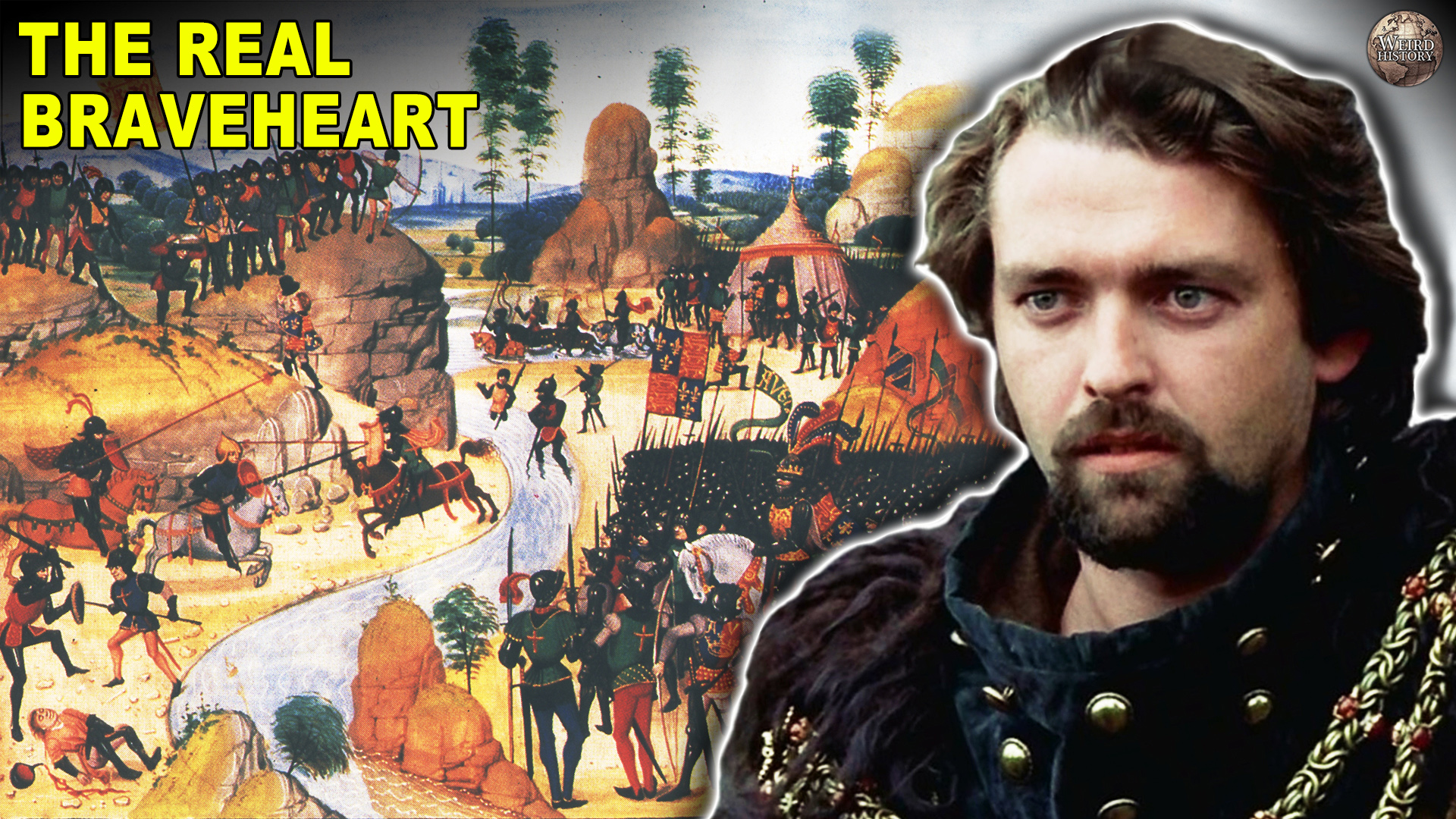
Portrayed by Scottish actor Angus McFadgen, the film's version of Bruce betrays Wallace to his English enemies
1:05
But in real life, Robert and William Wallace were allies who openly fought together
1:11
Heck, they probably partied together. And Robert the Bruce, the real Braveheart, was much tougher, craftier, and crazier than he was shown to be in the movie
1:21
Robert was born on July 11, 1274, into a noble family in Scotland
1:26
As a young man, Robert watched England's King Edward I invade Scotland and seize control
1:32
And long after William Wallace was gruesomely executed by the English, Robert the Bruce kept fighting for freedom
1:38
He would go down in history as the heroic Scottish king who successfully gained independence from the English
1:44
But it wasn't easy. The movie got that part right. If you watched Braveheart for the History, and we highly recommend that you do not do that
1:56
you might come away thinking that Robert the Bruce stabbed William Wallace in the back
2:01
betraying him in the heat of combat at the Battle of Falkirk. It never happened, though
2:07
In real life, Robert the Bruce wasn't even at the Battle of Falkirk. Guess he had errands that day
2:12
And it is unlikely that Robert the Bruce would have ever betrayed Wallace. They were besties, kinda
2:18
He supported Wallace publicly, and he even used tactics he learned from Wallace in his
2:23
fights against the English. But in fairness to Hollywood, two guys getting along doesn't make the most thrilling movie
2:30
After William Wallace was defeated by the English, Robert the Bruce was at risk of losing
2:34
all his lands, because your lands are the first thing to go when your uprising fails
2:39
generally followed by your head. Fortunately, Bruce lost neither. And in 1298, he became a guardian of Scotland
2:48
along with a guy named John Common They managed to work together for a couple of years but the two later became rivals for the Scottish throne Turns out thrones are even harder to share than a tonka truck During this period Robert the Bruce often worked for the King of England
3:03
which must have been awkward since Robert had openly supported William Wallace's fight for
3:07
independence. Later, historians claimed this was evidence of Robert's shifting allegiances and general untrustworthiness. But the Scottish nobility was often forced to side with whomever
3:19
held the power, and Robert had to be practical to preserve his family's lands. But when Bruce saw
3:24
an opening for power, he seized it. He proclaimed himself King of Scotland in 1306, the year after
3:30
Wallace was executed by the English. In 1306, Robert the Bruce took on his greatest political
3:40
rival, Bruce the Robert. Just kidding. It was the aforementioned John Common. Bruce and Common had
3:48
been the Guardians of Scotland together from 1298 to 1300. But after that, the two had a falling out
3:54
Bruce ended up serving King Edward, the bad guy from Braveheart, while Common led the king's enemies
4:00
In 1306, the two men met at the Greyfriars' church, and not to shake hands
4:07
According to an account by chronicler Walter of Gisborough, the meeting was intended to discuss
4:12
certain matters touching both of them. But the conversation did not go so well
4:18
Bruce loudly accused Common of treachery, then drew his sword and stabbed him
4:22
Bruce then fled the church while his followers brawled with Common's men
4:27
Based on Bruce's next actions, it's likely that Bruce had planned on whacking Common from the beginning
4:33
He arrested Edward's justices and then sent his men back to Greyfriars to make sure Common was dead
4:39
That basically ended his working relationship with King Edward of England. About six weeks after he killed Common, around March 25, 1306, Robert crowned himself King of
4:53
Scotland at Scun, which was an abbey. Several bishops were in attendance, along with a number
4:59
of important earls. But the ceremony was somewhat makeshift, and most Scottish nobles stayed away
5:05
unwilling to publicly side with a usurper who might be soon defeated. Hey, you gotta hedge your
5:11
bets. Naturally, King Edward of England was enraged at Robert's disloyalty. He began to form an army
5:18
to march on Scotland immediately. Within six months, many of Robert's supporters and family
5:24
members were either captured or in the ground. After crowning himself King of Scotland, Robert
5:30
the Bruce raised an army to face Edward at the Battle of Mevan. Unfortunately for the Scots
5:35
Robert's army was defeated. He was forced to flee, becoming an outlaw in the process
5:41
Whether he meant to or not he sort of left his family to take the heat in his place Robert wife and daughters were captured by the English and three of his brothers were eliminated Robert sister Mary Bruce was even imprisoned in an iron cage
5:56
and hung from the walls of Roxburgh Castle. Meanwhile, Robert spent the winter hiding out on an island
6:02
off the coast of Ireland in a cave. All in all, it was probably not the year he'd had in mind
6:08
when he made himself king. According to one legend, while Robert was hiding out in that Irish cave
6:17
he spotted a spider on a beam above his head. That spider bit him, and he became Braveheart
6:24
Oh, wait, no. Robert watched the spider repeatedly try and fail to make a small jump
6:30
The small creature was trying to swing itself to another beam. Robert counted six times that the spider failed
6:37
Then he thought to himself, six times have I fought against the English and failed
6:42
But the seventh time, the spider finally reached the beam and stretched the first line of its web
6:48
Robert the Bruce took that as a sign, leaving the cave behind a fight against the English
6:53
It took another eight years before he was able to drive them out of Scotland at the Battle of Bannockburn in 1314
7:01
Huh, eight years. That's the same number of legs that a spider has
7:05
Obviously, the spider story is likely not true. Historians have pointed out that the tale first appears in a book written about 500 years after Robert died
7:16
Also, similar stories have been told about the Jewish King David, the Polish King Władysław I, and the Mongolian warlord Tamerlane
7:25
So it's sort of a historic urban legend. Scotland's greatest military victory came in 1314 with the Battle of Bannockburn
7:38
On one side, Robert the Bruce led an army of around 6,000 infantrymen and a small group of
7:44
cavalry. On the other side, Edward II amassed the largest army to ever invade Scotland
7:50
calling up 2,000 mounted knights and 25,000 infantrymen. That's a pretty big rumble
7:56
The odds were daunting, but King Robert started the battle off with a bang, technically a chop
8:03
The English knight, Sir Henry de Bohen, spotted Robert and charged, hoping to capture or eliminate him
8:10
But Bruce hopped onto a horse and dodged the lance, bringing his battle axe down onto Bohen's helmet and chopping the man in two
8:18
That is a hell of a way to start a fight. They probably should have kept that in the movie
8:21
King Robert's army went on to rout the English on the first day of the Battle of Bannockburn
8:27
which isn't a huge surprise. Watching a guy get cut in half really
8:31
takes a lot of the fight out of you. Before the second day, King Robert made a speech encouraging
8:36
the Scots to victory. Chronicler Walter Bauer wrote at these words the hammered horns resounded and the standards of war were spread out in the golden dawn The Scottish army cornered the English and Bruce led the onslaught that finally broke his enemies
8:52
By defeating a massive English army led by King Edward II, Robert was able to solidify his position as the King of Scotland and proclaim Scotland's independence
9:02
Robert the Bruce didn't just win Bannockburn for Scotland. He also won it so that he could get his family back, like Liam Neeson had taken
9:14
His wife, daughter, and sisters were still being held captive by the English
9:19
But fully years after they had been seized in 1306, at Bannockburn, the Scots had taken so many English nobles prisoner that King Robert could trade them back for his family
9:30
Robert's daughter, Marjorie, had been confined to an English convent from before the time she turned 10 years old
9:37
After her father's victory, Marjorie returned to Scotland, where her father arranged a marriage with a powerful Scottish lord
9:44
Sadly, Marjorie suffered a fatal fall from her horse only two years later, at the age of 19
9:49
Talk about some bad breaks. When Robert the Bruce wasn't claiming independence for Scotland
9:58
Or rescuing his daughter from the English He was busy building castles
10:02
Or at least one important castle Loch Dune Castle Which was constructed in the late 1200s
10:08
It had an 11-sided stone curtain wall And King Robert's brother-in-law fled to the new castle in 1306
10:16
After the English won the Battle of Mevan Suppose you gotta stash your brother-in-law somewhere
10:21
The castle, originally built on an island in Loch Dune, was moved stone by stone in 1935 to preserve it, making it Britain's only transplanted castle
10:35
Bruce definitely made his mark on history, but he didn't get to do everything he wanted
10:40
According to a 14th century Scottish chronicler named John Barber, Robert the Bruce always regretted that he never went on a crusade
10:48
Hmm, most people's regrets are a little less theatrical, like I regret not going ziplining
10:53
that one time. On his deathbed in 1329, Robert asked one of his knights to take his heart on a crusade
11:00
so that it could fight against God's enemies. The knight, Sir James Douglas, carried Robert's heart in a silver case, riding to Spain where
11:08
the war raged against the Moors. Douglas ultimately wound up getting smoked in a surprise attack
11:14
But before riding into battle, he reportedly threw the urn containing Robert the Bruce's heart at the opposing force
11:20
shouting, lead on, Braveheart. I'll follow thee. This is how Bruce got the posthumous nickname Braveheart
11:28
The heart was returned to Scotland after the battle, where it was later interred at Melrose Abbey in Scotland
11:33
That is pretty hardcore, which is appropriate. He did cut a guy in half