Up next in 10



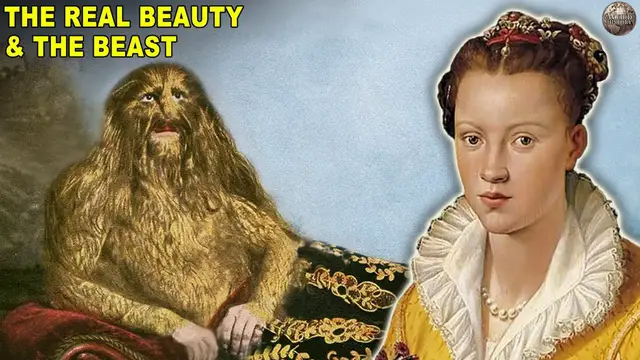
It’s a tale as old as time – or, at least as old as the 1500s. But the real couple that inspired Beauty and the Beast lived a tragic life. The real life Beauty and the Beast were Catherine and Petrus Gonsalvus, and they were treated like freaks of nature by Europe’s kings and queens. Although the tale of Petrus and Catherine Gonsalvus isn't the single inspiration of the tale – it has much deeper folkloric roots than that – its optics match those of the fictional couple.
Show More Show Less View Video Transcript
0:00
Beauty and the Beast is a tale as old as time
0:03
with deep folkloric roots. But the famous version may have been inspired
0:07
by the lives of Catherine and Petrus Gonsalvus. In the 1500s, they were treated like freaks of nature
0:13
by European royalty. And their tragic story did not have a fairy tale ending
0:19
So today, we're going to take a look at how the real couple that inspired Beauty and the Beast
0:24
led remarkably tragic lives. In the Disney version of Beauty and the Beast, Belle is an intelligent, strong-willed beauty who falls for a man who has been cursed to look like a beast
0:39
In spite of the curse, the Beast has caring eyes, a heart of gold, and the singing voice of Robbie Benson
0:46
He also has a fierce devotion to Belle, and in between all the singing with dishes, twirling through candlelit ballrooms, and impromptu snowball fights, the couple falls deeply in love
0:57
Disney's Beauty and the Beast earn a fairy tale ending when their love breaks the curse
1:02
and the two live happily ever after in a castle, something that holds true in both the 1991 animated movie and the 2017 live-action remake
1:10
But the real couple that inspired the story did not get a fairy tale ending
1:14
and there was no curse to break. The Beast had to live with his condition for his entire life
1:19
The real Beast, who not surprisingly didn't like to be called a Beast
1:23
was a man known through most of his life as Petrus Gonsalvus
1:28
He was born in 1537 in the Canary Islands, and he had a hereditary condition that made him appear hairy
1:34
Given that most people of the time were somewhat less than enlightened, instead of being treated like a person, Petrus was dismissed as a wild man
1:43
Stories of wild men had flourished for centuries. They were seen as more animal than human
1:48
barbarians that lived on the edges of civilization. and unfortunately, everyone assumed that young Petrus was somehow not fully human because of
1:56
his condition. When he was only 10 years old, Petrus was cruelly locked into an iron cage
2:01
where he was given raw meat and animal feed. In 1547, young Petrus was shipped off to France
2:07
as a gift to King Henry II of France for his coronation
2:11
If Yelp had existed in the 16th century, we're going to guess that Petrus would have given his
2:20
trip to France no stars because as soon as he arrived he was immediately locked in a dungeon for observation as if he were a wild animal The court doctors and academics then poked and prodded him for a while and eventually concluded that he was not a wild man but rather he was a 10 boy with soft
2:38
thick hair growing on his face and limbs. Petrus even told them his name, which the French transformed from Pedro Gonzales to
2:44
Petrus Consarvus. King Henry declared that Petrus should receive an education. Nonetheless, he still thought of Petrus as a savage who was incapable of learning
2:54
So the king did not expect Petrus to succeed. Young Petrus, however, shocked the court by becoming fluent in Latin and learning noble etiquette
3:03
After disproving the stereotypes about beasts, Petrus became an important court guest
3:08
Once Petrus proved himself in even greater curiosity, a savage who could be educated
3:13
he became an important figure in King Henry's court. Along with his noble education in at least three languages, Petrus was allowed to dress
3:20
like a nobleman and eat cooked food. The king even reportedly took a liking to Petrus, which was considered a great honor in the 16th century
3:29
Along with his rise in social status, Petrus' living conditions improved, and he was no longer locked in a cage or stashed away in a dungeon
3:37
Yet he was still seen as less than human. A freak of nature meant to dazzle visitors to the court
3:42
Just as dwarfs were kept at royal courts for entertainment, Petrus was treated like a human pet
3:47
Artist Agostino Caracci even painted a portrait of three of the members of King Henry's court
3:53
where Petrus was shown naked, wearing only a small fur as a symbol of his status as a wild man
3:59
The portrait was titled Hairy Hairy, Mad Peter, and Tiny Amon. Petrus was the first recorded person to suffer from hypertrachosis
4:11
a condition that caused excessive hair growth on the body. Hypertrachosis is extremely rare
4:16
So rare, in fact, there are only about 50 known cases in history
4:22
Dermatologist Sarah K. Taylor reports that since the Middle Ages, approximately 50 individuals
4:27
with congenital hypertochosis have been described. And according to the most recent estimates, approximately 34 cases are documented adequately
4:36
and definitively in the literature. But the French court didn't care about the uniqueness of Petrus's medical condition
4:42
They just wanted to marvel at the savage who dressed like a nobleman
4:46
There is no wicked queen in the Disney version of Beauty and the Beast, but there sure was
4:51
one in the real-life version, and it was Catherine de' Medici. After King Henry death Catherine who was his wife and mother to his heir became the Queen Regent of France She had a reputation for devious actions like when she invited her religious rivals to Paris for an arranged marriage and then ordered thousands of people
5:09
slaughtered in the streets. Queen Catherine thought it would be hilarious to arrange a marriage for Petrus
5:16
but she decided not to tell his future bride about his condition
5:20
Queen Catherine found her beauty in a young maiden who was also named Catherine
5:24
She was the daughter of a royal court servant, and the queen couldn't wait to see what kind of children the beauty might produce with the beast
5:30
Would they be covered in hair like their father? Queen Catherine hoped to manufacture her own
5:35
royal pets from the unconventional arranged marriage. When Queen Catherine announced to maiden Catherine that she would soon wed
5:48
there was no way to reject the queen's arranged marriage. Just as royalty were often married off
5:53
without their say, kings and queens could dictate the marriages of their court followers. Of course
5:58
Queen Catherine had a surprise for the unsuspecting bride. Her husband was covered in hair. Catherine's
6:04
reaction to her husband's appearance was not recorded, but rumors swirled that the beauty
6:08
was initially unhappy with the union. Certainly, finding a wild man at the end of the aisle must
6:14
have been quite shocking for a young Catherine. But like in the fairy tale, beauty eventually came
6:19
to see past the beast's rough exterior, and over time, she came to care for Petrus. The two were
6:25
married for 40 years. Within a handful of years after their wedding, Catherine and Petrus had two
6:35
children, neither of whom were born with their father's condition. Queen Catherine must have been
6:40
disappointed that her experiment didn't work. But then the next two children were born covered in
6:45
hair, proving to Europe's nobility that beauty did not necessarily always conquer the beast
6:50
Catherine and Petrus had seven children total, and four of them were born with their father's
6:55
condition. Europe's royal courts went crazy for the Gonçalves family, and the family spent much
7:00
of their time touring around Europe so that nobles could gawk at them. Catherine, Petrus
7:05
and their children were sent on tour to entertain Europe's royalty. Across Europe
7:09
people marveled at the Wild family, and naturalists studied the children. In the 1580s
7:15
the Consalvus family had their portraits painted at a number of courts
7:18
In the paintings, the wild children were always shown in noble dress, as if to highlight
7:23
the gap between their savage appearance and their civilized status. In the 1590s the famous naturalist Ulisse Aldrovandi examined the eight daughter of Petrus and Catherine and commissioned a drawing of the family Multiple authors published their descriptions
7:38
of the curiosities as if the children were not human beings. The family eventually settled in Parma, Italy, where Duke Ranuccio Farnese employed them
7:51
But the Consalvus family was still treated like property, and there was no way for them to lead
7:56
a normal life. Instead, their condition was exploited by aristocrats who still just wanted to gawk at
8:02
freaks of nature. In a tragic turn of events, the duke sent away the four Harry Gonsalvo's children as gifts
8:09
to his noble friends. Just like Petrus, they were seen as pets rather than people
8:14
There were no paintings made of the Gonsalvo's children who were born without Petrus's condition
8:19
Artist Joris Hufnagel's portrait of Catherine and Petrus, painted sometime between 1575 and
8:25
1580 hints at the mystery of their true relationship. Although they were married for 40 years and produced seven children, were they truly in love
8:33
Their marriage was arranged as a joke for a European royalty, and their children were
8:38
snatched away to act as court pets. Their story is so bleak that it's difficult to imagine how it became the basis of the
8:45
fairy tale Beauty and the Beast. But what about the relationship between Catherine and Petrus
8:50
The portrait shows Catherine's hand on Petrus' shoulder. Does that indicate warmth between the pair
8:55
Or does the steady, far-off look shown on her face hint at something more tragic
9:00
We may never know. The real-life Beauty and the Beast were trapped in Europe's royal courts
9:11
where they lived with aristocrats and wore beautiful clothes but had no control over their lives
9:16
In his biography of Petrus, Robert Zapierry described the couple as neither captured nor free, and sadly, the same fate struck their children. While the fairy tale
9:26
version ends with Beauty and the Beast happily wed, in real life, no one knows what exactly
9:31
happened to Catherine and Petrus. After being shuffled from one court to another, they eventually
9:36
settled in the small village of Capodumonte in Italy. Catherine died in 1623, according to the
9:43
town's registrar of death, but there is no record of Petrus' death, perhaps because only people who
9:49
received last rites were recorded in the registrar. It is possible that Petrus was not considered human enough
9:55
to receive last rites. Even at death, Petrus may have still been seen as a curiosity rather than a man
10:01
You can probably see why Disney changed that ending