Up next in 10



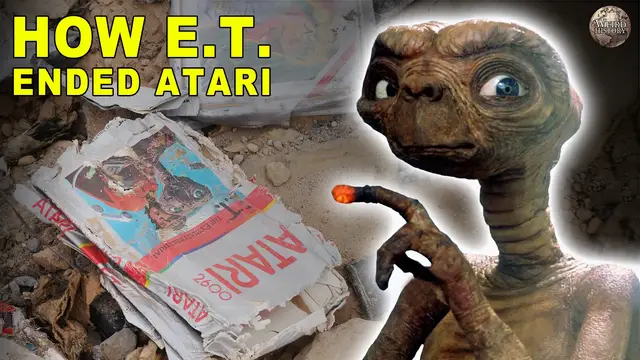
Perhaps you've heard stories of the mythical Atari landfill in New Mexico full of unsold E.T. the Extra-Terrestrial games. Well, there's actually nothing mythical about it: the E.T. game landfill is very much real. In fact, it's not just the universally panned game based on the beloved Spielberg film that's hidden beneath the earth in Alamogordo, NM. Atari dumped a number of their garbage games in this infamous spot, and they tried to cover it up - literally.
Show More Show Less View Video Transcript
0:00
E.T. is a classic 80s film and is often heralded as one of the best family adventure films ever
0:06
E.T. won awards, launched superstar careers, and generated mountains and mountains of merchandise
0:12
One of these licensed products, however, is notorious for being the worst video game of all time
0:21
Today, we're talking about how the E.T. video game bankrupted Atari and ended up in a landfill in New Mexico
0:30
Atari Inc. was an American video game company. It radically redefined what the United States thought of video games in the 1970s and 80s
0:39
Atari was founded by Nolan Bushnell and Ted Dabney in 1972, and its importance in the history of gaming cannot be overstated
0:48
The company birthed the video game arcade cabinet and the modern video game industry as we know it
0:53
Atari initially began its life as a video game company called Syzygy. If you're unfamiliar with that word, it means a pair of connected or corresponding things
1:01
In this case, it was a reference to the two founders' connection. Both Bushnell and Dabney had been working with a manufacturing company named Nutting Associates
1:09
to pioneer a standalone computer and screen inside a cabinet that would be linked to a
1:13
coin slot that would allow a player to go on an adventure for 25 cents a try
1:18
Ultimately, they reached an impasse with Nutting Associates and partnered with Ballet Manufacturing
1:23
to produce video game cabinets and pinball games. Bushnell and Dabney's partnership proved to be successful
1:29
and they continued to produce games and products for Bally. In fact, they offered Bally their next product
1:34
a video game named Pong. Bally, however, was not interested. And so Bushnell and Dabney built their own Pong machine
1:41
and set it up in a local Walgreens to see if it would attract an audience. And boy, did it ever
1:48
Pong was so successful, they put cabinets in a variety of local bars and restaurants
1:52
Each machine was earning about $400 a week. In 1972, the duo incorporated Atari Inc
1:59
Bushnell had thought long and hard about the name of their new company. All of the names he was considering were derived from the game Go
2:05
Atari is the positioning of stones when they're in the most danger of being captured
2:10
Think of it as the game's version of the last stand, but when things are the most dangerous
2:14
By 1973, Nolan had hatched a plan for how to divide and conquer the gaming world
2:20
As video games started to slowly gain prominence, pinball cabinets were everywhere
2:24
having been an institution for decades. The issue with them though was that pinball distributors were very proprietary and wanted exclusive rights to games when Atari pitched them So how did Bushnell get around this issue Well Bushnell started a side company with his next neighbor Joe Keenan titled Key Games
2:42
Atari would sell a pinball game. Then they'd change the name, and Joe Keenan would go and sell it to another pinball distributor
2:49
Basically, they were making twice the money for their efforts. This was the catalyst to allow Joe Keenan to become promoted to Atari president
3:00
Steven Spielberg, as we all know, is arguably the most successful commercial film director of all
3:05
time. After rising through the ranks of New Hollywood, he crafted one of the most successful
3:10
films ever, E.T., The Extraterrestrial. In today's world, it's somewhat difficult to comprehend just
3:16
how looked down upon genre filmmaking was in the 60s and 70s. Much of that changed thanks to
3:22
Spielberg. He took ideas like aliens and abnormally sized animals and evolved them from schlocky
3:28
exploitation stories into emotionally resonant human tales that captured a generation's heart
3:33
His film, E.T., is widely credited with normalizing science fiction for an entire generation
3:39
It took the ideas of alien invaders and space travel and flipped it on its head
3:43
Spielberg created a cinematic world where the alien wasn't your enemy, but your long-lost best friend. And with that emotional intimacy came
3:51
merchandising, which is how we'll eventually get E.T., the extraterrestrial, the video game
3:58
Atari released an individual home gaming console in 1977
4:08
It was dubbed the Atari VCS initially. Later, it would be renamed to the Atari 2600
4:14
The 2600 was originally priced at $199 and shipped with two joysticks and the game Combat
4:21
Atari initially sold around 375,000 units. 1978 didn't go quite as well
4:28
Atari, anticipating a massive uptick in sales, manufactured 800,000 units. However, people weren't flocking to the gaming system
4:36
And by the end of 1978, there were only 550,000 units sold
4:41
Up until this point, all the games being produced for the Atari gaming system had been programmed and created in-house
4:47
In an effort to try and mix things up, they decided to branch out and bring in third-party developers
4:52
the gaming industry was still basically controlled by Atari at this point even though there were new
4:57
competitors popping up here and there in fact Activision who made legendary games such as
5:02
Kaboom and Pitfall was one of the third developers they contracted with to produce games Activision was founded by four ex employees That how quickly the market was expanding Atari started snapping up licenses to popular arcade games and porting them over to the 2600
5:19
Pac-Man, which was developed by Namco, sold close to $10 million worth of cartridges
5:25
Atari found their blueprint. Find licenses that people were familiar with, make them into games, and then sit back and
5:32
let the cash roll in. Heading into the 1982 holiday season, Atari gained a license that they thought was going to be their golden goose
5:42
E.T., the extraterrestrial. Howard Scott Warshaw was selected to program the game
5:49
and he was the closest thing Atari had to a sure thing. After graduating from Tulane University
5:59
Warshaw was hired by Hewlett Packard, where he worked as a multi-terminal systems engineer
6:04
However, in 1981, he was hired by Atari to work as a game designer and programmer
6:09
Warshaw's first big success at Atari was the game Yars Revenge. Originally, it was intended to be a refit of the arcade game Star Castle
6:17
but Warshaw turned it into something entirely more unique. The game became a story about mutated houseflies fighting alien invaders
6:25
From there, he was chosen to adapt the iconic Spielberg movie Raiders of the Lost Ark into a video game
6:31
That game was a massive success. In fact, Raiders was the first video game based on a movie
6:37
Howard was on fire. He was the best designer at the best video game company
6:42
E.T., the extraterrestrial, should have been a no-brainer. The task that Atari had handed to Warshaw was nothing less than Herculean
6:54
This wasn't a project that would be served to him on a silver platter. E.T. was a delicate high-wire act
7:00
The film was a massive success, and the game's deadline was just shy of Inhuman
7:05
E.T. the game needed to be programmed in six weeks to fulfill its holiday release deadline
7:10
A cash-strapped Atari also really needed this game to be a hit
7:15
Bad. I mean, really bad. In the game, you play as E.T. as he attempts to navigate various fields that are riddled with sunken potholes
7:23
The player has to attempt to not fall into the holes. If they do, well, then they have to use E.T.'s alien abilities to attempt and fly out of them
7:31
That's pretty much the game. Believe it or not, Warshot did the impossible
7:35
He made it happen. The game met its deadline and was released for the holiday season rush But his efforts were all in vain The game was critically lambasted No one liked it Most everyone found it exceedingly difficult to play pointless with no story and it was too
7:51
loosely connected to the film. The game became the biggest commercial failure in video game history
7:57
Since then, E.T. has been christened the worst game of all time. To add insult to injury, it didn't
8:03
help that in 1983, the video game market crashed. In Japan, it was informally referred to as
8:09
the Atari Shock. In short, it was a large-scale recession that set in across the video game world
8:15
The Atari Shock lasted from 1983 to 1985. Factors contributing to the crash were market saturation
8:23
the number of gaming consoles, and the waning interest in consoles versus the renewed interest
8:28
in personal computers. This wave of contracting business, coupled with the major defeat that was
8:33
E.T. decimated Atari, and the company was put up for sale. A legend began to swirl through the back
8:40
alleys of the gaming world that said, in September of that year, Atari supposedly took 14 truckloads
8:46
of cartridges out to the New Mexico desert and dumped them into a landfill. This tale has
8:52
persisted as an urban legend among the gaming community for decades. Eventually, Atari was sold
8:57
to Commodore founder Jack Tramiel. It limped along for a little while and then was officially shut
9:02
down. So the question is, was it real? Did Atari truck literal tons of ETs out to the desert
9:13
In 2014, X-Men 2 and Hulk screenwriter Zach Penn set out to answer this question definitively
9:19
He produced and directed a documentary titled Atari Game Over, about his quest to get to the
9:25
bottom of what was in that New Mexico landfill. The film was first announced on December 19th
9:31
2013. Penn and his team worked on it for years. They tracked down all the original Atari employees
9:37
including the creatives, and conducted many, many, many fan interviews. Everyone had a different
9:43
answer. Even the official records were spotty. Nobody could say what really happened. Eventually
9:49
Zach Penn arranged to excavate the landfill to see if there were actual ET cartridges at the bottom
9:54
A group traveled out to the El Magordo, New Mexico landfill on April 26, 2014
10:00
Celebrities were even in attendance. Ernest Cline, author of Ready Player One
10:04
Nolan Bushnell, Howard Scott Warshaw, and legions of fans. The dig lasted roughly three hours
10:11
But at the end of it, they did indeed find the E.T. cartridges at the bottom of the landfill
#Entertainment Industry
#Movies
#Computer & Video Games
#Sandbox Games
#Strategy Games
#Video Game Emulation