Up next in 10



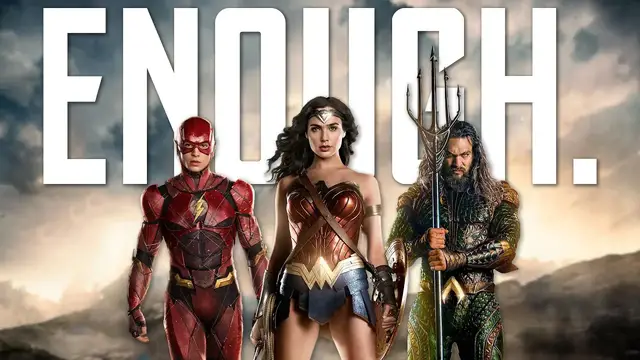
Much like DC Comics, the DC Extended Universe has started going down a road causing many die hard fans to suffer from Crossover Fatigue. Every few years DC Comics puts out another Crisis Book seemingly to clean up the timelines they have created over the last decade. When this happens over and over again, fans of DC Comics start to notice the stories becoming old and tired. Can the DCEU prevent this from happening? Or has it already started?
Show More Show Less View Video Transcript
0:00
Over at the duration of the DC cinematic extended universe's existence, it's had some relative ups
0:08
Hey, what's up? I'm a superhero. Yeah, his name is Captain Sparkle Fingers
0:13
No, it's not. No, it's not. It's not my name. Hey, we should hang out. We're like the same age
0:17
And some very serious downs. You're letting him kill Martha. But it's really hard not to acknowledge that the bad far outweighs the good
0:32
Now, behind the scenes, it's practically always been a quagmire. Sure, they've had some good films, or relatively good films, like Wonder Woman or Suicide Squad or Shazam
0:43
But when juxtaposed against the consistency and ubiquity of the quality coming from Marvel, it really isn't much of a comparison
0:50
And DC has continued to attempt to establish this precedent of bigger and bigger projects
0:56
stories so big they would be too extravagant to ignore. Only problem being, this isn't a good way to produce interlocking or interconnected feature films
1:06
It's how you instill event fatigue into your audience, which is the last thing you want when you're attempting to build any kind of cinematic universe
1:17
As most people watching this video are probably aware, the DCEU began in 2012 with Zack Snyder's Man of Steel as a response to the mammoth success that was the quickly burgeoning Marvel Cinematic Universe
1:28
For the majority of its existence, the DCEU has relied on brand recognition over, well, quality, which is something that the always-go-bigger mindset is perfectly in line with
1:39
And this is the DCEU's fundamental flaw. And part of this is, well, kind of avoiding character exploration altogether
1:48
Batman vs. Superman, Dawn of Justice, the theatrical cut of Justice League, the Snyder Cut, and the upcoming Flash movie are all the cinematic equivalents to crossover or event comics, which make that aforementioned thing very difficult
2:01
And when you're just building a superhero universe, when you're at the front of it, you need to be careful how many times you return to that narrative well before you've established anything or anyone worth watching
2:14
And this is a relatively new problem. Despite having had success on the big screen since the 70s with projects like Superman, the motion picture, Batman 89
2:22
the attempt at building a interconnected multi-film universe for their characters to exist in has proved very difficult for DC
2:29
which in some ways is strange given that they were wildly successful in the 90s with their animation silo
2:34
But the live-action world didn't and hasn't fared as well. To put it simply, the DCEU has struggled to get off the ground, to find its identity
2:43
And the plans for this date back to unfilmed projects from the 90s
2:48
Once again, the 2000s attempt at a Batman vs. Superman, Multiple Justice League tries
2:52
and even the Ryan Reynolds Green Lantern film were all intended as launching points but never succeeded in bringing this goal to life Which brings us to today See in the comics DC has a long track record as does most superhero publishers of publishing
3:07
exciting and medium-defining stories that generations of fans love, and then eventually
3:13
screwing it up, and then wiping the slate clean and starting again, and repeating the cycle
3:18
Repeatedly. If that sounds tedious, well, to some, it is, and it can be
3:22
But with comics, you can do and try so much that, well, people often forgive
3:27
These editorial reboots are typically called event comics. Sometimes they're even crossovers
3:32
And at DC, they're typically branded with the term Crisis. Crisis on Infinite Earths, Identity Crisis, Infinite Crisis, Final Crisis, and Flashpoint
3:41
Because DC Comics Editor-in-Chief Dan Didio promised that there would be no more Crisis books ever again
3:48
And then produced a Crisis book, but called it something else. And this has been happening for a while
3:54
1985 saw the creation of the first, oh man, continuity is too complex, let's wipe the slate clean, event dubbed Crisis on Infinite Earths
4:03
Already aforementioned, a titular callback to the Silver Age crossover Crisis on Tours that showed the mainline DCU characters meeting up with their Earth 2s, also known as Justice Society of America
4:14
and for those that haven't read it, Infinite Earths, created by superstar team Marv Wolfman
4:19
and George Perez, tells the story of the Anti-Monitor, a rogue celestial watcher who
4:25
is hell-bent on destroying all life throughout the universe. But it does get a little out of control
4:30
Special cameos are made by everyone you can think of. People like Psycho Pirate and Alexander Luther's luscious red mullet jerry curl
4:37
But it also did things that were important. Crisis killed Barry Allen in such a way that he actually stayed dead for close to 30 years
4:45
In comics, that's kind of unheard of. And this would start the pseudo-transition of a Flash dying every time DC published a
4:52
Crisis, either literally or metaphorically. Wally West, Barry's nephew, took over as the Flash from this point on, and he was eventually
4:59
retired at the end of Infinite Crisis. The ramifications of this initial Crisis were pretty monumental for the DCU
5:05
They took continuity and restarted it, saying that from this point forward, all of DC's
5:10
stories happened on a single Earth. They renumbered many of the books, brought on fresh creative teams, and rejuvenated the
5:15
line with iconic runs that are still highly respected to this day. John Byrne's Man of Steel presses Wonder Woman
5:20
Year One, just to name a few. Moving forward, both Marvel and DC would return to this tried and true formula of producing
5:26
universe-spanning climactic events every decade or so, and then every five years, and then
5:31
every two years, and then by the time the 2000s rolled around, the idea of crossovers and events being a publishing initiative that was necessary to boost sales was near gospel
5:39
They were so omnipresent that they were practically the only thing keeping these publishers alive
5:43
after the spectacular implosion of the late 1990s. And that's kind of the same place to work this
5:49
all the way back around that the DCEU is in these days They so desperate to prove to everyone that they can compete with Marvel that they basically staging each film as if it its own event Perhaps the biggest misstep in the DCEU short history was how WB handled Justice League
6:07
Theoretically, the pinnacle of the DCEU, the beloved superteam's theatrical debut, which was supposed to jumpstart multiple feature film franchises, was almost in every way bungled
6:19
Director Zack Snyder was let go of the project after a personal family tragedy
6:23
or maybe a better way to put it would be that he stepped down to some extent, and Whedon was brought in to reshoot large swaths of the film
6:30
It was not well-received, and after nearly four years of fans, crew, and cast
6:34
clamoring for a redux of the film to be released, with Zack Snyder's original vision intact, WB finally acquiesced
6:41
and in March of 2021, Zack Snyder's Justice League, colloquially referred to as the Snyder Cut
6:46
was released on HBO Max to a nearly four and a half hour running time
6:51
Now, whether that version of the film is any better is an entirely different conversation
6:55
but Warner assured everyone that this project was a one-off and that they would not be producing any more films in the precise continuity established by this one
7:03
which leads us to the deeply strange happenings at hand. The conclusion of sorts
7:10
After the release of Justice League, the plan was to spin each of the characters out into their own feature film franchises
7:15
almost a reverse MCU, if you will, which is a bad idea, both theoretically and foundationally
7:21
But again, topic for a different time, because this didn't really happen anyways. The Flash and Cyborg got it the worst
7:27
There are currently no plans of a Cyborg feature film franchise, and The Flash, currently in
7:30
production, has been through no less than four versions before making its big screen
7:36
debut, which brings us to screenwriter Christina Hodgson, best known for Bumblebee and Birds
7:40
of Prey, and Andy Muschietti's The Flash, which will finally be released next year
7:45
Only issue being is that, well, it is ostensibly an event movie
7:51
Again, here we are. The Flash will be a loose adaptation of the crisis-level crossover event Flashpoint, which
7:56
was responsible for jump-starting the publisher's new 52 publishing initiative. It saw Barry Allen jumping between dimensions, visiting alternate multiverse versions of
8:04
the DCU, which is very similar to what The Flash ultimately devolved into
8:09
As unthinkable as it is, the Flash's first feature film ever produced will be a multiverse buddy comedy film starring Ezra Miller's Flash and Michael Keaton's Batman from Batman 1989
8:20
They will be traveling from multiverse dimension to multiverse dimension attempting to do something
8:26
So this should be a standalone Flash film, right? The idea behind these origin films, or at least individualized films, is to see this character come up against a problem and solve it on their own
8:36
To establish themselves as a hero, we want the movie to make us fall in love with The Flash
8:40
for reasons other than, isn't it cool that he's standing next to other characters you like
8:44
Well, so far in the DCEU's life, The Flash's only real characteristic is that he's kind of a weird
8:48
loner alongside other characters you like This would be the equivalent of Thor Ragnarok being the initial film in the Thor franchise or Captain America Civil War being the first Cap movie Those movies are successful because you had time and context to attach to that particular character
9:03
They're allowed to be overly complex with cameos from other characters because the films have done the heavy lifting of establishing the protagonist previously
9:11
With The Flash, they're trying to start at third base. How are we supposed to fall in love with Barry as a character
9:16
when the most development he's gotten is the non-canon Snyder Cut when he gets slightly too excited about hot dog juices
9:22
In the comic world, the feeling of not wanting to support the new summer event but feeling backed into it by the publisher is often referred to as event fatigue
9:30
And while the prospect of Michael Keaton returning as Batman is exciting, is that really what you should be most looking forward to about a Flash film
9:38
Ultimately, this is yet another example of DC and Warner not wanting to do the legwork
9:42
and take the time and money to develop a franchise properly. Of feeling the weight of competition a little too much
9:49
The event fatigue syndrome is directly tied to the fact that DC doesn't want to invest in their characters
9:55
only their highly recognizable IP instead, which is exhausting and antithetical to the way their competition has done it
10:02
Remember, previous to the Iron Man film, it was unfathomable that that character could even get a solo film
10:08
He was not viewed as one of Marvel's most popular characters. That movie changed things
10:13
They invested in a character that was risky, that wasn't their most recognizable IP
10:19
DC just wants to see Superman and Batman everywhere. And even those characters, they've tried to reboot multiple times
10:26
Superman in particular is dark and conflicted. And yet across the street, Chris Evans' Captain America is a shining example of how to do
10:31
that man out of time show perfectly, which is essentially what Superman is. And this isn't a Marvel versus DC video
10:37
Instead, it's a video about DC's need to be first and how that need is forcing them
10:43
into these events, this exhausting cycle of cataclysm, which appears to be exactly what
10:49
the Flash film is about. Crises, not character, not development, not universe building
10:55
Crises. Will the release of the Flash set up a new multiverse? Yeah, probably
11:00
Will it try to redefine what is and isn't canon? Probably as well
11:05
If it's successful, will it signal to WB executives that the only real solution going
11:08
forward is more event-style tactics? Unfortunately, the answer there is yes. The point here is very, very simple
11:17
The bigger is always better approach does not work when trying to create quality film
11:23
Does that mean blockbusters can't be great movies? Absolutely not. That's not what I'm saying at all
11:28
What I am trying to articulate, however, is that when the big becomes the focus
11:33
you've inevitably torn from the small that creates attachment. That is what matters
11:39
You go big or go home as a last resort, not as a first
11:45
You want to give your audience every reason to care before you attempt to manipulate their emotions
11:51
And that's with all film. Big, small, doesn't matter. It's a lesson that DC should take to heart