Up next in 10



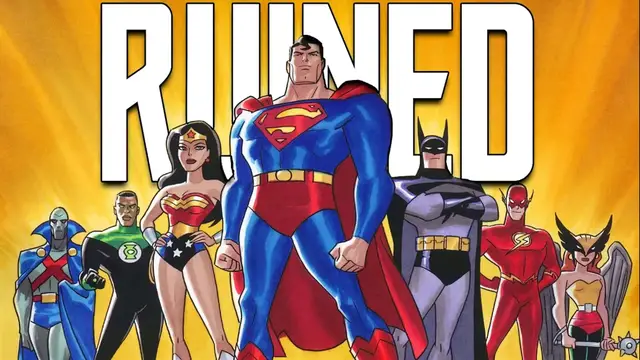
For the most part, a lot of the DCAU is looked back on as some of the best superhero content ever made by DC Comics. The one-two punch of Justice League and Justice League Unlimited produced some of the best superhero animation that the small screen has ever seen. Though after a move to Cartoon Network, things went downhill pretty fast for The Justice League. But how exactly did Cartoon Network ruin the ending of The Justice League?
Show More Show Less View Video Transcript
0:00
He's not the easiest person in the world to buy birthday presents for
0:03
Bruce, you didn't get him a gift certificate. No. Cash. The one-two punch of Justice League and Justice League Unlimited
0:12
inarguably produced some of the best superhero animation that the small screen has ever seen
0:17
There's only one catch, though. This masterclass in beautifully rendered animation falls short in one regard
0:23
The ending. Bruce Timm and his stalwart cohort of creative brethren had been working toward the idea of making an animated Justice League cartoon
0:31
for almost as long as they'd been working in DC's animated universe. Ever since the beloved crossover World's Finest
0:37
Tim, Paul Dini, and the cavalcade of minds behind the early DC animated universe
0:42
were attempting to produce a show centered around the Big 7. In fact, well before the inaugural episode hit airwaves on November 17, 2001
0:51
a sample animation of the proposed show was produced. The test footage is now referred to as the first mission
0:57
This version of the series showcases just how different things almost were
1:01
A cast of characters that featured Impulse, Robin, and a young girl cyborg
1:05
would have put a very different mark on the iconic legacy of the Big Seven
1:09
After the roaring success of Batman the Animated Series, Superman the Animated Series, Static Shock, and Batman Beyond
1:16
Warner Brothers head honchos decided it was finally time to pull the trigger on making a Justice League show
1:21
Certainly after we had done the Superman show, we got that question a lot from the fans was
1:24
you know, when are you going to do Justice League next? there was a lot of interest in doing the Justice League. Despite having loads of experience producing animated action-adventure stories
1:32
the prospect of having to do seven times the action wasn't exactly thrilling to Tim and fellow producers Dan Reba and Rich Fogle
1:39
There was a concern that they wouldn't have enough money to afford enough crowd scenes and multi-combatant fights
1:44
to keep the various superheroes all busy. To add more complexity, the valuable pre-teen and teen demographics
1:50
that had previously supported the weekday afternoon programming blocks were aging out
1:54
So, Warner's decided to take a risk, pivot Justice League to be an evening show
1:59
which would air on Cartoon Network And to add even more headaches the decision was made to have the show be a full hour instead of a standard half hour It was all a risk What do I need with money
2:09
Everyone needs money. The only question is, how much? Unfortunately, season one wasn't as creatively successful
2:17
as everyone would have liked it to be. When the show finally did debut, it would be as a three-part epic
2:22
titled Secret Origins, showcasing the formation of the team around their combined attempt at repelling and invading alien force
2:29
The season isn't horrible. There's some solid character development and some amazing animation
2:34
but it really does feel like a growing pain season. The forced cliffhangers and stop-start nature of the stories
2:40
feels like a compromise as opposed to a truly inventive next step
2:44
for the long-running animation brand. However, the show quickly won over fans
2:48
with their still on-point characterizations of Batman and Superman and their new inventions, like including Hawkgirl
2:54
Jon Stewart's version of Green Lantern, and a romantic subplot between Batman and Wonder Woman
2:59
into the series. Sounds wacky to me too. The show's second season climaxed in what, at the time
3:05
the creatives anticipated would be the end of the series. The ratings were good, but not good enough
3:10
to see the show continue, so everyone involved knew this was their last stab at the Justice League
3:15
In an attempt at redemption, they went about creating a three-part finale titled Star-Crossed
3:21
It featured a Thanagarian invasion of Earth and the emotional resolution of numerous running subplots
3:26
not the least of which being the simmering tension between Hawkgirl and Jon Stewart
3:30
Actually, when I was writing the last part of Starcross, I thought that was the end of the show
3:35
We definitely had some issues we had to deal with in the next season, if we were gonna get in the next season
3:41
This trinity of episodes would not be the end of the Justice League on television, however
3:45
After 52 episodes, the show ended on May 29th, 2004. And after much discussion with Cartoon Network
3:52
was reconceptualized and retooled as Justice League Unlimited. This new incarnation of the show would stop the one-hour format and instead focus on a half-hour runtime
4:02
It would also feature a massively sprawling cast including many new and obscure characters that had never been featured in animation previously According to writer Dwayne McDuffie the prevailing thought was The show first season features a combination of standalone and serialized episodes
4:28
Almost from the get-go, Justice League Unlimited is a complete breath of fresh air
4:32
After two seasons of this newly revamped format, the writing was on the wall
4:36
The ratings were slipping, and it seemed Cartoon Network was unlikely to bring back the show
4:40
for a third season. So the decision was made to craft an episode that would work as a coda on the entirety
4:46
of the DCAU. That episode would be Epilogue, written by Bruce Timm and Dwayne McDuffie
4:51
In it, we learn that Batman Beyond, aka Terry McGinnis, is actually a clone of Bruce Wayne
4:57
If you'd like to know more about this topic, please watch our video on it. The link is in the description
5:01
This is how Justice League Unlimited should have ended. It's a perfect way to give the audience both a look to the future and a closing of the book on the DCAU
5:09
But because nothing is predictable or stable in the business of show, Cartoon Network did in fact renew the show for a third season
5:16
Scrambling for what to do with this new runway, Tim and company decided to do the classic idea of the Legion of Doom
5:22
The results of this third season are a bit all over the place. You have high points like the Great Brain Robbery, where the Flash and Lex Luthor swap bodies
5:30
but you also have episodes like Chaos at the Earth's Core and Patriot Act that are just not that great
5:36
However, it's this third finale that lacks the real punch. Episode 13 of season 3, titled Destroyer, shows the JLU having to team up with Luther's secret society
5:45
in order to stop the return of Darkseid, who has a plan to use futuristic technology to transform the Earth into new apocalypse
5:53
Let's be clear about this. We're not here to help you save the world
5:57
You're here to help me get revenge on Darkseid. When this is over, it's back to business as usual
6:03
How is the mortal enemy of Highfather and the new gods thwarted? Well, after the requisite amount of punching
6:08
Lex Luthor is taken by Metron to the source where he accomplishes the impossible He finds the anti equation He returns to Earth and uses it to blink both himself and Darkseid out of
6:20
existence. But what does this mean exactly? The show ends with something of a cliffhanger where
6:25
the Justice League vows to go find these two villains, and we end on a roll call of all the
6:30
cast running toward the camera. It feels very self-conscious, like we thought this was ending
6:35
twice before and we had to keep going, so now we're not totally convinced that this is the end
6:39
of the show. Cartoon Network didn't expect the ratings to sag to the degree that they had
6:43
and this has never been officially confirmed, but it's theorized that discussions were still being
6:47
had with Cartoon Network about a possibility of a fourth season. But by the time they realized that
6:52
this would be their final outing, there wasn't exactly a lot of runway to tell a story that
6:56
could conclude all the running plot elements and give everything a final send-off. Both star-crossed
7:01
which also wasn't a definitive ending, but felt like a brilliantly executed emotional stopping point
7:06
and Epilogue, which features the most explicit thematic ending of any of the finales, are great ways to end the show
7:13
They have both a literal ending of the character and an emotional ending for us, the viewers
7:17
who've lived with these characters for so long. Destroyer, it feels like exactly what it was
7:22
a rushed conclusion to a gargantuan amount of work, which truly is a shame
7:27
They do so much work over the course of the third season to try and build Luthor up and make him into a threat
7:33
and then Metron just shows up, takes him to the source, and that's it
7:37
Luthor doesn't even really feel like he gets to choose what happens next. Not only does Destroyer not have any actual conflict
7:43
or character sacrifice for our leads, but the literal mechanics of the final moment
7:47
don't even register as an ending. They just feel like a to-be-continued
7:51
It turns out the ultimate villain of the DC Universe was Cartoon Network executives
7:56
The sagging ratings, the late-night programming block, and the lack of rapidly escalating toy sales
8:01
all proved to be too much for the Justice League. On one hand, we should all be thankful
8:05
for the genre-breaking, boundary-pushing work that we did get in the time
8:09
that these shows were being produced. On the other hand, it's truly a shame that one of the crowning achievements in animation
8:14
doesn't have a proper ending due largely to corporate meddling
#Cartoons
#Film & TV Industry
#TV & Video