Up next in 10



History is littered with the stories of people who, for a variety of reasons, were cast away from their homes and forced to live in foreign lands. Getting exiled was always a risk in the game of politics. Make the wrong enemy or fall from grace, and men and women who lived public lives could be banished by their opponents to get them out of the way.
Show More Show Less View Video Transcript
0:00
If you misbehave and or are too awesome at a local bar or public event, they may kick you out
0:06
And if you stir up too much of a ruckus, they toss you out of the country
0:10
History is littered with the stories of people who, for a variety of reasons
0:14
were cast away from their homes and forced to live in foreign lands
0:18
So today we're going to take a look at some famous historical figures who were exiled
0:23
Time to take a look at our Exiles Files. The poet Ovid was one of the great writers of the Roman world
0:35
Born to an elite family in 43 BCE, he made a name for himself by composing poems like
0:40
The Art of Love, which was something of an ancient seduction manual
0:45
Nowadays, that type of thing usually asks for a credit card number. But Ovid's fortunes changed in 8 CE, when Emperor Caesar Augustus exiled him to Tomis
0:54
in what is today Romania. The full reason for the exile has been lost to history
1:00
with the record only stating that a poem and a mistake with a cause
1:04
It must have been some poem. In the subsequent centuries, researchers have tried to parse out what exactly happened
1:10
It's well known that Augustus initiated conservative moralistic laws during his reign
1:14
and it's possible that something Ovid did, said, or wrote may have put him in conflict with that
1:19
Theories include the possibility Ovid poetry was just a bit too horny, that the poet was openly disrespectful of the emperor
1:25
or that he may have actually been involved in a plot against the emperor or some other scandal
1:30
But these are just all guesses. Far from his friends and loved ones, Ovid was miserable in Thomis
1:36
He repeatedly wrote letters to his friends in Rome, asking them to make petitions on his behalf to end his exile
1:43
He also used his alone time to write what would become his signature work
1:48
Metamorphoses, a collection of mythic poems that is now considered one of the most influential works in the history of Western culture
1:55
Basically, he cranked out stairway to heaven under house arrest. But metamorphosis or not, Ovid would never return to Rome
2:03
He wrote his final stanza in exile in either 17 or 18 CE
2:13
Ovid certainly wasn't the last writer to piss off powerful people and get the boot as a result
2:18
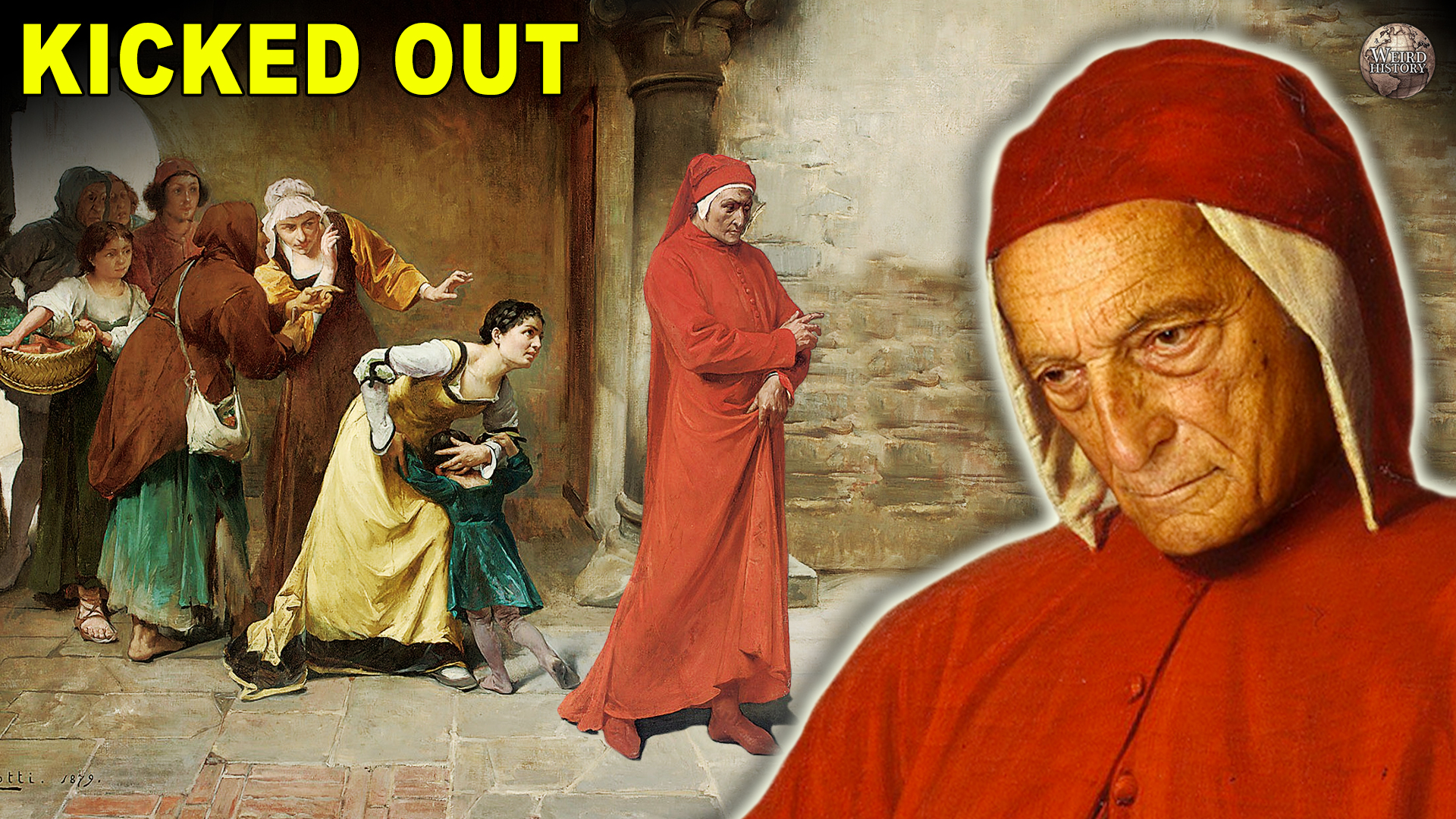
Take Dante Alighieri. He was a proud son of Florence and is best remembered for writing the book
2:23
that would come to be known as the Divine Comedy. The masterpiece was a classic trio of texts
2:29
about his imagined descent into purgatory and hell and his subsequent ascentance to paradise
2:35
But he was also deeply involved in Florentine politics. In the late 13th century, Florence was torn
2:41
over how much influence should the pope have over Florentine affairs. Dante believed the pope should have limited influence
2:48
in the city. That was obviously not what the pope and his allies wanted to hear
2:52
So when Dante refused to recant his beliefs or pay a fine
2:56
he was shown the door. They literally booted him out of the boot. Kicked out of his home in 1302 his punishment would eventually be extended to a life sentence and Dante would never see his beloved home again Perhaps taking his cues from Ovid Dante used his newfound free time
3:12
to write the aforementioned The Divine Comedy. In the book, he captures the eternal longing of an exiled Florentine
3:18
to return home to Tuscany, writing, You shall leave everything you love most dearly
3:24
This is the sorrow that the bow of exile shoots first. You are to know the bitter taste of others' bread
3:30
how salt it is. Dante also uses the text of the Divine Comedy to absolutely dunk on everyone who
3:38
wronged him, with one of his rivals literally drowning in a river of excrement. For a towering
3:43
work of world literature, the Divine Comedy is remarkably petty. Dante worked on his epic diss
3:49
track for around 20 years, finishing it just before he passed away in Ravenna in 1321, at the age of 56
3:57
And in 2008, the city of Florence retracted his exile and cleared the poet's name
4:03
Better late than never, we guess. Speaking of people getting kicked the flip out of Florence, in the late 15th century
4:14
much to the disappointment of their many enemies, the Medici family remained a political juggernaut
4:20
Three Medici men have even functioned as the city's most powerful rulers
4:24
First, Cosimo, then his son Piero, and finally Cosimo's grandson Lorenzo. His oil was known throughout the region
4:33
When Lorenzo passed in 1492, the mantle of leadership fell to his 20-year-old son, who
4:39
was also named Piero. But politics wasn't really young Piero's thing. So when France invaded Tuscany two years later, he hastily struck a deal with the king, much
4:48
to the outrage of the people of Florence. As you remember from the story of Dante, Florentines were really big on the whole exile thing
4:57
And true to form, they cast Piero and the rest of his family out of the city
5:01
Hey, the Florentines are gonna Florentine. Piero didn't give up, though. He spent most of his exile scheming to return to Florence and reclaim the power he had lost
5:11
But he couldn't pull it off. He came to be known as Piero the Unfortunate, which was the 15th century equivalent of being
5:18
called Piero, who sucks. or Piero the Giant Loser. He drowned in 1503, but his family
5:25
was able to return to Florence in 1512. It wasn't the first time the Medici were exiled from Florence
5:30
nor would it be the last. Like we said, the Florentines loved a good exile
5:41
In 1814, most of Europe breathed a sigh of relief after the decades-long French Revolutionary and Napoleonic
5:49
wars finally came to an end. Napoleon Bonaparte abdicated as emperor of France
5:55
and they couldn't kick his fancy-hatted ass out fast enough. The former dictator was quickly exiled to the island of Elba
6:02
Just 10 miles off the coast of the Italian peninsula, Elba was well-connected to the continent
6:07
So connected in fact it was arguably not the most secure place to send him Predictably Napoleon escaped after less than a year and stormed his way back to France During the so Hundred Days he scraped together what support and manpower he could
6:21
to launch a brief comeback that ended with his defeat in June of 1815 at the Battle of Waterloo
6:28
After that, they exiled him again, but this time he couldn't escape if he wanted to
6:33
Napoleon was sent to the remote island of St. Helena in the South Atlantic, where there
6:37
was little hope he could ever return to Europe. While on St. Helena, Napoleon killed time
6:42
by writing his memoirs and presumably playing a ton of Minecraft. He also made the most of the limited social circle
6:48
that surrounded him and received whichever visitors stopped on the island, including colonial officials
6:53
and dignitaries. Napoleon's stay on the damp, castaway island lasted less than six years
6:59
He passed away in 1821 at the age of 51. Thanks to a 2003 movie directed by Edward Zwick
7:11
you probably think of Tom Cruise when you hear the words The Last Samurai, even though Tom Cruise has very little to do
7:17
with Japanese history, just like the Ninja Turtles have very little to do with Italian cuisine
7:22
The Last Samurai title actually belonged to a man named Saigo Takamori
7:26
who overthrew the Japanese government and even challenged its successor state. But before earning his sterling reputation in the Japanese consciousness
7:35
Takamori experienced an exile. As a young man, he was committed to limiting the power of shoguns
7:42
a political stance the shoguns were not particularly into. As you can imagine, it put a target on his back
7:48
So to escape his enemies, he took refuge on the island Amami Oishima
7:52
He returned to court in 1862, but that turned out to be a tad premature
7:57
and he was quickly banished again. This time, he was arrested and sent to a different island called Okino Eirabu
8:04
Takamori's banishment finally ended in 1864. when he won an appointment in the Satsuma Army
8:11
In the Tom Cruise film, Ken Watanabe's character Katsumoto is based on the real-life Takamori
8:16
although he was apparently exiled from the movie poster. Born in 1869 in the Russian Empire
8:28
16-year-old Emma Goldman followed her sisters and immigrated to the U.S., escaping an arranged marriage and familial abuse
8:35
But life in the U.S. wasn't the paradise she hoped for. And in her discontent, she found radical circles, which soon gave her mentorship, ideas, and a lover
8:45
She embraced women's rights, workers' rights, and anarchism, along with a dash of violence in there for flavor
8:51
And since punk rock wasn't around yet, she poured herself into some old-fashioned activism
8:57
After a couple decades of writing, public speaking, protesting, striking, inciting a riot, planning an assassination, and some prison time
9:04
Goldman found herself vehemently opposed to the military draft at the start of World War I
9:09
She and others wound up in jail again for conspiring to induce men to defy federal law
9:14
and not register for the draft When she was released in 1919 the post War I red scare was in full swing J Edgar Hoover then head of what we now call the FBI had taken a personal interest in
9:26
Emma, considering her one of the most dangerous anarchists in the country. So under the Anarchist
9:32
Exclusion Act, she, along with 248 others, were deported. The act only applied to non-citizens
9:39
but since Goldman's claim to citizenship came through a brief marriage to a man who had since
9:44
had his citizenship revoked, the Fed said her citizenship was invalid and sent her to Russia
9:50
which was then in the throes of revolution and civil war. Years later, she recounted her feelings
9:55
of betrayal as she was escorted onto a ship in New York City that would carry her from America
10:00
writing, it was my beloved city, the metropolis of the new world. It was America indeed
10:05
America repeating the terrible scenes of Tsarist Russia. Goldman soon hightailed it out of Russia
10:11
in 1921, when she discovered the Bolshevik Revolution wasn't so cool. And she would spend the last decades of her life traveling in Europe and Canada, speaking
10:20
out on behalf of workers and against the rising tide of fascism in Europe. Although she never lived in the US again, she was allowed to return in 1933 to give lectures
10:28
With the stipulation, her talks could only be about her autobiography and theater
10:33
It was only after her death that she would be allowed to reside in the US. After she passed in Toronto in 1940, she was buried in Chicago
10:41
That's a very cold choice. On June 30, 1936, Emperor Haile Selassie of Ethiopia stood before the League of Nations
10:57
and begged for help. Although Ethiopia was a sovereign country and a member of the organization, Benito Mussolini
11:03
dictator of Italy and pioneer of fascism and big hats, had invaded the nation several months earlier
11:09
Selassie argued that the League, being an international organization dedicated to world
11:13
peace, had a moral duty to act and check Mussolini and his dangerous ambitions
11:18
You'd think that was exactly the kind of thing the League would want to get involved in, but whether due to impotence or indifference, they just kind of shrugged it off and did
11:25
nothing as Italy added Ethiopia to its collection like a Pokemon. Italy's successful conquest of the African country was only one of many invasions in
11:34
the years leading up to World War II. At the time, fascist countries felt emboldened to claim sovereign land they had no right to
11:40
and appeasement was all the rage with most international bodies. So they just kind of let it slide
11:46
It's the old, eh, somebody else will take care of it, approach. Selassie's exile from Ethiopia began in May of 1936, and he found a safe haven in Bath
11:55
England. Even in exile, Selassie continued to fight to regain his country
11:59
His perseverance paid off in 1941, when Ethiopian soldiers worked with the British to push Italian
12:04
troops out of Ethiopia. Selassie could finally return home, where he spent most of his post-war
12:10
years promoting African unity. Decades later, his authority was again undermined in 1974 when a
12:16
military coup stripped him of power and confined him to his palace, proving once again that some
12:20
emperors just can't catch a break. He passed away in 1975 at the age of 83