Up next in 10



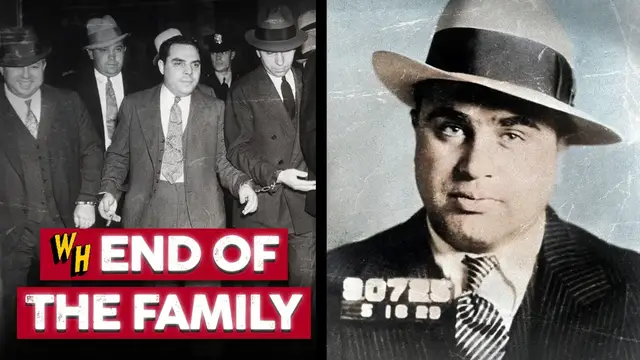
The Chicago Outfit was founded during the 1910s, but it became notorious under the leadership of Al Capone. When crime boss Johnny Torrio invited Capone to Chicago from New York in 1920, it set the foundation for Capone's rise to the top. Capone, leader of the Outfit from 1925 to 1931, was involved in underground activities long before taking over the group. Even after he went to prison in 1931, Capone may have had some knowledge of what the Outfit was up to. However, his mental deterioration from syphilis was so severe that the former gangster was released from prison early as a result.
Show More Show Less View Video Transcript
0:00
Al Capone is a legendary figure in the world of organized crime
0:03
but the movies tend to leave out what happened to his empire and his family, his real family, after he went to prison
0:10
Did organized crime stay organized? Did his relatives try to cash in on his notoriety
0:15
Or did they get all busted too? Well, today we're taking a deep dive into everything
0:20
that happened right after Al Capone went to prison. All right, let's see if we're untouchable like Elliot Ness
0:30
The Chicago Outfit was founded during the 1910s, but it became truly notorious under the leadership of Al Capone
0:37
When crime boss Johnny Torrio invited Capone to Chicago from New York in 1920, it set the foundation for Capone's rise
0:44
to the top of the criminal underworld. Capone, leader of the Outfit from 1925 to 1931
0:50
was involved in numerous illicit activities long before taking over the group
0:55
Even after he went to prison in 1931, Capone may have had some knowledge of what the outfit was up to
1:00
However, his mental deterioration due to syphilis was so severe that the former gangster was released from prison early as a result
1:08
Between 1939 and 1947, Al Capone lived out his days in Florida
1:12
He passed away on January 25, 1947, leaving behind a son, a wife, a mother, and numerous siblings
1:20
So who took over the Chicago outfit? And what happened to Al Capone's family members
1:27
Gabrielle and Teresa Capone arrived in the United States from Naples, Italy during the mid-1890s
1:35
Already parents to two boys, the Capones were expecting their third child when they settled in
1:39
New York City. The Capones expanded their brood, adding a girl and several more boys by the time
1:45
Gabrielle died of a heart attack in 1920. Elle went to Chicago soon after this, but Teresa and
1:51
the rest of his family stayed in New York, except for his brother James, who literally joined the
1:56
circus. What's worse, the mafia or the circus? Hmm. Al Capone reportedly called his mother regularly
2:04
and did his best to support her from afar. Teresa, for her part, remained devoted to her children and
2:10
her grandchildren, even taking in her son Ralph's child after the boy was all but abandoned by his
2:15
parents. Teresa later moved to Chicago and lived in a house purchased for her by Al. Few details
2:20
about Teresa's activities are known, but she continued to live in that house until she died
2:24
in 1952. Three of the four Capone boys became involved in organized crime, Ralph, Elle, and
2:34
Frank. Ralph Capone married in 1915 and had one son, little Ralphie, with his wife Filomena
2:41
or Florence. After Florence deserted the child, he was raised by Ralph's mother. Ralph left New
2:46
York for Chicago in 1920 securing a divorce the following year He took over the Chicago So Outfit bottling enterprise during prohibition tasked specifically and practically with controlling the market for non beverages
3:00
This helped him earn the nickname Bottles. Ralph managed to monopolize beverage sales in Chicago
3:05
during the early 1930s, becoming the biggest vendor during the 1933 World's Fair
3:10
When Al was eventually incarcerated, Ralph was in charge of the Chicago Outfit
3:14
and was also brought up on tax charges. He was indicted in 1930 and spent time in Leavenworth Penitentiary
3:20
The extent of Ralph's influence and criminal connections after Al's death isn't clear
3:25
though a report from a U.S. Senate Congressional Committee to investigate organized crime
3:29
described Ralph as exerting a considerable amount of political influence in Lyons, Illinois
3:34
at the very least. He remained wealthy until his death in 1974, having spent the last years of his life in
3:40
Mercer, Wisconsin, where he reportedly operated a tavern. As a member of the Mercer community, Ralph was respected, well-liked, always ready to help his fellow townspeople
3:51
Apart from the organized crime thing, he sounds like a swell guy. Al Capone's only son, Albert Francis Sonny Capone, was born on December 4, 1918, before his parents were married
4:05
Though shotgun wedding probably means something different in crime circles. Deidre Marie Capone, Al's grandniece, posits that May, Al's wife, didn't actually give
4:15
birth to Sonny, but rather took care of the illegitimate child of her husband. Either way, Sonny was Al's son and was likely born with congenital syphilis
4:23
This may have been transmitted to his mother by Capone and, in turn, passed on to Sonny
4:28
As a result, Sonny was sickly as a boy and had an ear infection that left him partially deaf
4:33
Sonny was well cared for by his family, but bullied because of his ailments and father's
4:38
vocation. He went on to attend Notre Dame University before returning to Florida to help
4:43
make care for his ailing father. Once back in Florida, Sonny completed his bachelor's degree
4:48
at the University of Miami and married Diana Casey. The couple had four daughters, Veronica
4:53
Patricia, Barbara, and Teresa. Sonny and Diana later divorced, and he would marry two more times
4:59
Sonny worked as a used car salesman, ran a restaurant with his mother, and was a printer's
5:03
apprentice before becoming a tire distributor. There's no indication that Sonny was involved in
5:08
his father's business, although he was once arrested for shoplifting in 1965. One year later
5:13
he reportedly changed his surname to Brown. Sonny Capone died in 2004 at the age of 85
5:19
and was buried in California. James Vincenzo Capone went to great lengths to set himself
5:28
apart from his family. As the oldest Capone's son, James left home when he was just 16 years old
5:33
and traveled through the American Midwest. He reportedly joined the circus and worked for a Wild West show
5:39
where he honed his shooting skills By some accounts James joined the military and spent time in France during World War I But no official records exist documenting his service He may have used a different name Richard James Hart
5:52
a nod to his hero, actor William S. Hart. The pseudonym stuck, and a new one was added
5:58
Richard James Two-Gun Hart worked as a federal prohibition agent during the 1920s
6:03
His nickname derived from the two guns he always carried. Eh, at least it's a cooler nickname than trousers or hat
6:09
Hart lived in Homer, Nebraska before moving with his family to the Dakotas to work as an agent for the Bureau
6:15
of Indian Affairs in 1926. After the repeal of Prohibition, Hart moved back to Homer
6:20
and served as marshal. But accusations of theft and hardship brought on
6:24
by the Great Depression prompted Hart to reconnect with his family. Well, you know, the criminal one
6:29
Hart asked Ralph Capone for help, a request that was not without consequences
6:34
When Ralph was under investigation for tax violations in 1950 and 1951, he asked Hart to testify on his behalf
6:42
which blew his real Capone identity wide open. Hart died the following year
6:47
But before he passed away, he saw Al Capone one final time
6:55
Francesco Rafael Nitto, also known as Frank Nitti, took over operations of the Chicago outfit in 1932
7:02
Another New Yorker who went to Chicago, Nitti spent time in Texas before linking up
7:06
with Johnny Torrio, L's mentor and predecessor. Nitti built his reputation as an alcohol smuggler
7:12
before becoming one of Capone's most trusted men. Nitti made his way through the ranks of the Chicago outfit
7:17
and served as head of operations when Capone went to prison in 1929
7:21
Upon Capone's release in March 1930, Nitti's station continued to rise, and he became known as Enforcer
7:28
After both Capone and Nitti went to prison in 1931, the latter's release in 1932 set the stage for him to take over
7:35
as leader in Capone's stead. But in 1943, he came under investigation for extortion
7:41
against members of Hollywood Studios and Unions, alongside many other organized crime figures
7:47
Maybe he just wanted them to release the Snyder Cut. Fearful he would end up back in prison
7:51
as a result of impending charges, Niddy left his home on March 19, 1943
7:56
and walked to the railroad tracks nearby, where he fired some drunken shots at a train
8:01
before taking himself out. Paul Ricca was among the members of the Chicago mob who were indicted in the Hollywood extortion
8:10
case of 1943. Born Felicia de Lucia, Ricca arrived in the United States from his native Italy in 1920
8:17
under a false name. Once in the US, Ricca made his way to Chicago, where he briefly worked at
8:23
Bella Napoli Cafe, a popular restaurant frequented by Al Capone. This is where his nickname, The
8:29
Waiter came from Although Ricca repeatedly insisted that he was a manager not a waiter We understand his frustration but when you in Al Capone outfit only one guy gets to be called the manager Capone came to trust Ricca and was even Ricca best man when he got married
8:44
in 1927. Four years later, when Capone went to prison for tax evasion, Ricca was among the top
8:50
men running the outfit, especially when Frank Nitti was also confined. Ricca also became allies
8:55
with Meyer Lansky, Lucky Luciano, and Frank Costello, key players in the New York contingent
9:00
of the National Crime Syndicate. But in 1943, Ricka was sentenced to 10 years in prison
9:05
on extortion charges, though he was paroled only four years later in 1947
9:10
However, he could not return to the Chicago outfit due to increased police scrutiny
9:14
Tony Accardo, who had been keeping Ricka informed on outfit activities, became the nominal leader
9:20
while Ricka worked behind the scenes. In 1957, the US government stripped Ricka of his citizenship
9:26
and attempted to deport him. Ricca stalled, only to be found guilty of tax evasion
9:31
Ricca went to prison again in 1959, but was released in 1961
9:36
He lived in the US for another decade before passing away. Mary Josephine Coughlin, called May, was from a devout Irish Catholic family
9:47
and purportedly met her future husband at a party or a club in New York
9:52
Those two things often overlap, so it's easy to forget. May was two years older than Al and worked as a timekeeper in an office
9:59
and the couple had a relatively short courtship. Their paths first crossed in early 1918, and by the end of the year, they were married
10:07
May's family was not stoked about the marriage, but by most accounts
10:11
May's pregnancy had sped up their nuptials. Al and May married after their son, Albert's sonny Francis, was born
10:17
and struggled financially from the outset, due in part to the boy's poor health
10:21
Additionally, Elle's mother, Teresa, and sister, Mafalda, did little to welcome Mae into the family
10:27
Mae was devoted to her husband and her son, but had a difficult time with the realities of Elle's life in organized crime
10:34
Not everyone makes the mob wife adjustments so easily. Surveillance, notoriety, and the constant presence of Elle's business associates put a strain on Mae
10:43
As Al's fortunes grew, May did benefit from a more extravagant way of life, but also tried
10:49
to keep the truth about Al from Sonny. When Al went to prison in 1931, May was one of the few people allowed to visit him
10:56
And after Al was released due to mental decline in 1939, May was her husband's caretaker in Florida
11:02
After Al Capone died in 1947, May stayed in Florida, but was forced to sell the Palm Island
11:07
home she shared with her husband in 1952. May eventually relocated to Hollywood, Florida, invested in a restaurant with Sonny, and joined
11:15
forces with Elle's sister Mafalda to sue CBS, Desilu Productions, and Westinghouse over
11:20
similarities to Elle's life and appearance in the Untouchables TV series. She passed away in 1986, which means she never got a chance to sue Robert De Niro over that
11:30
baseball scene