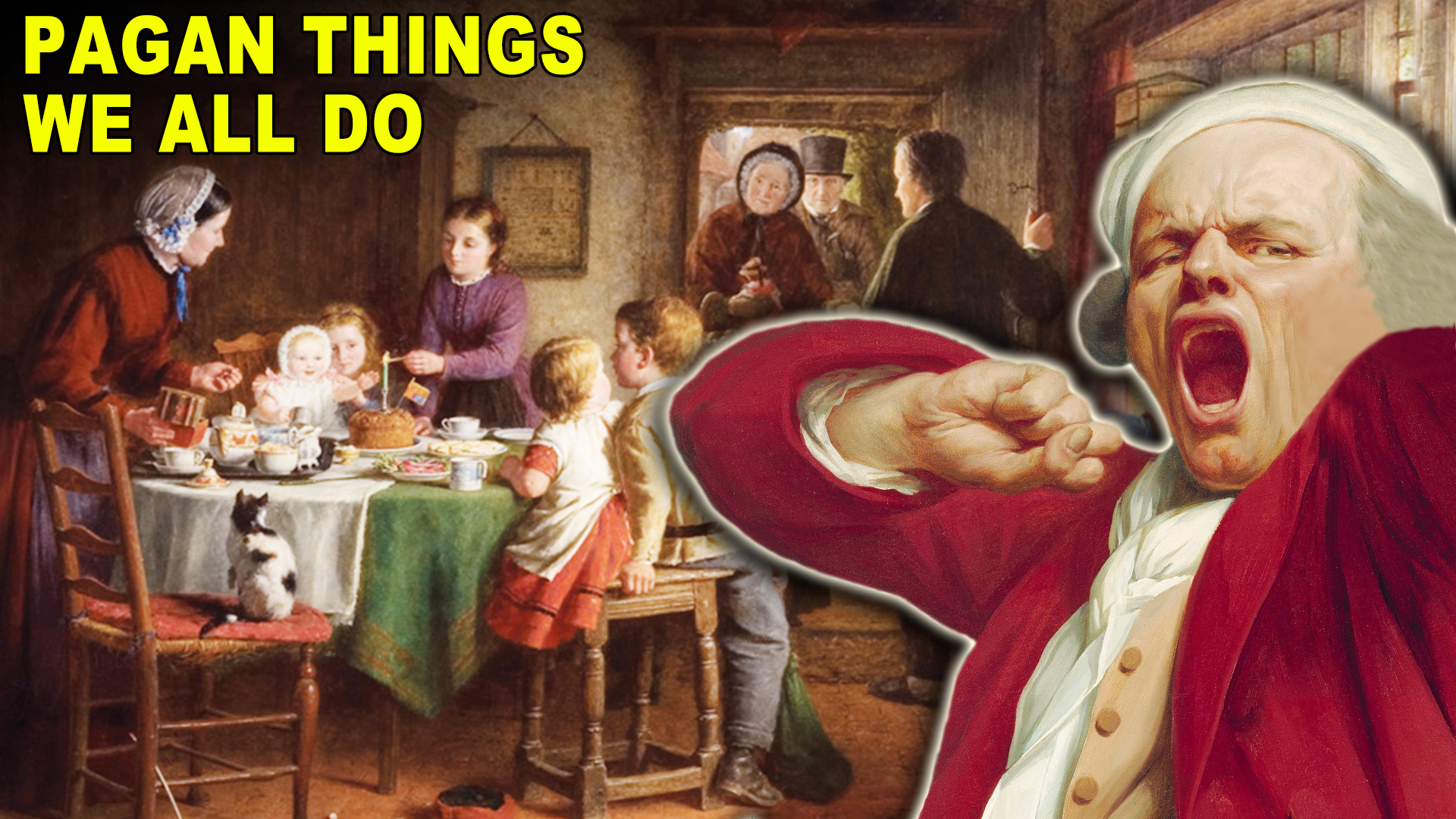
Up next in 10



Links between holiday traditions and pagan culture are well established - and occasionally celebrated - but there are also a lot of misconceptions about paganism that make the word itself a bit taboo. Paganism isn't something to be feared or shunned. In Latin, "pagan" was simply the word for villager or civilian. Religious connotations that developed during the Middle Ages made pagans into heathens rather than outsiders. With all that in mind, there continues to be a pervasive presence of paganism in the modern world.
Show More Show Less View Video Transcript
0:00
Pagan was originally a term used by early Christians
0:03
to describe citizens of the Roman Empire who practiced polytheism or any other local religions
0:09
not rooted in Judaism. Over time, we've started using the word to refer to basically any beliefs that predate
0:15
the major contemporary religions, also as an acronym for People Against Goodness and Normalcy
0:21
but only when referring to the 1987 movie comedy Dragnet. So maybe not super relevant here
0:28
Today, we're taking a look at everyday activities that can be traced back to pagan culture
0:34
Now, time to take the pagan challenge. Until the 20th century, no one would have really described themselves as pagan
0:45
It was used by Christians initially as a kind of put-down, referring to people they viewed
0:50
as believers in false gods. The term derives from the Latin word pagus, which refers to a rural region inhabited by
0:57
country dwellers. So right there, it's sort of implying that you're an uncivilized bumpkin
1:04
In modern times, various polytheists, those who practice nature worship, and others who embrace
1:09
spirituality but reject the world's largest religions have reclaimed paganism as a concept
1:14
and made the word their own. So when we refer to paganism here, we're not talking about a single
1:19
coherent set of beliefs that any one group in one part of the world held, but we're referring to
1:24
generally all the collective things people believed in ancient times that didn't involve
1:28
Abraham, Isaac, the Torah, or Jesus, and stuff like that. Most famously, these cultures and
1:34
faiths started celebrating many of the same holidays that we still take off work today
1:39
Halloween, for example, dates back to the Celtic festival of Samhain. Wait, who's taking Halloween
1:45
off work? In Samhain, the veil separating the worlds of the living and the dead was believed
1:50
to break down, allowing souls to cross over. It was probably also influenced by Festival of the Dead
1:56
celebrated in ancient Rome, during which people would bring offerings of food to their loved ones' graves
2:00
to keep their memories alive. Valentine's Day also started as a Roman fertility festival
2:06
celebrating the god Lupercus, who protected farmers and shepherds. Lupercalia, as it was called, was held in mid-February
2:14
to ensure a fruitful and fertile year, and found celebrants feasting, making ritual sacrifices
2:19
of goats and dogs. Oh, man, not dogs. And even running naked through town
2:24
while being flogged with strips of flayed goat skin. Oh, the things we do for love
2:30
Commemorating birthdays was fairly uncommon in early Christian culture. So a lot of our modern day traditions around the event
2:36
derived from earlier practices. In some Germanic cultures, evil spirits were believed to cross over into our world
2:42
and attack children on the anniversaries of their births. That's not a cool birthday surprise
2:47
Believers placed lit candles on a birthday cake, one for each year of life, to keep these
2:52
angry demons at bay. Wedding celebrations also owe a debt to pagan traditions. Some historians
2:59
and anthropologists think that the practice of wearing wedding rings or bands dates back to the Third Dynasty of Egypt Old Kingdom when the exchange of rings more generally indicated a binding agreement between two parties Greeks and Romans also believed that the fourth finger was special
3:14
and contained a vein that ran directly to the heart. It was sometimes known in these cultures as the medicated finger
3:20
used to stir up mixtures and potions, as its special connection to the heart would immediately warn
3:25
the apothecary of the presence of a toxic ingredient. Hey, why don't you just keep your finger out of my drink
3:30
Wearing a wedding ring on the medicated finger, therefore, indicates an added layer of commitment
3:35
love, and sentimentality. The pagans also gave us bridesmaids and other traditions associated with the wedding party
3:42
though they actually had a role to play aside from taking the bride to Vegas and getting her wasted
3:46
Some cultures believe that it was helpful to have other women around during a wedding
3:50
ceremony, all dressed alike, in order to trick evil spirits into attacking them instead of
3:55
the bride herself. Those are pretty gullible spirits. Even some contemporary Christian holidays had their origins in pagan culture
4:03
Easter was originally named for Ustra, a West Germanic spring goddess, who was feted for bringing longer, brighter days when food started to grow once more in abundance
4:13
Ustra was frequently symbolized by a hare, which remained closely connected to the Easter holiday
4:19
even after the event was repurposed to commemorate the resurrection of Jesus Christ
4:23
Christmas as well originated as the pagan festival of Yule, a nature ritual celebrating the continuation of life on Earth
4:30
even during the darkest and coldest months of the year. Many Yule traditions, like lighting a Yule log
4:36
giving gifts to family and friends, and decorating your home with wintry green plants like mistletoe, holly, and ivy
4:42
are now baked into our annual Christmas celebrations. Whether you like them or not
4:51
Still, we promised everyday activities that can be traced back to pagan culture
4:55
not annual events. And it doesn't get more every day than the actual names
4:59
for the days of the week, nearly all of which have pagan origins
5:03
Monday derives from the Anglo-Saxon word monondag, meaning moon's day. It was set aside for rituals giving homage
5:11
to the goddess of the moon. Tuesday is associated with both the Germanic god Tew
5:16
and the Norse god Tjör. Wednesday is derived from Woden's Day, a celebration of the old Norse god Odin
5:25
Thursday was named for Odin's son, Thor, the old Norse god of thunder and Hemsworths
5:31
Also, lightning. Friday is associated with another Norse god, Freyja, the wife of Odin and mother of Thor
5:39
while Saturday takes its name from Saturn, the Roman god of wealth and plenty
5:43
The pagan versions of the seven-day week were first established in ancient Babylon sometime
5:48
time before 600 BC, and was adopted by early Christians hundreds of years later, under the
5:54
Roman emperor Constantine. There were some attempts around this time to replace the pagan names with
5:59
Christian references, such as the names of the sacraments or Christ's apostles. Hmm, wonder which
6:04
five apostles got screwed But ultimately tradition won out and we kept the pagan origins in place The same thing happened again in the months of the year Today we follow the Gregorian calendar which was introduced by Pope Gregory XIII in 1582
6:21
But it had its own roots in the Julian calendar, first proposed by Julius Caesar in 46 BC
6:26
when he was still a Roman consul. So the month names mostly have Roman origins
6:32
many of which are associated with their polytheistic religion. January is named for the Roman god Janus
6:38
the protector of gates and doorways, like a superhero doorman. February takes its title from
6:45
Februalia, a Roman festival of purification and atonement. In the ancient world, military
6:51
campaigns often paused for the winter and started back up again in spring, which likely influenced
6:56
the decision to name March after Mars, the Roman god of war. May refers to Meia, who oversaw the
7:03
growth of plants, while June is named for the Roman goddess Juno, reflecting her connections
7:08
to the sky, marriage, and rebirth. June remains associated with getting married right up to the present day
7:17
Beyond just names and dates, many social practices from pagan societies have remained with us
7:22
today, passed down through thousands of years of human history and dozens of civilizations
7:28
Wearing jewelry was common in the ancient world, and just as it does today, was often
7:32
used to signal someone's social position or status. Viking men wore elaborate jewelry
7:38
that denoted their overall rank and significance in their community's hierarchy, while Egyptians, Greeks
7:43
and Romans commonly wore jewels adorned with spiritual and religious symbols. Prominent ancient Egyptians were buried alongside their jewels
7:50
in the hopes that they could bring them along into the afterlife. Amulets featuring hearts, scarabs, the fingers of Horus
7:57
and serpent heads are frequently found in Egyptian burial sites, as it was believed
8:01
they would provide protection in the next world. In ancient Rome, gold rings specifically indicated
8:06
political status and were worn exclusively by senators and nobles. After his memorable defeat
8:11
of the Romans at Cannae, Carthaginian general Hannibal famously sent home six dry gallons of
8:16
gold rings taken from the hands of slain Roman officers and politicians. Decorating one's face
8:22
and body with makeup also dates way back to some of the earliest human civilizations
8:27
In ancient Egypt, eye makeup specifically was seen as very important. Cosmetics made from combinations of lead, copper, and other common items, often colored in dark grays and greens
8:39
were frequently used to adorn humans with the eye of Horus, a symbol of power, protection, and wealth
8:45
Both women and men in ancient Egypt wore eye makeup, but women would additionally make their cheeks appear redder and their faces whiter
8:52
along with painting their nails and even applying early forms of lipstick. These products were made from materials like animal fat
8:59
plants, herbs, and oils, and were used for both decoration and to signal a woman's affluence and social status
9:05
Keeping animals around the house as pets was also a common practice in many pagan societies
9:10
some of which believe that certain species provided their masters with spiritual or supernatural powers
9:15
A number of pagans believe that animals including cats dogs and toads were intimately connected to fairies or other spiritual creatures making them a vital link with the unseen world of magic
9:27
Some even thought the animals themselves had supernatural powers, particularly cats, who were sometimes associated with shape-shifting or other physically impossible forms of mischief
9:37
In the popular imagination, cats have maintained some of this mystique and continue to be associated with witches, bad omens, and the afterlife
9:45
A lot of superstitions and social cues from early human history have persisted into our
9:53
modern world, even after people stopped believing in the root causes of these practices
9:58
For example, yawning was poorly understood in the ancient world and was thought to imperil
10:04
your health by either allowing diseases to enter the body or, even worse, allowing your
10:09
vitality and life force to escape the body. People started covering their mouths when they yawned, to either block admittance for
10:16
illnesses or ensure that their soul remained intact and on the inside
10:21
Today, we think of crosses as specifically Christian imagery, but many pagan societies
10:25
also had positive associations with them, using them as symbols for luck or unity
10:31
So making the sign of the cross with your fingers for good luck, you know, crossing them
10:35
could theoretically date back to the pagan culture. There is disagreement among historians and experts about this, though
10:43
Many believe that the practice of crossing your fingers for good luck was specifically
10:47
associated with the early Christians, and a time when their religion was still outlawed
10:52
throughout the Roman Empire. Theoretically, Christians might have shared crossed fingers or made other discrete hand
10:58
signals to identify one another in situations when they couldn't openly speak about their faith
11:04
Crossing your fingers when telling a lie may have also had early Christian origins
11:09
The sign of the cross was believed to protect an individual from God's wrath
11:12
So forming a cross with your fingers before breaking one of the Ten Commandments may have
11:17
been a superstitious insurance policy. Knocking on wood also has its roots in the ancient world
11:24
The Celts believe that spirits lived within trees. So it's possible that they thought tapping or knocking on the trees could invoke the
11:31
protection of these beings, or that creating the noise could keep evil spirits at bay or
11:36
prevent them from hearing human thoughts and desires. Traditions surrounding the tooth fairy
11:41
likely also have origins in pre-Christian culture from Northern Europe. In Viking and early Norse
11:47
societies, children's teeth were thought to bring good luck in battle, prompting warriors to sometimes
11:53
buy them from kids and wear them in strings around their necks. This led to the tradition of a tooth
11:58
fee paid to a child upon losing their first tooth. It's also possible that our current understanding
12:04
of the Tooth Fairy is an amalgamation of traditions from many different cultures, all being mashed up together
12:10
Unlike a lot of other characters from Western folklore, the Tooth Fairy varies widely depending on the region
12:16
appearing as both male and female, a child with wings, a pixie, a dragon, a flying ballerina, two old men
12:24
a bat, a bear, and a variety of other forms