Up next in 10



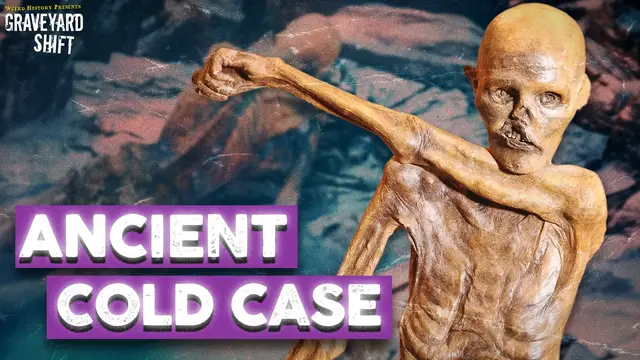
Scientists have long used fossils and ancient human remains to uncover what life was like in the distant past, but some discoveries come with chilling consequences. When Ötzi the Iceman, Europe’s oldest known natural human mummy, was found frozen in the Alps, it shocked the world. But even more disturbing? A series of mysterious and bizarre deaths linked to those who studied him. Is it coincidence… or a real-life mummy curse?
Show More Show Less View Video Transcript
0:00
Researchers and scientists have relied heavily on fossils and human remains to offer us a glimpse of what life was like on our planet before civilization and the modern world took over
0:11
But sometimes, they uncover more than what they bargained for. As is the case with Otzi the Iceman, Europe's oldest known natural human mummy
0:19
who may be linked to the mysterious and bizarre deaths of the several researchers connected to his discovery
0:24
Today, we go on an expedition of our own to show you the tragic history of Otzi
0:30
the undead caveman, in an attempt to uncover the truth behind this frozen corpse's curse
0:42
Otzi, who goes by many names such as Tyrolean Iceman, Similean Man, Frozen Fritz, and the Man of Tizen Josh
0:50
is the natural mummy of a man who lived between 3,400 and 3,100 BCE
0:55
as Europe's oldest known natural human mummy. Otzi offers an unprecedented view of Copper Age Europeans
1:03
The frozen Iceman is believed to have been murdered due to the discovery of an arrowhead embedded in his left shoulder
1:09
and various other wounds. The nature of his life and the circumstances of his death
1:13
are the subject of much investigation and speculation. Otzi was discovered by German tourists Helmut and Erika Simon
1:21
on September 19, 1991, while hiking on the east ridge of the Finalspitz of the Otzdel Alps
1:27
on the Australian-Italian border, near Similean Mountain and Tizenjak Pass. When the couple first saw the body, they both believed they had happened upon a recently
1:37
deceased mountaineer until further investigation revealed he was an ancient caveman, well-preserved
1:43
by the icy mountain. The following day, a mountain gendarme and the keeper of the nearby Similean
1:49
hut first attempted to remove the body, which was frozen in ice below the torso, using a pneumatic
1:54
drill and ice axes, but had to give up due to bad weather
1:58
The body was semi-officially extracted on September 22, 1991, and officially salvaged the next day
2:05
It was transported to the office of the medical examiner in Innsbruck, along with other objects found nearby
2:11
and examined by archaeologist Conrad Spindler of the University of Innsbruck. He dated the find to be about 4,000 years old
2:18
on the basis of the typology of an axe among the retrieved objects. The Cimelian Man
2:30
Otzi's cause of death remained uncertain for about 10 years after his body was discovered
2:34
It was initially believed that the Cimelian man died from exposure during a winter storm
2:39
but was later speculated that he might have been the victim of a ritual sacrifice perhaps for being a chieftain This explanation was inspired by theories previously advanced for the first millennium BCE bodies recovered from peat bogs such as the Toland Man and the Lindoman
2:56
In 2001, x-rays and a CAT scan revealed that Otzi had an arrowhead lodged in his left shoulder
3:01
and a matching small tear on his coat when he died. The discovery of the arrowhead prompted researchers to theorize that the man from Tizenjak died
3:10
of blood loss from the wound, which would probably have been fatal even if modern medical
3:15
techniques had been available. Further research found that the arrow's shaft had been removed before death, and close examination
3:21
of the body found bruises and cuts to the hands, wrists, and chest, and cerebral trauma
3:26
indicative of a blow to the head. Currently, it is believed that Otzi bled to death after the arrow shattered his scapula
3:33
and damaged nerves and blood vessels before lodging near the lung. Recent DNA ysis claimed to have revealed traces of blood
3:41
from at least four other people on his gear, one on his knife, two from a single arrowhead
3:46
and a fourth from his coat. Interpretations of these findings speculated that the frozen Fritz had killed two people with the same arrow
3:53
and was able to retrieve it on both occasions, while the blood on his coat came from a wounded comrade
4:00
he may have carried over his back. Otzi's posture in death, frozen body, face down
4:05
left arm bent across the chest, could support a theory that before death occurred
4:10
the rigor mortis set in. The Iceman was turned onto his stomach
4:14
in an effort to remove the arrow shaft. In 2010, it was proposed that Otzi died
4:18
at a much lower altitude and was buried higher in the mountains, as posited by archaeologist Alessandro Vanzetti
4:25
of the Sapienza University of Rome and his colleagues. According to their study of the items found near Otzi
4:31
and their locations, it is possible that the Iceman may have been placed above what has been interpreted as a stone burial mound
4:38
that was subsequently moved with each thaw cycle that created a flowing watery mix
4:43
driven by gravity before refreezing. While archaeobotanist Klaus Ogle of the University of Innsbruck agrees that the natural process
4:50
described most likely caused the body to move from the ridge that includes the stone formation
4:56
he pointed out that the paper provided no compelling evidence to demonstrate
4:59
that the scattered stones constituted a burial platform. Moreover, biological anthropologist Albert Zink
5:06
argues that the Iceman's bones display no dislocations that would have resulted from a downhill slide
5:11
and that the intact blood clots in his arrow wound would show damage if the body had been moved up the mountain
5:17
In either case, the burial theory does not contradict the possibility of a violent cause of death
5:28
Influenced by the Curse of the Pharaohs, which alleges that a curse may be cast upon anyone who disturbs the mummy of an ancient Egyptian and the media theme of cursed mummies claims have been made that Otzi is in fact cursed
5:42
The allegation revolves around the deaths of several people connected to the discovery, recovery
5:47
and subsequent examination of the frozen Iceman. In 1992, Rainer Hinn, who had the honor of placing Otzi's frozen remains into a body bag
5:55
died in a tragic car accident while en route to a convention where he planned to talk about Otzi's origins
6:01
This happened one year after the frozen man's remains were uncovered, making Rayner the first potential victim of Otzi's curse
6:10
Kurt Fritz took his place in history by leading researches to Otzi's body
6:14
and organizing the transportation of his remains. His untimely death occurred one year after Rayner Hins
6:20
when an avalanche claimed his life on an expedition. While Fritz's passing may have been an unfortunate accident
6:27
it seems worth noting that he, an experienced guide, was the only member of his group to perish in the avalanche
6:34
Helmut Simon, who discovered Otzi and his wife, Erica, received a lot of media attention and some compensation for this rare find
6:42
but may have also fallen victim to the Iceman's curse. In October 2004, the experienced hiker fell more than 300 feet to his death
6:51
while hiking the Alps. Due to poor weather conditions, it took search and rescue teams eight days to recover his body
6:57
While Dieter Warneck wasn't part of the original excavation or research crew of OTCI
7:02
he led the search team following Helmut Simon's disappearance in the Alps
7:06
Mere hours after Simon's funeral, Warneck discovered an unexpected heart attack. One major critic, the world's leading expert on OTCI, Conrad Spindler, didn't believe in the curse
7:17
He even joked about it in an interview saying, I think it's a load of rubbish. It's all media hype
7:23
The next thing you'll be saying, I will be next. Coincidentally, or because of the sinister curse
7:29
Spindler was in fact the next person associated with Otzi to die
7:33
He passed in 2005 due to complications with multiple sclerosis. Rainer Holtz was the only person ever allowed to film the recovery of Otzi's body
7:43
which he later turned into an hour-long documentary. He died from a brain tumor shortly after finishing his film
7:50
Tom Lowe was the first researcher to discover extremely important evidence on Otzi's clothing
7:55
His findings indicated that the Iceman had died during a violent conflict
7:59
due to the presence of multiple types of blood on the fabric and tools. Ironically, Loy ultimately died due to hereditary blood disease
8:07
that wasn't diagnosed until after he began studying the Similean man's remains
8:12
To date, seven deaths have been linked to the discovery of Otzi and attributed to his subsequent curse
8:19
Debate over whether or not the Iceman curse is real continues still to this day On one hand there are too many odd circumstances surrounding the mummified remains to rule out the theory of a real curse
8:30
But on the other, each misfortune may be chalked up to an isolated incident
8:36
Keeping in mind that hundreds of individuals have been involved with the recovery and research
8:40
of OTSI, these tragedies are most likely nothing more than deeply unfortunate coincidences
8:46
Or perhaps a curse really was bestowed upon those that were directly related to the original discovery and upheaval of his body
9:02
In 2017, German filmmaker Felix Randeau released the German-Italian-Austrian adventure drama Der Mann auf dem Eis, or simply, Iceman
9:12
which depicts the fictional account of Otzi's final days on Earth over 5,300 years ago
9:19
a revenge plot to seek justice on the clan that attacked his tribe and brutally murdered his family
9:24
The film was shot in the Tyrolean and Bavarian Alps, near the frozen Fritz's actual discovery site
9:30
and features almost no dialogue, with the minimal amount spoken in an early
9:35
reconstructed version of an untranslated rhetic, a language spoken in the Eastern Alps in pre-Roman and Roman times
9:42
After writing the first draft of his script, Randeau contacted the South Tyrol Museum of Archaeology and met the museum's director, Angelique Fleckinger, who became a scientific advisor for the movie
9:54
Although Randeau's story is fictional, he hired a profiler to check all of the facts about Otzi and confirmed that everything played out on camera could have actually happened in real life
10:03
Almost every scientific fact we know about the undead caveman made it into the film
10:08
From his costume design to his over 60 tattoos found on his body
10:12
and ending in his cause of death. Even the objects found on the Iceman were used to create all of the movie's props
10:19
While Randeau's film does not shed any light on the origins of Otzi's curse, or even gives a nod to its credibility
10:25
it does depict his violent final days, as indicated by the wounds uncovered by researchers on the caveman's body
10:32
Whether or not curses are real may never be proven in our lifetime
10:36
but it's fascinating to consider that an ancient caveman frozen in time
10:40
could somehow be linked to numerous modern day tragedies. No matter what side of the argument you're on
10:46
it's undeniable the effect Otzi's discover has had on modern view of ancient times
10:52
Perhaps we'll find more like Otzi and learn even more about the world before our time
10:56
or maybe we'll fall victim to even more curses. Regardless, if you're the superstitious type
11:02
then you may want to steer clear of the South Tyrol Museum of Archaeology
11:07
in Bolzano, South Tyrol, Italy, where Otsi's remains and belongings are on display for educational purposes