Up next in 10



Europeans were creative when it came to torture. They developed some of the most excruciating and slowest methods of torture in history, including the horrific blood eagle torture method. But one of the worst forms of torture was not even considered torture by the court. It was an official sentence: pressing to death. The men and women who were sent to death by crushing in Britain had not been found guilty of any crime.
Show More Show Less View Video Transcript
0:00
When it came to torture, 13th century Englishmen could be extremely creative
0:05
But one of their worst forms of torture wasn't even technically considered torture by the court
0:10
It was an official sentence, pressing to death. So today, we're going to take a look at how even in Enlightenment Britain
0:17
you could be sentenced to being crushed with huge weights. Dating all the way back to the 13th century, England used pressing as a form of punishment
0:30
and the practice continued well into Britain's Enlightenment. The punishment was technically
0:34
known as penforte dur, or strong and hard punishment, and the people who endured it
0:40
hadn't even been convicted of a crime in the first place. In fact, penforte dur was actually
0:45
used to coerce a suspected criminal to plead guilty or not guilty before the court, so that
0:50
they could then be put on trial. The victims, for their part, could end their torment at any time if
0:55
they simply cried out, not guilty. In its heyday, a pressing went a little something like this
1:00
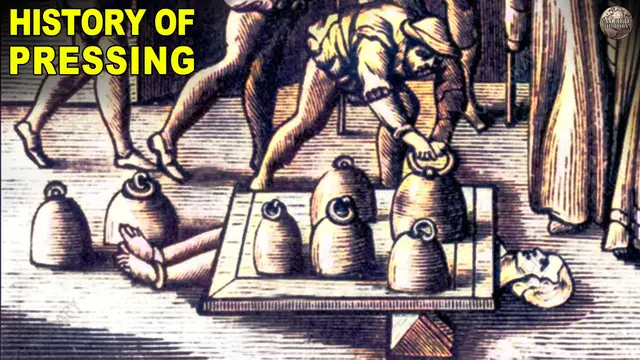
First, the individual sentenced to pressing was stripped nude. Then, heavy weights were laid upon
1:06
their body, essentially slowly suffocating the person. More and more weights were added
1:11
tormenting the poor sufferer. From there on out, gravity did the rest, and it wasn't necessarily quick
1:17
A man or woman could live for days with weights crushing them. In the end, though, they would succumb in an utterly agonizing way
1:24
Victims of pressing not only suffocated, but their bones were also crushed and sometimes even
1:29
burst through their skin. You're probably wondering why anyone wouldn't choose to opt out of such treatment
1:35
But surprisingly, many of the people who were pressed to death often had a very good reason for choosing their brutal demise
1:41
More on that later, though. During the bloody English Reformation, people practicing the wrong faith, with wrong in this
1:52
case meaning whatever faith had been declared illegal by the ruler of the moment, could easily
1:57
find themselves on the chopping block. For example, when Queen Mary took the throne in 1554
2:02
she burned hundreds of Protestants at the stake. As Queen Elizabeth I outlawed Catholicism
2:07
even sheltering a Catholic priest was a capital offense. In 1586, Margaret Clitheroe was caught
2:14
red She had created a secret room in her house to hide priests When the room was discovered Margaret was arrested She had already been thrown in jail three times for refusing to attend Anglican church services
2:26
So authorities were pretty confident she was guilty. Perhaps for that very reason, Margaret
2:31
refused to enter a plea. Without a plea, the trial could not move forward
2:35
And Margaret was ordered to endure the punishment of pressing. First, she was stripped down in front of everyone
2:41
Wait, what does being stripped down have to do with refusing to enter a plea? Well, nothing really
2:46
In fact, scholars Peter Lake and Michael Questier explain it as an obscene shaming ritual
2:52
That being said, it wasn't the worst thing that would happen to her that day, because right afterward, her limbs were tied with ropes
2:58
and stretched. Next, a door was placed on her chest, and then the weights were slowly added
3:04
At any point during the extended torture, Margaret could have chosen to enter a plea of guilty
3:09
or not guilty. Now, this isn't quite the escape hatch it appears to be
3:13
because if she had pleaded not guilty, she would have been put on trial and almost certainly
3:17
found guilty and then executed. So Margaret refused. The jailer began to pile more stones on the board
3:24
eventually burying Margaret under an astounding 800 pounds of weights. Her spine snapped and her ribs burst
3:31
It probably would have been little comfort to Margaret, but centuries later, her story would inspire a scene
3:37
in the BBC series Gunpowder, in which an elderly woman was crushed for conspiring against the monarchy
3:43
Margaret Clitheroe wasn't the only woman to have been pressed. Years later, in 1676, another woman was suspected of burglary
3:51
Although her name was not recorded in the court records, this woman had already faced trouble with the law
3:56
She had been accused of stealing clothes, but she had been found not guilty
4:01
But this time, under suspicion of burglary, the woman refused to enter a plea
4:06
The sheriff tried to persuade the woman to enter a plea. Even her own lawyer said she drew her blood upon her own head
4:13
But with her continued refusal, the court was forced to that terrible judgment, and
4:17
the woman was taken to Newgate Prison and pressed to death. In 1676, a soldier by the name of Major Strangeways was accused of murdering a lawyer who had
4:28
seduced his sister. When he refused to plead in court, Strangeways was sent to be pressed in the Old Bailey Press Yard
4:34
The court even had a machine purposefully constructed with a view to pressing on the region of the heart and so expediting death As the machine pressed down Strangeways face turned from white to black The weights were piled on until 400 pounds
4:48
pressed down on Strangeways. But he still didn't perish. Finally, his friends, who had come to witness the pressing
4:55
jumped on top of the press to add their own weight to the wood and iron. Their weight finally ended the victim's suffering
5:05
In 1692, a panic over witches swept the village of Salem, Massachusetts, and nearly 200 people
5:13
were accused of witchcraft. In the popular imagination and many works of fiction, those
5:18
convicted were burned at the stake. But as anyone who's watched Weird History's video on myths about
5:23
the Salem witch trials knows, no one was actually burned. In fact, almost all the victims were
5:28
hanged, except one who was pressed. And that particular execution might be the most famous
5:33
case of pressing in history. One of those accused by the special court of practicing
5:37
witchcraft was Giles Corey, an elderly farmer with a bad reputation. Nearly two decades earlier, Corey
5:44
had beaten a man to death for stealing apples. And Corey's wife, Martha, had also
5:49
been accused of witchcraft. On September 9, Martha was convicted of witchcraft
5:53
and sentenced. Just days later, the same court told Giles that he would stand trial for witchcraft
5:59
He refused, and the court decided to press him. Giles Corey had seen how the court had twisted the words of his wife, Martha, during her trial
6:07
for witchcraft, and he refused to allow himself to be put through the same thing. So to force Giles
6:12
to enter a plea, the court pressed him. As was customary with pressing, Corey was stripped naked
6:18
before a board was placed on his body. Heavy stones were then set on top. This went on for a full day
6:23
and Giles refused to enter a plea. In fact, the only words he spoke were, more weight, which
6:29
honestly makes him sound pretty badass, unless he was actually saying, more? Wait. On the second
6:35
day, even more stones were added until the weight was unbearable. On September 19, 1692, Giles finally
6:42
succumbed after two days of being pressed and was buried in an unmarked grave
6:52
So by this point you probably thinking something like if refusing to enter a plea he was just going to get you a more gruesome death than entering a plea and being found guilty why did anyone bother Well if the suspect refused to enter a plea was just going to get you a more gruesome death than entering a plea and being found guilty why did anyone bother Well if the suspect refused to enter a plea under English law
7:07
the person could not be put on trial. And if the suspected criminal was never convicted
7:11
his heirs could still inherit his land and wealth. Under English law, when a convicted
7:16
criminal was executed, the king would seize all forfeitable lands. But if the suspect was
7:22
executed by Penforte d'Or, or pressing, rather than standing trial, the family could keep the
7:27
victim's property. That's why pressing was so gruesome. The whole point was to scare accused
7:33
criminals into entering a plea before their trial. In the late 17th century, a Frenchman named Guy
7:39
Miege moved to London. He eventually wrote a book that discussed the English court system
7:44
including the practice of pressing. Miege explained that if an accused criminal
7:48
stand mute at their trial, the person could be pressed. According to Miege, in such a case
7:53
the prisoners laid in a low dark room in the prison, all naked but his privy members, his back upon the bare ground
7:59
his arms and legs stretched with cords. Miege went on to say that during the pressing
8:04
victims would only be given foul water. He also described the motives of the pressing victims
8:09
They accepted the grievous death to save their estates to their children
8:18
People like Giles Corey and Margaret Clitheroe agreed to be pressed in part because they knew
8:23
that convicted criminals could receive even worse torments than pressing. 16th century England was
8:29
known for sending religious criminals to be burned at the stake. Giles Corey, for example
8:33
knew he was choosing between pressing or hanging, neither of which were really ideal choices
8:39
And as if burning and hanging weren't bad enough, traders could also be drawn and quartered. In that
8:44
option, the traitor was hanged until nearly dead. Then his bowels were removed. His privates were
8:50
sliced off and burned in front of him. And then he was quartered while still alive. Severed body
8:55
parts were common adornments at execution sites or on the London Bridge. During much of Britain's
9:01
enlightenment, having suspected criminals pressed to death was legal. In fact, it was not until 1772
9:07
that Great Britain finally outlawed the practice, changing the statute so that refusing the plea
9:12
was seen as a sign of guilt equivalent to a conviction. By outlawing pressing, the loophole
9:17
allowing suspected criminals to keep their property and the family was closed