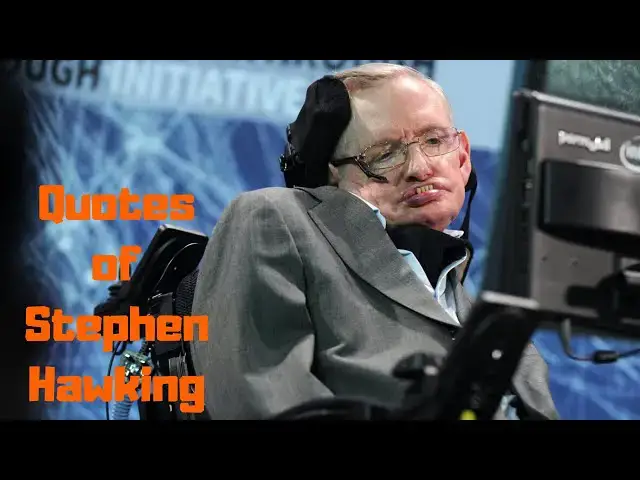

Quotes of Stephen Hawking
Dec 21, 2019
Stephen William Hawking CH CBE FRS FRSA (8 January 1942 – 14 March 2018) was an English theoretical physicist, cosmologist, and author who was director of research at the Centre for Theoretical Cosmology at the University of Cambridge at the time of his death. He was the Lucasian Professor of Mathematics at the University of Cambridge between 1979 and 2009.
His scientific works included a collaboration with Roger Penrose on gravitational singularity theorems in the framework of general relativity and the theoretical prediction that black holes emit radiation, often called Hawking radiation. Hawking was the first to set out a theory of cosmology explained by a union of the general theory of relativity and quantum mechanics. He was a vigorous supporter of the many-worlds interpretation of quantum mechanics.
Hawking achieved commercial success with several works of popular science in which he discusses his own theories and cosmology in general. His book A Brief History of Time appeared on the British Sunday Times best-seller list for a record-breaking 237 weeks. Hawking was a Fellow of the Royal Society (FRS), a lifetime member of the Pontifical Academy of Sciences, and a recipient of the Presidential Medal of Freedom, the highest civilian award in the United States. In 2002, Hawking was ranked number 25 in the BBC's poll of the 100 Greatest Britons.
In 1963, Hawking was diagnosed with an early-onset slow-progressing form of motor neurone disease (MND; also known as amyotrophic lateral sclerosis "ALS" or Lou Gehrig's disease) that gradually paralysed him over the decades.[22][23] Even after the loss of his speech, he was still able to communicate through a speech-generating device, initially through use of a hand-held switch, and eventually by using a single cheek muscle. He died on 14 March 2018 at the age of 76, after living with the disease for more than 50 years.
Family
Hawking was born on 8 January 1942 in Oxford to Frank (1905–1986) and Isobel Eileen Hawking (née Walker; 1915–2013). Hawking's mother was born into a family of doctors in Glasgow, Scotland. His wealthy paternal great-grandfather, from Yorkshire, over-extended himself buying farm land and then went bankrupt in the great agricultural depression during the early 20th century. His paternal great-grandmother saved the family from financial ruin by opening a school in their home. Despite their families' financial constraints, both parents attended the University of Oxford, where Frank read medicine and Isobel read Philosophy, Politics and Economics. Isobel worked as a secretary for a medical research institute, and Frank was a medical researcher. Hawking had two younger sisters, Philippa and Mary, and an adopted brother, Edward Frank David (1955–2003).
In 1950, when Hawking's father became head of the division of parasitology at the National Institute for Medical Research, the family moved to St Albans, Hertfordshire. In St Albans, the family was considered highly intelligent and somewhat eccentric; meals were often spent with each person silently reading a book. They lived a frugal existence in a large, cluttered, and poorly maintained house and travelled in a converted London taxicab. During one of Hawking's father's frequent absences working in Africa, the rest of the family spent four months in Majorca visiting his mother's friend Beryl and her husband, the poet Robert Graves.
Primary and secondary school years
Hawking began his schooling at the Byron House School in Highgate, London. He later blamed its "progressive methods" for his failure to learn to read while at the school. In St Albans, the eight-year-old Hawking attended St Albans High School for Girls for a few months. At that time, younger boys could attend one of the houses.
Hawking attended two independent (i.e. fee-paying) schools, first Radlett School and from September 1952, St Albans School, after passing the eleven-plus a year early. The family placed a high value on education. Hawking's father wanted his son to attend the well-regarded Westminster School, but the 13-year-old Hawking was ill on the day of the scholarship examination. His family could not afford the school fees without the financial aid of a scholarship, so Hawking remained at St Albans. A positive consequence was that Hawking remained close to a group of friends with whom he enjoyed board games, the manufacture of fireworks, model aeroplanes and boats and long discussions about Christianity and extrasensory perception. From 1958 on, with the help of the mathematics teacher Dikran Tahta, they built a computer from clock parts, an old telephone switchboard and other recycled components.
Although known at school as "Einstein", Hawking was not initially successful academically. With time, he began to show considerable aptitude for scientific subjects and, inspired by Tahta, decided to read mathematics at university.
Show More Show Less