Up next in 10


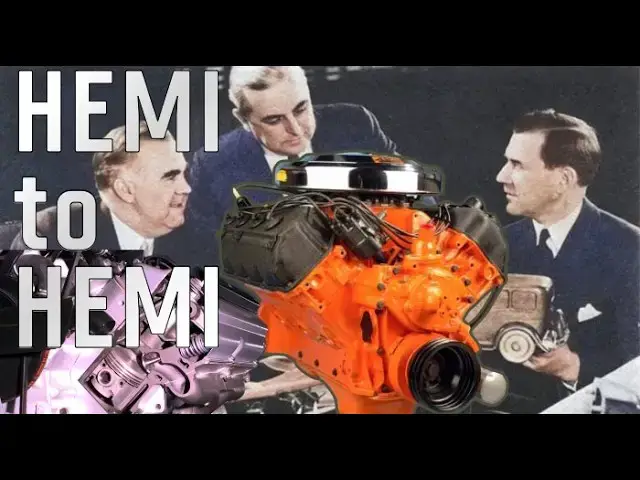
A quick talk about how Mopar never really quite left the Hemi, even during the 1980s and 1990s.
From a talk to the Rusty Relics on 4-26
Show More Show Less View Video Transcript
0:00
Chrysler's famous for the Hemi engine.
0:02
They actually created the trademark,
0:04
which is why we call it the Hemi. They
0:06
trademarked the name, short for
0:08
Hemispherical Heads. And that's one
0:11
picture of the original 1951
0:14
uh blueprint for the Hemi V8 coming from
0:17
William Weirman who was head of engine
0:20
design for a while. And uh not he didn't
0:22
design this. So this is from one angle
0:25
and it doesn't look very hemispherical
0:27
here but you can see you look at it and
0:29
you say holy moly that thing has big
0:31
valves
0:33
>> and that was really the point. Here's
0:34
from another angle and you can see here
0:36
the hemisphere. You can't see the valves
0:38
anymore but from this angle you can see
0:40
the hemisphere and there's a spark plug
0:42
all the way dead center top and there
0:46
from the uh the dividing line the yellow
0:48
shows your hemisphere. And in those days
0:50
they were real hemispheres which is one
0:53
of the problems of this engine was you
0:55
had great air flow. It was efficient. It
0:58
didn't carbon up which was a big deal in
1:00
those days of you know fairly poor
1:02
gasoline not carboning up having low
1:05
knock self-destructing the first time
1:07
that you gave it gasoline that wasn't
1:09
really properly refined and durable. It
1:12
was adorable.
1:14
It was also really expensive and slow to
1:17
make. And one of the reasons for that
1:18
was because generally speaking, Hemi
1:21
designs in the hemispherical head
1:23
designs in those days had to have twin
1:25
cams. As far as anybody knew, you needed
1:27
twin cams because of the valve placement
1:29
at opposite ends. You had to machine the
1:32
heads. That requires a guy literally
1:34
sitting there machining the head. This
1:37
is expensive. It's slow and you end up
1:39
with wide and heavy heads because of the
1:41
valve gear. You know the guys who
1:43
started who who made Chrysler what it
1:45
was. Zeter skeleton and breer three
1:48
engineers they were just about the first
1:50
automotive engineers to say we should
1:52
really be using science as the center of
1:54
everything that we do. It was their big
1:56
thing. It's why it's how they met. Two
1:58
of them met in college and the three of
2:00
them collected together at Studebaker
2:02
and then they went on to Willis and then
2:04
they ended up at Chrysler. Along the way
2:06
they designed some engines for Durant.
2:08
Don't want to get too far down there,
2:10
but while they were cooling their heels,
2:12
waiting for somebody to make their car,
2:15
they went through and they tested
2:17
hundreds and hundreds and hundreds of
2:19
head designs, the single cylinder
2:21
engines, and they did it again later on
2:25
for Chrysler. At first, they did not
2:27
invent hemispherical head engines by a
2:30
long shot. The first one anybody has
2:33
heard of that I have spoken to is the
2:36
Welch company in Michigan. Their car had
2:39
a two-cylinder with I think something
2:41
like 20 horsepower back in 1903 and
2:45
eventually they made it bigger. They got
2:47
up to I think 70 brake horsepower. Then
2:50
Belgian Pipe Company made one. Delage in
2:53
27. A bunch of racing cars in the 30s
2:55
had them. And of course, Ardune heads
2:57
for the um uh the Ford V8 were popular
3:01
at the time. And some people think Ardun
3:02
actually created the Chrysler heads or
3:04
they ripped them off for him. Uh there's
3:06
two stories about that. The basic answer
3:08
is we don't know. But he himself said
3:10
there's nothing to it. There were plenty
3:12
of hemispherical head engines. The first
3:15
Mopar Hemi though was the XI 2220
3:19
V16
3:20
made during World War II. mostly
3:23
engineered by volunteers working on
3:25
their own time without being paid. So,
3:27
they do their day of work and then
3:29
they'd come out and they'd work on this
3:30
ridiculous aircraft engine. 3,000
3:33
horsepower supercharged on the dyno.
3:36
They found it very durable compared to
3:37
the day's uh aircraft engines and it
3:40
added 70 mph to the top speed of their
3:42
test aircraft. Problem is, by the time
3:45
it was done, we had this thing called
3:47
the jet. So, that's the team that made
3:50
it. That's one of the actual engines
3:52
that was discovered and restored for the
3:55
Chrysler Museum. They went through all
3:58
this stuff of testing the one-cylinder
4:00
engines and they came up with the Hemi
4:01
as the ideal. Chrysler run by engineers
4:05
at that point Zader skeleton and breer
4:07
basically they would go up to Walter
4:09
Chrysler and say please do this for us
4:11
and he would say okay boys. The big
4:14
breakthrough there was making it not a
4:15
twin cam engine. So, it had one cam per
4:18
bank of cylinders with two rocker arms.
4:22
Very clever setup. So, one of the rocker
4:24
arms would do the intake valves and the
4:26
other one would do the exhaust valves.
4:28
That way, you get rid of one cam and you
4:30
make it a lot more practical for
4:33
not high production, but high compared
4:36
to the previous hemispherical head
4:38
engine production. Wasn't called a Hemi,
4:41
was called a dual rocker by everybody
4:43
involved. That point has been made to me
4:45
so many times I thought I would bring it
4:47
to you and it was only in the first year
4:49
it was just for the New Yorker in the
4:51
Imperial but you could buy it as an
4:52
option in the Saratoga. So they did not
4:55
think V8s were going to be a big deal at
4:58
Chrysler. Everybody else knew that they
5:01
were going to be a big deal but Chrysler
5:03
was kind of thinking still it's going to
5:06
be an exclusive engine so we will make
5:08
it as efficient as we can get it as as
5:10
good as we can get it. And the funny
5:12
thing is again that um one of the guy
5:15
one of the engineers I knew over there
5:17
who's passed on since who worked on most
5:20
of the engines of the 70s and the 80s
5:23
and the 60s uh said, "You know, it was a
5:26
funny thing because they had this great
5:28
racing engine here [clears throat] that
5:29
had enormous potential." And what did
5:30
they do? They stuck on a two barrel
5:32
carburetor for almost every one that
5:34
they made. But the cool thing about it
5:36
was doubled in the meantime four
5:39
failures from the normal industry 50,000
5:42
to 100,000 miles beat Cadillac by 20
5:44
horsepower which is a big deal because
5:46
Chrysler was not at Cadillac's level
5:49
generally speaking. Even the Imperial
5:51
was their try at meeting Cadillac. And
5:54
by 1956 in the C300 they had their 300
5:58
horsepower 345 pound feet. Keep in mind
6:01
anytime I'm talking numbers before 1971,
6:04
I use a convention brake horsepower in
6:06
the uh that's gross horsepower. That's
6:09
without any accessories or anything. So
6:11
that is what we would today call an
6:13
optimistic number. It's probably 30 to
6:16
60 horsepower less than today's
6:18
measurements would give you. Also,
6:19
today's measurements are a lot uh
6:22
tougher. And you'll notice every old
6:24
measurement I give you ends in a zero or
6:26
five. So that tells you that they're not
6:28
very uh precise.
6:31
My favorite term also comes from one of
6:33
the old engine designers. He said that
6:35
yeah, that was our marketing horsepower,
6:37
but 300 horsepower was a big deal
6:40
nevertheless. And it was an honest 300
6:42
horsepower that you could sustain and
6:44
that you would get if you bought the car
6:45
and you tested it, you would get that
6:46
300 horsepower. So that was they named
6:49
the whole Chrysler 300C after it. And
6:52
then they just kept on. Even though the
6:54
power raised every year, they would
6:56
still call it the 300. Uh others quickly
6:59
made bigger engines. Not a surprise.
7:01
They were all competing with each other.
7:03
And it's not that hard to expand the
7:06
bore and the stroke of most engines. So
7:08
they did. So Chrysler also did. What's
7:11
really a little weird about Chrysler,
7:13
although actually the day it was a
7:15
normal, they had a completely different
7:17
design for Dotto and Dodge without
7:20
interchangeable parts for the same
7:22
engine. All three were designed by the
7:26
same guys, the lead engineer and the um
7:29
the one who made sure that all the
7:30
drawings were done correctly. Same
7:32
people, completely different engines.
7:35
And Chrysler always had to be above
7:37
Dodto, which had to be of do above
7:39
Dodge. So you have all these different
7:42
displacements even though these engines
7:44
were only made 51 to 58 and they it you
7:47
know and and I know that GM basically
7:50
did the same thing where you had your
7:51
Oldmobile engine until God when was that
7:54
that Oldmobile there was that big fuss
7:56
over using Chevrolet engines. Is that
7:58
the 80s7s?
8:01
>> 307.
8:03
>> The polywood's an interesting idea
8:04
because they didn't test different
8:07
designs. This case they just said, well,
8:09
this rounded combustion chamber
8:11
obviously is good with the hemispherical
8:13
head because you can have all these
8:16
advantages that we mentioned, no carbon
8:18
buildup, stuff like that. So, we'll do
8:21
something like the Hemi. We'll use the
8:24
same boring stroke so that we don't have
8:25
to buy new equipment to make to make the
8:27
things. But we'll go down to the one
8:31
rocker arm. We'll move the valves.
8:34
Let's make it simpler and have less
8:37
machining on it with a polyphere instead
8:39
of a hemisphere. They assumed it was
8:42
better. The one engine that was that I
8:44
looked at where they had the same size,
8:48
the same displacement was 354
8:51
and the poly was 45 horsepower less than
8:53
the heavy. But it's hard to know if some
8:55
of that was also the carburetor
8:57
>> compression
8:59
>> compression carburetor. There's a lot of
9:01
things that could
9:02
>> 9 and a quart versus like seven and a
9:05
quarter.
9:06
>> Thank you Pete for actually remembering
9:08
that fact. So then the question is did
9:11
it have to be like that or did they make
9:13
it like that so that one would be the
9:14
clearly superior engine because there
9:16
was a lot of that at the time
9:18
>> the hemi design that's the you could
9:20
semi yeah it's a semi hemi
9:22
>> yeah that's why we call them
9:24
>> yep semi hemi
9:25
>> the semi hemi without the
9:27
>> so then we have the engines which are
9:29
still the semihemi they're still the
9:31
poly design but and they're still the
9:34
hemi block I might add but they changed
9:37
it a little bit so they could automate
9:39
it more easily. So any changes that they
9:41
made to the engine block, they made so
9:43
they could use their new automation
9:44
equipment at Mound Road that they had
9:46
just put up, but they changed it so that
9:48
it would be more durable because they
9:50
had learned a bit from failures on older
9:51
Hemi engines.
9:53
And this time they shared it among the
9:56
brands because they kind of realized
9:58
that they were going to go bankrupt if
10:00
they made so many different things. They
10:02
could not compete. GM and Ford were
10:04
already so much larger than Chrysler at
10:06
this point that they were having a
10:07
pretty serious hard time competing. So
10:09
they had to find their own economies of
10:11
scale and this is one way that they did
10:12
it. Shared them among brands and they
10:16
were down to just yeah four varieties.
10:18
And the funny thing to me is that they
10:20
got rid of the engine in ' 66 and
10:22
switched to the LA but in Canada it took
10:24
one more year to change over the factory
10:26
because they did it one at a time. They
10:29
were making engines in Windsor, Ontario
10:32
for Canadian use because of the tariff
10:34
situation. Let's see. The LA Lightweight
10:37
A. They had a new casting method. They
10:39
cut 50 lbs off the engine block. And to
10:41
quote, let's see, I think this was Pete
10:43
Hogen book said it. They finally got rid
10:46
of those silly polypheres.
10:48
They actually tested the wedge against
10:50
the polyphere and said, "Oh, the wedge
10:52
is actually better, isn't it?" And
10:54
cheaper. Yeah, maybe we should do the
10:56
wedge from here on. They did that
10:58
actually with the B engine. I'm not
11:00
going in strict chronological order, but
11:02
uh this was a much cheaper engine to
11:04
make as you can imagine. They could
11:06
truly truly just crank them out. And so
11:09
you had the 273 was the first one coming
11:11
out in ' 65. Then you had the 318.
11:15
340 is the one everybody remembers
11:17
because that was the hot performance
11:19
engine. They really got a lot more out
11:20
of that than people had a reason right
11:22
to expect. And then the fun thing is
11:25
take the 360, you cut off the cylinder,
11:28
you get the 3.9 L truck engine, the V6
11:31
that had the lumpy uh idle, and you get
11:33
the Viper V10 that had a lumpy idle that
11:35
people liked where you take the two
11:37
cylinders that you took off for the 3.9
11:40
and you stick them on to the 360. Then
11:42
you get the Viper 488 cubic inch V10.
11:46
But yeah, that that's the fun way of
11:48
saying it all, although it's not really
11:49
true. And then the LA really continued
11:52
on to 2003 as the Magnum V8. That was
11:56
basically taking the old engine and
11:58
sticking it into the modern era. They
12:00
replace the heads, they replace fuel
12:01
delivery, they replace spark, all that
12:04
stuff. The block is pretty much the
12:06
same. It's an evolution of the Hemi. So,
12:10
you're still working off the basic Hemi
12:12
block design here, which is pretty
12:14
amazing because you're going on to 2003
12:17
and your block is your very, very first
12:20
V8 block. Meanwhile, it's your Chevrolet
12:22
1955. Yep. We're done.
12:26
>> Still making it.
12:27
>> Still making.
12:28
>> All right. Second path is where we get
12:30
the Hemi trademark from. They're going
12:32
down. They're making these Hemi engines
12:34
and they're saying, "Well, these are
12:35
great. efficient engineers can love this
12:38
engine, but they're slow and they're
12:40
expensive and the competition is just
12:43
making bigger displacements all the
12:45
time. So, what do we do? Like I said,
12:47
first of all, we we reexamine whether
12:50
we're actually getting any benefit from
12:51
the polosphere and we find out that
12:52
we're not, which is a little
12:54
embarrassing for the company that says
12:56
we are the engineering automaker. Karen
13:00
engineering makes the difference. That
13:02
was their slogan. and they realized that
13:04
they were doing something based on what
13:05
they thought should be without actually
13:07
testing it. Low cost, high volume
13:09
instead and it works fine. And it turns
13:12
out that this is actually a great path
13:14
to follow. You can make a uh cheap
13:17
powerful engine. You stick on more
13:18
carburetors if you need to. You have
13:20
tricks like that one over there with the
13:22
tuned intakes.
13:24
>> Get a slight supercharging effect at uh
13:26
whatever RPM you choose by varying the
13:28
length of the manifolds. And today they
13:30
do that very cleverly by having the a
13:33
little solenoid that goes in and alters
13:35
the length of the manifold for you. So
13:37
the air can go through one path or the
13:39
other depending on where the solenoid
13:41
is. So you get that supercharging effect
13:43
on your modern engine. And of course
13:45
there's the famous uh bark bet one to
13:47
350 Chrysler engine. That was the first
13:50
year only. And generally we call the
13:52
smaller ones the the uh nonraised block
13:55
versions the B and not the LB.
13:58
Technically, it's the LB. If I say LB,
14:00
people say I'm wrong. If I say B, people
14:02
say I'm wrong. I'm not going to get into
14:04
the weird story. The 2383s
14:06
across all brands. Everybody had them.
14:09
Chrysler usually started with the 440 or
14:12
the 413 and then the 440 when the 440
14:15
came out and then the the low-end
14:17
Chrysler always was the top end Dodge
14:19
and that had the smaller engine 383 once
14:22
that was out. The main thing is here we
14:25
have another Hemi. So, they have this B
14:27
engine, and the whole point is it's not
14:29
a Hemi. The whole point of the B engine
14:31
is it's cheap, it's fast, it's mass-
14:35
prodduced. Now, we're racing, and we
14:37
want an edge. What do we do? We take our
14:40
old 392 Hemi, the biggest Hemi that we
14:43
made, and we basically adapt that head
14:46
design to our 440 engine. It ends up at
14:49
four at 426 cubic inches, and we race
14:52
that as though it's a stock car engine.
14:55
Mhm.
14:55
>> They get away with that for a year and
14:57
then they're told they can't do it
14:59
anymore. So, they come up with this
15:01
street Hemi in ' 66, which you can
15:03
actually buy off the street if you're um
15:06
really into power or insane. And this
15:09
thing just sort of wipes the tracks. I'm
15:11
supposedly underrated at 425 horsepower.
15:15
Different people come up with different
15:16
ideas. What's interesting is in 71 they
15:19
publish a net horsepower figure. And
15:22
I've heard from a lot of people, you
15:23
know, the the Hemi, it's the only engine
15:25
that was rated the same gross and net.
15:28
And it's like, yeah, that that's just
15:29
not true. It was 370 horsepower. It was
15:32
net rating that they published. Still
15:34
the single cam twin rocker design.
15:37
That's the Hemi that was the first to be
15:39
called a Hemi. So, what goes on? It's
15:42
time goes on. Chrysler uh you know 1973
15:46
happens the fuel crisis of 74 happened
15:49
people start going four-cylinder
15:51
frontwheel drive and the V8s go only
15:53
into trucks and the only V8s that
15:55
survive at Chrysler after 1978 are the
15:58
318 and the 360 LA designs with the
16:03
original Hemi block as modified. They
16:07
buy AMC. France Estang comes in from AMC
16:10
and says, "Oh my god, what a bunch of
16:12
old obsolete stuff you have over here.
16:15
Can you make me a brand new engine,
16:17
please?" Why yes, we can. We can make
16:21
you the 4.7. It's cheaper to make than
16:23
the 318, now called 5.2. They upped the
16:27
minimum life to 150,000 mi from 100,000
16:31
as a target. and they got 240
16:33
horsepower, 300 pound- feet of torque
16:36
with unled gas, regular unled, which is
16:39
pretty good. And then in the redesign,
16:41
they uh give it new heads, fuel, spark
16:44
systems, and they get up to over 300
16:45
horsepower, which is even better. A year
16:48
after this is out, Castine goes to the
16:50
same guy and says, "Hey, you know what?
16:53
I'd like something to replace a 360."
16:55
Now, that's all right, but I don't think
16:57
even the high performance version is
16:59
what we need. So, I want something a
17:00
little better. And the guy he goes to
17:04
creates a new hemi. Says, "This was a
17:06
great idea. I don't know why we ever
17:08
dropped it. Let's do it again." But it's
17:10
not a really a hemispherical head. It's
17:12
a again semihemi. Sort of kind of Hemi
17:15
like pretty close to a Hemi without
17:17
being a Hemi. They have to do some
17:19
tricks because you know the original
17:20
Hemi would never ever have passed
17:22
emission standards after 1971.
17:25
So they do things like having the twin
17:27
spark plugs that you don't actually see
17:30
over there. So, I don't know why I'm
17:31
pointing. Uh, they bring in William
17:34
Weirman again and Pete Hogenbulk and Tom
17:36
Hoover to help them on this. It's
17:38
actually William Wearman, the guy who
17:40
was the developer of the SL 6 who says,
17:44
"Hey, uh, you know, you ever think of
17:46
twin spark plugs? That that might work.
17:47
That might solve your problem with
17:49
emissions." And it does. So, they get
17:51
345 horsepower from a 345 cubic inch
17:55
engine in 2004. They put in the uh
17:59
cylinder deactivation. this time so that
18:01
you get decent mileage if it's in a car
18:03
and eventually if it's in a truck. And
18:06
the one quote again from Pete Hogenbook,
18:08
former head of engine tuning, it's the
18:11
most successful Hemi we ever made
18:13
because it made a profit. We make them
18:15
without losing our shirt. Famous one,
18:18
the SRT Hemis, the allout high
18:20
performance with the 6.1. They matched
18:23
that 425 horsepower except now it's a
18:25
real number that's net that you can get
18:28
uh repeatedly. And then the 6.4 is
18:31
really cool because they actually got
18:33
much better. Well, much better. They got
18:35
better gas mileage than with the 6.1
18:37
while adding 60 horsepower.
18:40
And I'll tell you that that 6.4, it's
18:42
something else to drive because you get
18:45
in there and it's just instant on. I
18:47
mean, doesn't matter how how fast you're
18:50
going, when you hit the gas, it just
18:52
jerks you back no matter it. It's And of
18:55
course, the Hellcat, we all know about
18:57
the Hellcat now. starts out at 77
19:00
horsepower and just knocks everybody to
19:02
the floor. I I didn't think that that
19:03
was going to happen. You know, I was
19:05
still plugged into all the rumors there
19:06
in Auburn Hills at the time. When people
19:09
said 700 horsepower, I thought they
19:11
meant dyno, we're getting 700 gross
19:13
horsepower and then when it actually
19:15
comes out after we tune it for
19:17
durability and stuff like that, we'll
19:19
get maybe 590
19:21
and it comes out and yeah, it was 707
19:24
and then a couple years later it's 8008
19:27
and it's reliable. People are going out
19:29
and they're racing those things every
19:31
weekend and they're not replacing parts.
19:33
It's uh the Demon 170 with 1,025
19:37
horsepower. Not so much. Future engines.
19:39
We've gone from 1951 Hemi. Now every V8
19:44
that they make is a Hemi again. What are
19:46
they making in the future? The almost
19:48
definite is that we know that they've
19:50
been working on a 426 cubic inch Hemi
19:53
engine for ages. 7 L. It's probably
19:56
going to replace a 6.4, but I don't
19:59
know. truck version that has mild
20:01
horsepower and high durability like
20:03
today's 6.4 ESG engine that they never
20:06
stopped making and then uh probably
20:08
something to replace a 392 SRT and maybe
20:12
something to replace the Hellcat. The
20:14
weird one is the 4 L. I thought when I
20:16
heard about the 4 L that it would be the
20:19
uh 2 L GME design but made into a
20:22
straight eight which is a bizarre idea
20:24
or a V8. Uh they've got that standard
20:28
GME design for the four-cylinders.
20:30
That's they they just optimized the uh
20:33
combustion chamber as much as they
20:34
possibly could. So I thought that's what
20:36
it would be, but then I was told, "Nope,
20:38
it's going to be a Hemi V8. It's going
20:39
to be a little Hemi V8." And the basic
20:42
idea for it is that it would be
20:43
non-turbocharged.
#Autos & Vehicles