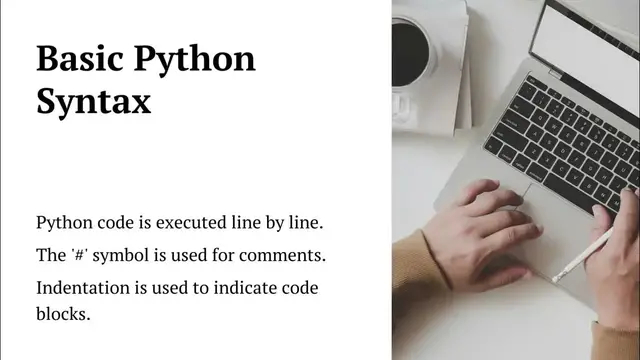

Introduction to Python Programming Language | Python, variables are used to store data.
Oct 15, 2023
Python is a general-purpose, high-level programming language. Its design philosophy emphasizes code readability with its notable use of significant whitespace. Its language constructs and object-oriented approach aim to help programmers write clear, logical code for small and large-scale projects.
Python is a popular choice for beginners in programming because it is relatively easy to learn and has a large community of users and developers. It is also a popular language for data science, machine learning, and artificial intelligence.
Here is a brief introduction to the Python programming language:
Variables and data types
In Python, variables are used to store data. To create a variable, you simply assign a value to it. For example, the following code creates a variable called name and assigns the value "Bard" to it:
Python
name = "Bard"
Use code with caution. Learn more
Python has a number of different data types, including strings, numbers, booleans, and lists. The data type of a variable determines what kind of data it can store and what operations can be performed on it.
Functions
Functions are used to group code together and perform a specific task. To create a function, you use the def keyword followed by the name of the function and a pair of parentheses. Inside the parentheses, you list the parameters that the function takes. The body of the function goes between the curly braces. For example, the following code creates a function called greet():
Python
def greet():
print("Hello, world!")
Use code with caution. Learn more
To call the function, you simply type the name of the function followed by a pair of parentheses. For example, the following code calls the greet() function:
Python
greet()
Use code with caution. Learn more
Conditional statements
Conditional statements allow you to control the flow of your code based on certain conditions. The most common conditional statements are if, else, and elif. For example, the following code uses an if statement to check if the variable name is equal to the string "Bard". If it is, the code prints a greeting to the console:
Python
if name == "Bard":
print("Hello, Bard!")
Use code with caution. Learn more
Loops
Loops allow you to repeat code a certain number of times or until a certain condition is met. The most common loops are for loops and while loops. For example, the following code uses a for loop to print the numbers from 1 to 10 to the console:
Python
for i in range(1, 11):
print(i)
Use code with caution. Learn more
Classes and objects
Python supports object-oriented programming concepts such as classes and objects. Classes are used to define the structure and behavior of objects. Objects are instances of classes.
For example, the following code creates a class called Person:
Python
class Person:
def __init__(self, name, age):
self.name = name
self.age = age
def greet(self):
print(f"Hello, my name is {self.name} and I am {self.age} years old.")
Use code with caution. Learn more
To create an object of the Person class, you would use the following code:
Python
person = Person("Bard", 2)
Use code with caution. Learn more
You can then access the members of the object using the dot notation. For example, the following code calls the greet() method on the person object:
Python
person.greet()
Use code with caution. Learn more
Conclusion
Python is a powerful and versatile programming language that can be used for a wide variety of tasks. It is a good language for beginners to learn, as it is relatively easy to learn and there are many resources available to help you get started.
If you are interested in learning more about Python, there are many resources available online and in libraries. You can also find many Python tutorials and courses on websites such as Coursera and Udemy.
Sources
dev.to/veldakiara/the-framework-for-perfectionists-with-deadlines-4n6c
profoundedutech.com/blog/what-is-python-and-benefit-of-python-course/
cgpioneer.in/rsx3e/python-cheat-sheet-poster
github.com/C5fifteen/python-examples
Show More Show Less