
Why Isn't a Year a Whole Number of Days?
Oct 28, 2026

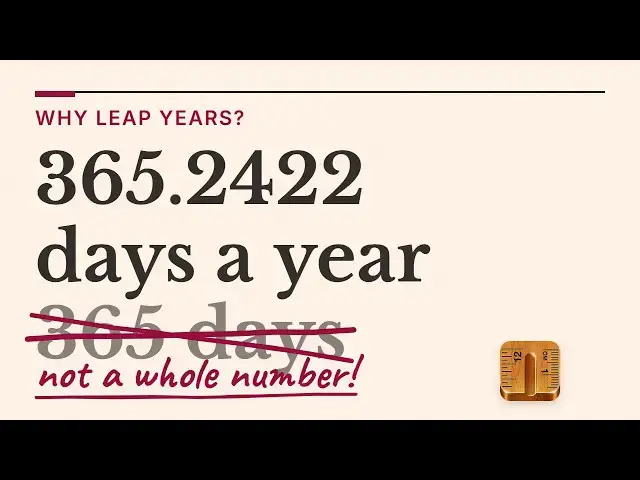
Why isn't a year a whole number of days? Because a day is one spin of the Earth and a year is one trip around the Sun, and nothing makes one fit a whole number of times into the other. A year, measured by the seasons, is about 365.2422 days: the leftover 0.2422 days is about 5.8 hours (5 h 49 min). Ignore it, and the calendar ends up about 24 days out of step with the seasons after a century.
This video also shows how Julius Caesar's leap day every fourth year made the average year 365.25 days, about 11 minutes too long, and how Pope Gregory XIII cut 10 days in 1582 and added the century rule: 97 leap days every 400 years, for an average of 365.2425 days, within half a minute of the seasons. It ends with why Britain and its American colonies had to drop 11 days in 1752, which moved George Washington's birthday from February 11 to February 22.
Try it yourself:
▶ https://www.metric-conversions.org/time/day-to-hour.htm
Chapters:
0:00 A birthday that moved
0:21 The awkward number
1:14 Ignoring the leftover
1:29 The Julian calendar
2:06 The Gregorian fix
2:59 Britain and America catch up
Sources:
• NPS: George Washington's Birthday: https://www.nps.gov/articles/000/george-washington-s-birthday.htm
• US Naval Observatory: Leap Years: https://aa.usno.navy.mil/faq/leap_years
• Days to Hours converter: https://www.metric-conversions.org/time/day-to-hour.htm
• Gregorian calendar – Wikipedia: https://en.wikipedia.org/wiki/Gregorian_calendar
• Calendar (New Style) Act 1750 – Wikipedia: https://en.wikipedia.org/wiki/Calendar_(New_Style)_Act_1750
Is there anything else you'd like us to cover? Let us know in the comments below.
Show More Show Less