0:00
Sometimes, you encounter a person so mean that all your regular old insults don't really do
0:05
them justice. Luckily, there's shabaroon, a fiery zinger of a word that can also refer to
0:11
an ill-dressed shabby fellow, according to English lexicographer Francis Grosse's A Classical
0:16
Dictionary of the Vulgar Tongue, first published in 1785. The word's etymology is uncertain
0:22
though one theory is that it might have been influenced by the word picaroon, which referred to a pirate or just any garden-variety scoundrel
0:30
Chabaroon was first recorded in the late 17th century, and I think it's high time we made it a thing in this century, too
0:36
Hi, I'm Erin McCarthy, editor-in-chief of mentalfloss.com, and if there's one thing that became clear to me while editing our new book
0:43
The Curious Compendium of Wonderful Words, it's that today's insults have nothing on the barbs and burns thrown in era's past
0:50
In this episode, we're dropping a few unforgettable insults from the book, and some others for good measure
0:55
just in case you ever need to spice up a squabble. Let's get started
1:05
First, let's talk about one of my favorite insults often used by my favorite president
1:09
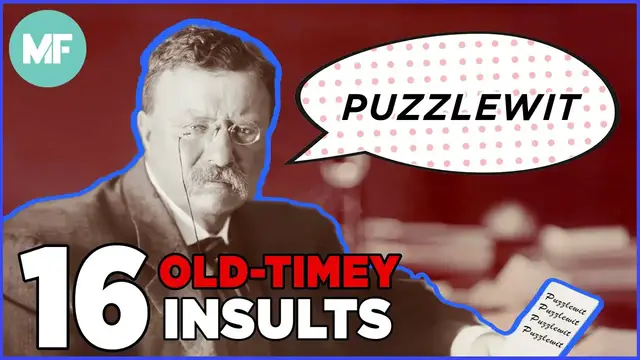
Theodore Roosevelt. According to the Oxford English Dictionary, puzzle wit was coined in
1:14
the 1860s and refers to one who is puzzled, a stupid or silly person. Tierra specifically
1:20
levied it against his former friend and handpicked presidential successor, William Howard Taft
1:25
craft, as we noted in our video about the sickest burns from history. Puzzle wit isn't just
1:29
an insult, by the way. It can also be used as an adjective to describe something that
1:33
puzzles or would puzzle one's wit. I prefer Teddy's use, though. Thank you very much
1:39
Unlicked cub refers to both an unformed ill young man and a rude uncouth young fellow as Grouse explained in a classical dictionary of the vulgar tongue If you need my permission to tell your friends to quit being unlicked cubs and watch Mental
1:52
Floss on YouTube, consider it granted. Here's an insult you couldn't use on someone who watches this channel
1:58
A sci-a-list is a person whose knowledge is only superficial, especially one who makes
2:03
much of it. A pretender to learning, according to the OED. and any expert would be able to easily see through their nonsense
2:11
The word came into English from Latin in the 1600s. Silas would probably act like they already knew that
2:16
We've probably all encountered a rude, gossipy person. And now you'll know exactly what to call them. Nashgab
2:24
The word dates back to the 19th century, and was likely formed by combining the word snash
2:28
meaning abuse, insolence, with gab. When the latter word was first recorded in the 18th century, it referred to lively conversation
2:36
according to the OED, but it later came to mean foolish or inconsequential talk. Put them
2:41
together and voila! Nashgab. On the topic of Nashgabs, quidnunc is a word derived from the Latin phrase quidnunc, or
2:48
what now, for a nosy, bossy person who's always on alert for the next juicy morsel of gossip
2:54
You know, I actually heard that Larry from HR has been a bit of a quidnunc lately
3:00
The 17th century term rapscallion has nothing to do with music or onions. According to the
3:05
In OED, it describes a rascal, rogue, or vagabond. Picture a troublemaker running through a crowded street stealing wares from various stalls
3:13
Another colorful alternative to rascal is scapegrace, a 19th century combo of the words
3:18
scape and grace that essentially means one who escapes the grace of God
3:24
You can also call them a wantgrace but that doesn roll off the tongue quite as well Do you know a gullible person who believes everything they told Let them know they a gobbmouche The word came into English from French in the early 19th century
3:37
But if you told a gobbmouche you made it up as a term of endearment just for them, they'd probably buy that too
3:43
Austin Powers had nothing to do with the term shagbag, which means a poor, sneaking fellow, a man of no spirit, according to Grouse
3:51
It could also be used to refer to something that's shabby in general. But also, in golf, a shagbag is a type of bag that allows you to pick up golf balls without bending over
4:00
So if a poor sneaking fellow owns a shabby old one, that's a shagbag, shagbag, shagbag
4:06
Language is strange. To blather is to talk a lot of nonsense, which makes a blatherskite a person who loudly talks a lot of nonsense
4:14
Its first recorded usage is in a mid-17th century folk song attributed to Scottish poet Francis Simpel
4:19
Right, scornfully, she answered him, Begone ye, Hallin' Shaker! Jog on your gait, you blather skate. My name is Maggie Lauder
4:28
Dang, I wouldn't want to yell nonsense around Maggie. The next time you encounter an utter coward, you can call them a poltroon, which came into
4:36
English from French in the 16th century. They'll probably be too much of a poltroon to ask
4:41
you what poltroon means. If you're like me and believe that there's no such thing as too much time in bed, here's
4:47
an insult you might actually wear with pride. Slug-a-bed is a term for a person who stays in bed late, and apparently it hasn't been
4:54
used much since the early 20th century, which is a real shame
4:58
The OED's first citation is none other than Romeo and Juliet. In a scene towards the end of the play, Juliet's nurse goes to fetch her charge, who she finds
5:06
is still in bed. Why, lamb? Why, lady? Fie you slug she says before pulling back the curtain to discover Juliet is dead Oh sorry uh spoiler alert Galempus seems like the perfect word to describe a large clumsy fellow which is convenient because that exactly what it means
5:23
It might sound like a Ruel Dahl original, but it actually predated his work by several decades
5:28
I'm currently picturing the troll from the first Harry Potter movie, but any big, clumsy
5:32
guy will do. Okay, sure, you could tell someone they're loathsome, but the alternate form of that
5:38
insult, loathly, sounds even more scathing. The word could be found as early as 900
5:43
It eventually fell out of favor before being revived in literary works in the 19th century
5:48
Peter Pan author J.M. Barry used it in his 1986 book Margaret Ogilvie, writing
5:53
I don't know about you, but this passage really brought back visions of the pens I used to
6:01
chew in high school. I'm not proud. Scaramouche was a stock character from Italy's Commedia dell'arte, a type of theater production
6:09
with ensemble casts, improvisation, and masks. He was easily identified by his boastful yet
6:15
cowardly manner. And from the 1600s through the 1800s, you could call any boastful coward
6:20
a Scaramouche. If the obsolete expression sounds kind of familiar to you, it might be
6:25
because you're a music fan. The band Queen borrowed it for their operatic masterpiece
6:30
Bohemian Rhapsody, though Scaramouches aren't necessarily known for doing the Fandango. Make sure to check out our new book, The Curious Compendium of Wonderful Words. You'll learn
6:39
all about the origins of everyday phrases, like why we tell people to take it with a grain of salt
6:45
and find out the science behind our collective hatred of the word moist. We also cover obscure
6:49
stories in word history, like the murderer who contributed to the Oxford English Dictionary
6:54
and offer tips for taking your Scrabble, Wordle, and Crossword games to the next level
6:59
We'll pop a link in the description below. See you next time