Up next in 10

Atoms In A Grain Of Sand
Jun 19, 2026

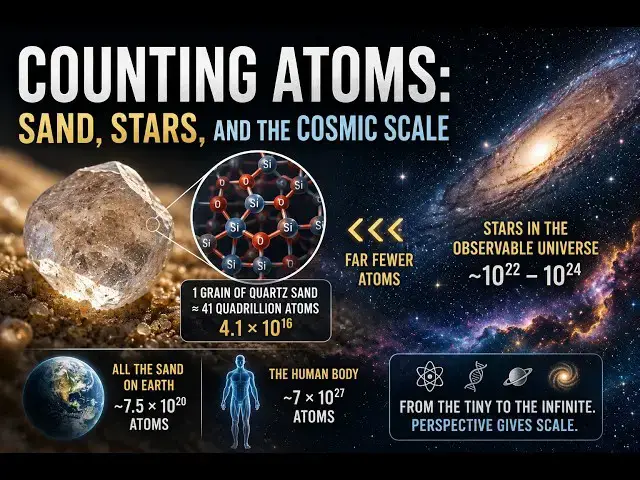
Have you ever heard that a single grain of sand contains more atoms than there are stars in the universe?
It sounds incredible, but is it actually true?
Visit the Article: https://lancelhoff.com/atoms-in-a-grain-of-sand/
In this video, we break down the science behind one of the internet's most repeated cosmic claims. Starting with a tiny grain of quartz sand, we'll estimate how many atoms it contains and compare that number to the estimated stars in the observable universe.
Along the way, you'll discover:
• How scientists estimate the number of atoms in everyday objects
• How many atoms are in a grain of sand
• How many stars exist in the observable universe
• Why the popular comparison is often misunderstood
• How atomic and cosmic scales compare to the human body and even all the sand on Earth
From the microscopic world of atoms to the vast expanse of galaxies, this journey puts some of nature's biggest numbers into perspective.
If you enjoy science, astronomy, physics, and mind-bending facts about the universe, be sure to like, subscribe, and share.
#Atoms #Science #Astronomy #Universe #Physics #Cosmos #Space #Stars #Sand #EducationalVideo
Show More Show Less View Video Transcript
0:00
All right, welcome to today's explainer.
0:02
We're about to embark on a seriously
0:04
mind-bending journey that honestly
0:05
stretches the very limits of human
0:07
imagination. We are going to be
0:09
exploring the extreme microscopic
0:11
building blocks of our reality and then
0:13
we'll zoom all the way out to the
0:15
unimaginable macroscopic scales of our
0:17
entire universe. It's a journey of true
0:19
cosmic scale where we're pitting the
0:21
absolute tiniest specks of matter
0:23
against the sheer vastness of space.
0:26
Okay, let's dive right into this. You've
0:28
probably heard this famous claim
0:30
floating around the internet, right? Or
0:32
maybe someone dropped it at a dinner
0:33
party. There are more atoms in a grain
0:35
of sand than stars in the universe. It
0:38
sounds profoundly poetic. I mean, it
0:40
makes us feel incredibly large and
0:42
incredibly small at the exact same time.
0:45
But as fascinating as this widely shared
0:47
fact is, we kind of have to ask
0:49
ourselves, is it actually true? Well,
0:52
today we are going to run the numbers,
0:53
consult the science, and settle this
0:56
cosmic debate once and for all. So, to
0:59
actually answer this question, we first
1:00
need to establish exactly what we're
1:02
measuring. Like, what is a typical grain
1:04
of sand made of? While sand composition
1:07
definitely varies all across the world,
1:08
a lot of those beautiful beach sands are
1:10
primarily composed of a mineral called
1:12
quartz. And chemically speaking, quartz
1:14
is silicon dioxide or SiO2. This means
1:18
every single molecule of quartz consists
1:20
of just one silicon atom tightly bound
1:22
to two oxygen atoms. So for every
1:24
molecule of quartz sand, we are looking
1:26
at exactly three atoms. This gives us a
1:29
really solid factual baseline for the
1:30
math we're about to do. But before we
1:33
start counting at wraps around the sheer
1:36
size here,
1:38
standard grain of sand
1:41
in diameter. Now compare that to the
1:43
diameter of a single silicon atom, which
1:45
is a mind-bogglingly microscopic 0.3
1:48
nanome. To put that into perspective, a
1:51
simple tiny grain of sand, you know, the
1:53
kind that annoyingly sticks to your feet
1:54
at the beach, is roughly 300,000 times
1:57
wider than a single silicon atom. And
1:59
honestly, it's this massive disparity in
2:02
size that allows literally so many atoms
2:04
to pack into a single tiny grain. So,
2:07
how do researchers actually figure out
2:08
how many atoms are in there? Well, they
2:10
don't just guess. They use a rigorous
2:12
step-by-step scientific method. First,
2:14
they calculate the volume of our
2:16
little.1 mm spherical grain. Next, using
2:19
the known density of quartz, they
2:20
calculate its mass, which is a tiny tiny
2:23
fraction of a gram. From there, they use
2:25
molecular weights to find the number of
2:26
moles and then apply Avagadro's number.
2:29
And hey, don't worry. There won't be a
2:30
pop quiz on high school chemistry today.
2:32
But that gives us the total molecules,
2:34
which comes out to roughly 1.39 * 10
2:37
16th. Finally, since we know there are
2:39
three atoms per molecule of silicon
2:40
dioxide, they simply multiply that
2:42
number by 3. And the result of all that
2:44
calculation, 4.17 * 10^ 16th power. If
2:49
we write that whole shebang out, it
2:51
means that our single small 0.1 mm grain
2:54
of sand contains roughly 41 quadrillion
2:58
atoms. Just take a second to let that
3:00
sink in. 41 quadrillion. That is a 41
3:04
followed by 15 zeros. It is a magnitude
3:07
so unimaginably large that our human
3:09
brains genuinely struggle to even
3:10
visualize it. And all of that is
3:12
contained within a tiny speck of rock
3:14
you can barely even feel between your
3:16
fingers. Now what's really interesting
3:18
about this is when we contrast that
3:20
massive number with the cosmos.
3:22
Astronomers using some incredibly
3:24
advanced telescopes and mathematical
3:26
models estimate that there are roughly
3:28
10 to the 22nd power stars in the
3:31
observable universe. And notice I said
3:33
the observable universe. just a part of
3:35
the cosmos whose light has actually had
3:37
time to reach us. 10 to the 22nd power.
3:40
That's a one followed by 22 zeros. So,
3:44
here's the moment of truth. When we put
3:46
41 quadrillion atoms up against 10^ the
3:48
22nd power stars, the universe
3:51
absolutely wins this round. In fact,
3:53
there are roughly 240,000 times more
3:56
stars in the observable universe than
3:58
there are atoms in a small grain of
4:00
sand. So, yeah, we have officially
4:02
busted the myth. But hey, don't let this
4:04
diminish the magic of the sand grain.
4:06
The only reason the universe wins is
4:07
simply because it is unimaginably vast,
4:10
filled with billions upon billions of
4:12
galaxies, and each of those contains
4:14
billions of stars. But let's pivot back
4:16
to Earth for a second. We know how many
4:18
atoms are in one grain. But what about
4:20
all the sand in the world? Researchers
4:23
have actually tried to estimate the
4:24
total number of individual sand grains
4:26
existing on our entire planet. We're
4:28
talking every beach, every desert, every
4:30
ocean floor. And that number is
4:32
estimated to be roughly 7.5 * 10 18th
4:36
power. That's 7.5 quintilion grains of
4:39
sand. So the really crucial point here
4:42
is how these two earthbound numbers
4:44
compare. When we weigh the entire
4:46
planetary supply of sand against the
4:48
atoms hiding inside just one tiny speck,
4:51
we find that there are about 180 times
4:53
more grains of sand on Earth than atoms
4:55
in one small grain of sand. I mean,
4:57
think about that. The entirety of the
5:00
Sahara Desert, all the sand dunes, every
5:02
beach trip you've ever taken, all of it
5:04
combined, is only 180 times larger in
5:06
quantity than the microscopic atoms
5:08
composing just a single tiny grain.
5:10
Crazy, right? Now, I promised you an
5:13
ultimate plot twist in this explainer,
5:15
and here it is. We've talked about sand,
5:18
and we've talked about stars. Now, let's
5:20
talk about you. The estimated number of
5:22
atoms in an average adult human body is
5:25
an absolutely staggering 7 * 10^ the
5:28
27th power. Put another way, that is 7
5:31
octillion atoms. When we compare
5:33
ourselves back to our little baseline,
5:35
we discover that the human body contains
5:37
roughly 170 billion times more atoms
5:39
than a small grain of sand. We are
5:41
infinitely complex, walking, talking,
5:44
breathing galaxies of atoms. And what's
5:46
really fascinating is that the vast
5:47
majority of these seven octian atoms
5:49
inside of you are simply hydrogen,
5:51
oxygen, carbon, and nitrogen. Literally
5:54
the same fundamental elements found
5:55
throughout the stars we were just
5:56
talking about. And this brilliantly
5:59
illustrates our whole journey today.
6:01
Let's consolidate these mind-bending
6:02
data points to really see the clear
6:04
escalation in scale here. We escalate
6:06
from the microscopic 10 the 16th in a
6:09
single sand grain. Move up to the
6:11
planetary scale with all the sand on
6:12
Earth. Leap to the cosmic scale of the
6:14
observable universe. And then finally
6:17
top the entire chart with a biological
6:19
marvel that is you. Now if your head is
6:22
kind of spinning from all these powers
6:24
of 10, understandable. We can easily
6:26
wrap our heads around a thousand or a
6:28
million. But as those zer pile up, the
6:31
scale just explodes. We jump from
6:33
billions to the quadrillions of our sand
6:35
grain past the quintilians of total
6:38
earth sand, the sextillions of stars all
6:41
the way to the staggering realm of
6:42
octillions, a one followed by 27 zeros.
6:46
Grasping this math is absolutely crucial
6:47
to making sense of our reality. Okay,
6:50
before we wrap up, let's quickly clear
6:51
the air and separate fact from fiction.
6:54
First major misconception, there are
6:55
always more atoms in a sand grain than
6:57
stars. Nope, false. As we've proven, the
7:00
observable universe takes the crown
7:02
there. Second, the answer depends
7:04
entirely on the size of the sand grain
7:05
you actually choose to measure. Larger
7:07
grains naturally contain exponentially
7:09
more atoms. Third, different beaches
7:11
have different sand, meaning wildly
7:12
different atom counts based on their
7:14
chemical composition. And finally, not
7:16
all sand is made of quartz. Sand is
7:18
actually just a classification of size,
7:20
not necessarily a strict rule about what
7:21
the mineral actually is. Which brings us
7:24
to the end of our explainer and a final
7:26
thought I really want to leave you with
7:27
today. We looked up at the stars. We
7:29
looked down at the sand. But ultimately,
7:31
the absolute most astonishing numbers
7:33
were found inside of you. You sit
7:36
perfectly positioned right between the
7:37
microscopic world of atoms and the vast
7:39
expanse of the cosmos. So, I just have
7:41
to ask, if you contain billions of times
7:44
more atoms than a grain of sand, aren't
7:45
you a universe all your own? Thank you
7:48
so much for exploring with me today, and
7:49
keep questioning the incredible world
7:51
around you.
Arts & Entertainment