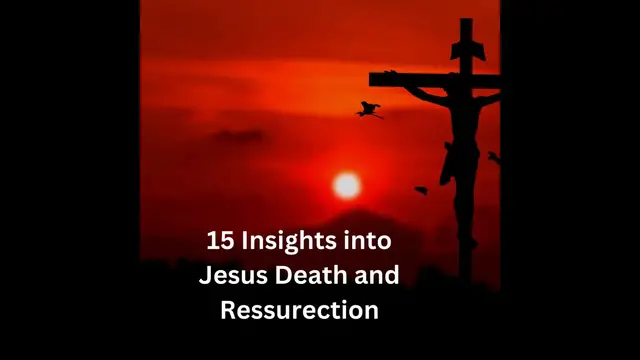

15 Insight into Jesus Death and Ressurection
Jun 16, 2024
Insights into Jesus Death and Ressurection - greg
The death and resurrection of Jesus Christ are central events in Christianity, carrying profound theological significance. These events are described in detail in the New Testament, particularly in the Gospels of Matthew, Mark, Luke, and John.
Here are 15 unique insights into the death and resurrection of Jesus:
1. Passover Timing
The crucifixion of Jesus coincided with the Jewish festival of Passover. This timing is significant because Passover commemorates the Israelites' liberation from Egypt, symbolizing Jesus as the sacrificial Lamb of God who delivers believers from sin.
2. The Last Supper
The Last Supper, which Jesus shared with his disciples before his arrest, is commemorated by Christians as the institution of the Eucharist. During this meal, Jesus broke bread and shared wine, symbolizing his body and blood, establishing a new covenant.
3. Gethsemane Agony
In the Garden of Gethsemane, Jesus experienced intense anguish and prayed fervently, asking God if the cup of suffering could be taken from him. This moment highlights Jesus' human vulnerability and submission to God's will.
4. Betrayal by Judas
Judas Iscariot, one of Jesus' twelve disciples, betrayed him for thirty pieces of silver. Judas' betrayal led to Jesus' arrest and subsequent trial. This act fulfilled the prophecy from Zechariah 11:12-13.
5. Illegal Trials
Jesus underwent a series of illegal trials, first before the Jewish Sanhedrin and then before the Roman authorities, Pontius Pilate and Herod Antipas. These trials were held at night, contrary to Jewish legal procedures.
6. Pontius Pilate's Role
Pontius Pilate, the Roman governor, played a pivotal role in Jesus' crucifixion. Although he found no fault in Jesus, he succumbed to the crowd's demands for crucifixion to avoid a riot and maintain political stability.
7. Scourging and Mockery
Before being crucified, Jesus was scourged, a brutal form of Roman punishment. Soldiers mocked him, placing a crown of thorns on his head and a purple robe on his body, mocking his claim to kingship.
8. Via Dolorosa
The path Jesus walked to his crucifixion site, known as the Via Dolorosa, or "Way of Suffering," is a significant pilgrimage route in Jerusalem. It includes several traditional stations marking events that occurred along the way.
9. Crucifixion Method
Crucifixion was a Roman method of execution reserved for the worst criminals. Jesus was nailed to a cross, with nails driven through his wrists and feet, causing immense suffering and a slow death by asphyxiation.
10. Seven Last Words
Jesus spoke seven phrases from the cross, known as the Seven Last Words. These include expressions of forgiveness, fulfillment of scripture, and his final surrender to God. Each phrase holds deep theological significance.
11. Darkness and Temple Veil
At the moment of Jesus' death, darkness fell over the land, and the temple veil, separating the Holy of Holies from the rest of the temple, was torn from top to bottom. This symbolized the removal of the barrier between God and humanity.
12. Burial by Joseph of Arimathea
Joseph of Arimathea, a wealthy member of the Sanhedrin and secret follower of Jesus, requested Pilate for Jesus' body. He buried Jesus in his own new tomb, fulfilling the prophecy in Isaiah 53:9.
13. Women Witnesses
The first witnesses of Jesus' resurrection were women, including Mary Magdalene. This is significant in a historical context where women's testimonies were not highly valued, highlighting the counter-cultural nature of the Gospel.
14. Road to Emmaus
On the day of his resurrection, Jesus appeared to two disciples on the road to Emmaus. They did not recognize him until he broke bread with them, illustrating how Jesus revealed himself through scripture and fellowship.
15. Great Commission
After his resurrection, Jesus appeared to his disciples and gave them the Great Commission, instructing them to spread the Gospel to all nations, baptizing them and teaching them to obey his commands. This directive is foundational to Christian mission and evangelism.
Final Thoughts
The death and resurrection of Jesus are pivotal to Christian faith, symbolizing sacrifice, redemption, and the promise of eternal life. These events, rich with theological depth and historical context, continue to inspire and guide believers worldwide. By understanding the intricate details and significance of these occurrences, one gains a deeper appreciation for the foundational truths of Christianity.
Show More Show Less