Up next in 10


📚 PARTS OF SPEECH – PRONOUNS | Easy English Grammar Lesson
Welcome to Think Better with Rimple! 🌟
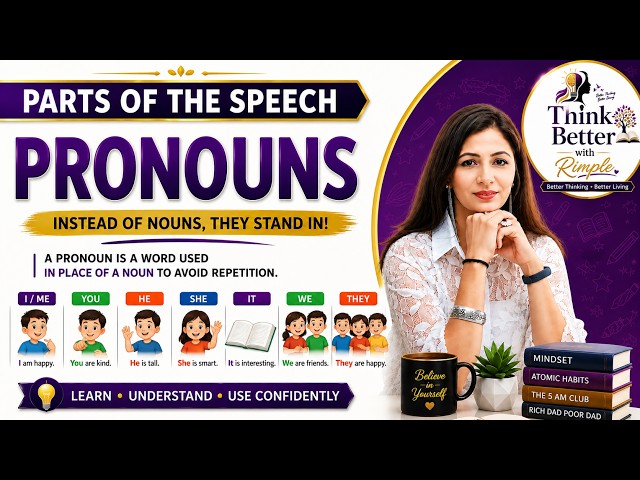
In this video, you will learn about PRONOUNS in a simple, fun, and easy-to-understand way. Pronouns are words used in place of nouns to avoid repetition and make sentences smoother and more natural.
✨ In this lesson, you will learn:
✔ What are pronouns?
✔ Why pronouns are important
✔ Different types of pronouns
✔ Easy examples for daily use
✔ Sentence practice for students
✔ Simple grammar explanation for beginners
📘 Examples included:
👉 I, You, He, She, It, We, They
👉 How to use pronouns correctly in sentences
👉 Common mistakes to avoid
🎯 This video is perfect for:
✅ School students
Show More Show Less View Video Transcript
0:00
Hello friends. Good morning. Today I'm
0:02
going to give you the thorough
0:04
explanation of the next parts of speech,
0:07
that is pronouns.
0:09
Let's discuss the lesson agenda. Today
0:12
we will discuss what are pronouns, the
0:15
types of pronouns which are
0:17
demonstrative, reflexive, relative,
0:21
indefinite, interrogative, possessive,
0:24
and personal pronouns. What is a
0:26
pronoun? Pronouns are the words that
0:29
replace nouns, groups of words
0:31
functioning as nouns, or other pronouns.
0:34
So in simple words, pronouns are those
0:36
words which are used in place of the
0:39
noun.
0:40
There is one more term which you should
0:42
understand, and the term is antecedent.
0:45
What is antecedent? It is a word that a
0:48
pronoun replaces or refers to is called
0:51
its antecedent.
0:53
Every pronoun has an antecedent, even if
0:56
it's not in the same sentence. Let's try
0:59
to understand with the help of an
1:01
example.
1:02
Samira loves watching movies. So here
1:04
Samira is the noun.
1:07
So it is Samira which we are going to
1:09
replace with a pronoun.
1:11
So she's a female, so in place of Samira
1:14
we will use the word she. But she is not
1:18
fond of horror movies. So here she is a
1:21
pronoun which has taken the place of
1:23
Samira,
1:25
and because it's Samira in place of
1:28
which we have used the word she, so here
1:31
Samira, the noun, is the antecedent.
1:34
Let's start with the understanding of
1:36
different types of pronouns. First of
1:39
all, we are going to discuss are the
1:40
personal pronouns. What are personal
1:43
pronouns? Personal pronouns refer to
1:46
those pronouns which are used in place
1:48
of specific people, places, things, or
1:51
ideas, and they indicate whether the
1:53
noun in the first person is at the
1:55
second person or at the third person.
1:58
Personal pronouns can be singular or
2:00
plural. If we talk about first person,
2:03
the pronouns which are used in place of
2:05
it are I and me. And if it's plural,
2:08
it's we and us. For second person, both
2:12
for singular and plural, the pronoun
2:14
that we use is you. And when we talk
2:17
about the third person, at singular
2:19
place, we use the pronouns like he, she,
2:22
it, him or her. But if it is plural,
2:25
then we use the pronouns like they and
2:28
them.
2:29
Let's try to understand with the help of
2:31
the example.
2:32
If we say, "The apple was picked by me."
2:36
Here, the personal pronoun is me. It
2:39
refers to the speaker of the sentence.
2:43
Samira will buy coffee for you. Here,
2:46
you, the personal pronoun, is referring
2:49
to the person who is being spoken to.
2:51
This is about the journey.
2:54
Aaron gave him the laptop. Here, the
2:58
pronoun him refers to the person about
3:01
whom we are talking about. It means the
3:04
first and second person are talking
3:06
about some third person. So, for him, we
3:09
are using the pronoun him. I hope the
3:12
things are made clear. Let's also
3:14
understand that if I am talking about
3:17
the pronoun he and him, we always use it
3:20
for males. She and her, we use for
3:24
females. And if we are using it, it is
3:27
used for things or we even use it for
3:30
animals and birds.
3:33
Next pronouns which we are going to
3:34
discuss are the possessive pronouns.
3:37
Possessive pronouns are the pronouns
3:39
which are used to express the possession
3:42
or the ownership.
3:44
They don't require any apostrophe.
3:47
If we talk about first person, then we
3:49
use my and mine. And for plural we use
3:53
our and ours.
3:55
In second person, we use your and yours,
3:58
and in plural it still remains the same.
4:01
And for third person, in singular we use
4:04
his, her, hers, or its, and in plural we
4:08
use their and theirs.
4:12
Let's take an example.
4:13
If I'm talking about the first person,
4:15
if I say, "The pencil is mine." So, here
4:18
the possessive pronoun mine refers to
4:21
the ownership of the speaker.
4:24
Next sentence, "This calculator is
4:27
yours."
4:28
The possessive pronoun yours here refers
4:31
to the ownership of the person whom we
4:34
are being speaking to.
4:37
And the third sentence, "Her book is
4:39
missing." Here the possessive pronoun
4:42
her refers to the ownership of the
4:44
person being talked about.
4:48
So, the words like mine, yours, her,
4:52
his, all are possessive pronouns. Third
4:55
type of pronoun is indefinite pronouns.
4:58
As the word itself reflects, they are
5:01
the pronouns which refers to no
5:04
particular person, thing, or quantity.
5:07
So, the name indefinite, about which we
5:10
are not definite about, about which we
5:13
are not clear about. Some examples are
5:16
all, any, both, each, most, much,
5:20
neither, someone, etc.
5:23
Let's take some more examples in form of
5:25
sentences.
5:27
"Everyone in the class needs to come up
5:29
with an idea." Here the indefinite
5:32
pronoun everyone refers to an unspecific
5:35
person in the class. We are talking
5:37
about everyone.
5:39
Similarly, "Someone messaged her." Here
5:42
the indefinite pronoun is someone. It
5:45
refers to any unspecific person.
5:48
Similarly, how much will it cost to
5:51
build a house? So, here the indefinite
5:54
pronoun much refers to an unspecific
5:58
amount.
5:59
Next type of pronouns are interrogative
6:02
pronouns. As the name itself reflects,
6:05
interrogation means asking questions.
6:08
So, an interrogative pronoun is a
6:10
pronoun which is used to ask questions.
6:13
Some of the common pronouns are who,
6:16
whom, whose, which, what. Let's try some
6:20
easy examples. Who is your best friend?
6:23
So, here who reflects the interrogative
6:26
pronoun. What is your name? Here what
6:29
reflects an interrogative pronoun.
6:33
The next type of pronoun are the
6:35
demonstrative pronouns. A demonstrative
6:38
pronoun is a word which is used to point
6:41
out to a person, place, animal, or
6:43
thing. Just to help you understand,
6:46
always remember
6:48
under demonstration, always four
6:50
important words come. This, that, these,
6:54
and those.
6:56
This and these are used for the
6:58
objects or the people who are near to
7:01
us. And that, those are used for the
7:04
things or the people who are far away
7:06
from us. So, this is my pen. These are
7:10
my pens.
7:12
That is your bag. Those are your bags.
7:16
So, this, that, these, those are the
7:19
four words which are considered
7:22
demonstrative pronouns. Next type of
7:24
pronouns are reflexive pronouns. A
7:27
reflexive pronoun is a type of pronoun
7:30
that refers back to a noun or a pronoun
7:33
within a sentence.
7:34
This pronoun can act as an object in a
7:37
sentence. For example, in case of
7:40
reflexive pronoun, always remember with
7:43
the pronouns with simple pronouns we are
7:45
going to attach self or selves. For
7:49
example, if I say I will do my work
7:52
myself.
7:54
You will do your work yourself.
7:58
In first person, myself is singular,
8:01
ourselves is plural. In second person,
8:04
yourself is singular, but when we talk
8:07
about more than one person, we say
8:10
yourselves.
8:12
And in third person, in singular place,
8:15
the words like himself, herself, or
8:18
itself comes. But when it's plural, then
8:21
we use the word themselves.
8:24
I have given some examples as well.
8:26
Under first person, I can take the
8:28
example I bought myself flowers. So here
8:32
the reflexive pronoun myself is
8:34
referring back to the subject of the
8:36
sentence, that is I.
8:39
In second person, I have taken the
8:40
example you help yourself with the
8:43
dinner. So here yourself is referring
8:46
back to the subject of the sentence,
8:48
that is you.
8:50
And finally in third person, she ordered
8:53
herself a cake or she ordered a cake
8:56
herself. So here the reflexive pronoun
8:59
herself refers back to the subject of
9:02
the sentence.
9:05
There is one more type of pronouns that
9:07
are the relative pronouns, which we will
9:09
do in proper detail when we'll be
9:11
reaching the conjunctions. But first of
9:14
all, let's try to understand what are
9:15
relative pronouns. A relative pronoun is
9:18
a pronoun which helps us to join two
9:20
sentences or gives more information
9:23
about the noun.
9:24
Here are some words which are used as
9:26
relative pronouns are who, whom, whose,
9:30
which, that. Let's try with some
9:33
examples. The boy who gave the idea is
9:37
Rohan. So, here who is adding more
9:41
information about the subject, that is
9:43
the boy.
9:45
The another example, this is the message
9:47
that I received yesterday. So, the more
9:51
information is being added about the
9:53
message is I received yesterday. So,
9:55
here the words like who and that are the
9:59
relative pronouns. One more example I
10:01
have given, the women whose money was
10:04
stolen called the police. So, here whose
10:07
is the relative pronoun. Now, you might
10:10
be assuming that there are so many
10:12
pronouns and their types, how it is
10:14
possible to learn them all. I have made
10:16
a very simple acronym to remember all
10:19
the types of pronoun and the acronym is
10:22
drip.
10:23
Where D comes one time, R I P comes two
10:28
times each. D stands for demonstrative
10:31
pronouns, R one is reflexive pronouns, R
10:35
two is relative pronouns. Then I, I one
10:39
is indefinite pronouns and I two is
10:42
interrogative pronouns. And finally
10:45
comes P, P one is the personal pronouns
10:48
and P two is the possessive pronouns.
10:51
So, with the help of this acronym it
10:53
will be very easy to remember all the
10:55
types of the pronouns. I hope I have
10:58
made you understand pronouns in an easy
11:01
way. Thank you so much students. Follow
11:03
and subscribe. Think better, think
11:05
different.
#People & Society