Up next in 10


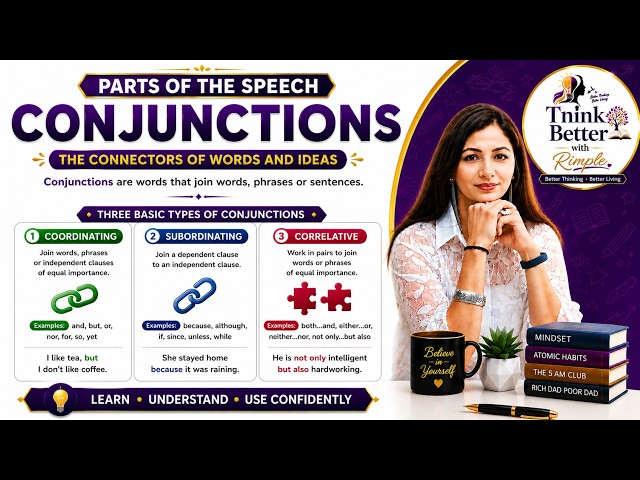
📚 CONJUNCTIONS | Parts of Speech Made Easy
Welcome to Think Better with Rimple! 🌟
In this video, you will learn the basics of CONJUNCTIONS in the easiest and most interesting way. This lesson is specially designed for beginners and school students who want to improve their English grammar confidently.
✨ In this lesson, you will learn:
✔ What are conjunctions?
✔ Coordinating Conjunctions
✔ Subordinating Conjunctions
✔ Correlative Conjunctions
✔ Easy rules with examples
✔ Daily-use sentence practice
📘 Examples Included:
👉 and, but, or
👉 because, although, while
👉 either…or, neither…nor
🎯 Perfect for:
✅ School students
Show More Show Less View Video Transcript
0:04
Good morning students. So we have
0:05
already covered various parts of the
0:07
speech. Today the next parts of the
0:10
speech that I'm going to explain you is
0:12
conjunctions. So first of all let's
0:15
check what are the various lesson
0:17
objectives that I'm going to cover
0:19
during this video.
0:23
So, I'm going to explain you the
0:25
functions of conjunctions, identify
0:27
different types of conjunctions,
0:30
determine how conjunctions function in
0:33
specific sentences, and use conjunctions
0:36
correctly in our own writing. So, first
0:40
of all, I'm going to explain you what a
0:43
conjunction is. A conjunction is a word
0:47
that joins words, phrases, and clauses.
0:52
Conjunctions ensure that sentences are
0:55
smooth and coherent.
0:58
There are mainly three categories of
1:00
conjunctions which I'm going to explain
1:02
in the coming slides. They are
1:05
coordinating conjunctions, subordinating
1:07
conjunctions and correlative
1:09
conjunctions.
1:11
But before we jump to the type of
1:13
conjunctions, let's see how conjunctions
1:16
help us to join the words. For example,
1:19
if I say there are two people Rimple and
1:22
Pra. So if I have to connect them, I'm
1:25
using the word and. Rimple and Pra are
1:29
going to market. So here and is a
1:32
conjunction.
1:34
Let's take another example. Rimple is
1:37
going to market because she needs to buy
1:40
some grocery. So here there are two
1:43
parts in a sentence. Rimple is going to
1:46
the market. She needs to buy the
1:49
grocery. I have connected these two
1:52
parts with the help of a word because
1:55
and here because is a conjunction.
1:59
So now first thing which I'm going to
2:01
explain you are the coordinating
2:04
conjunctions. Let's understand what are
2:07
coordinating conjunctions. Coordinating
2:09
conjunctions help us to join equal parts
2:12
of a sentence. In simple words,
2:16
coordinating conjunctions help us to
2:18
join two independent sentences.
2:21
Now your question might be what is an
2:23
independent sentence? Independent
2:26
sentence means a sentence which can be
2:28
written alone. It makes a complete
2:31
meaning in itself. For example, Rimple
2:34
is a good girl. Ram is going to the
2:37
market.
2:39
So now the coordinating conjunctions
2:41
which are mainly used to join two
2:44
sentences
2:46
follow an acronym. It is very easy to
2:48
remember these coordinating conjunctions
2:51
using an acronym. Fan boys.
2:54
Here the f stands for for a and n nor b
3:02
but o or o or y yet s. So so there are
3:09
total 1 2 3 4 5 6 seven coordinating
3:12
conjunctions.
3:14
So when a coordinating conjunction is
3:16
used to join two independent clauses, a
3:19
comma is always used before the
3:22
conjunction. Remember it. If you are not
3:24
going to use the comma, it is going to
3:27
be a grammatical error. Check the
3:29
examples. I love movies and popcorn. So
3:32
here movies and popcorn are joined with
3:35
and
3:37
it was getting dark so I went inside. It
3:41
was getting dark is one independent
3:43
clause. I went inside is another
3:46
independent clause. And I have joined
3:49
them using a conjunction so. And there
3:52
is a comma before saw. Let's see one
3:56
more example. I was tired but I finished
4:00
my homework. I was tired is one
4:03
independent part. I finished my homework
4:06
is another independent part and I have
4:08
joined the two clauses with the help of
4:11
a conjunction using but and I have used
4:14
a comma before it.
4:18
Now the next slide I have explained the
4:21
functions of the coordinating
4:23
conjunctions. Usually students find it
4:26
difficult you know to understand where
4:28
to use which coordinating conjunction,
4:31
where to use for, where to use and.
4:34
Let's understand the function of each
4:37
coordinating conjunction properly and
4:39
use them in the sentences. The first
4:42
coordinating conjunction that comes is
4:45
for. What is for used for? For is always
4:49
used whenever you have to give a reason
4:52
or you have to give a purpose. Check
4:54
this sentence. He left early for he was
4:58
feeling sick. So here in case of
5:01
coordinating conjunctions for is being
5:03
used in the form of because. Because is
5:06
used to give a reason but we can't use
5:08
it as a coordinating conjunction. So
5:09
here for is used when we have to explain
5:12
a reason. He left early,
5:15
for he was sick because he was sick.
5:19
Next is and. And and you have to always
5:22
use when you have to add one thing to
5:25
the another.
5:27
Let's see the example. The sun rose and
5:31
the birds chirped. So these are two
5:34
sentences which I have just joined with
5:36
one another. The sun rose, and the birds
5:41
chirped.
5:43
Next comes nor.
5:46
Nor is a coordinating conjunction that
5:48
you're going to use when you have to
5:50
showcase a negative idea.
5:53
Check the example. I cannot sing nor can
5:57
I dance. So here when you have to tell
6:00
that you can neither sing nor dance. But
6:02
when we have to use it as a coordinating
6:04
conjunction, I have used nor. I cannot
6:08
sing, nor can I dance. Full stop.
6:14
Next comes but. But is always used when
6:17
you have to join two opposite things.
6:19
When you have to show a contrast.
6:22
Check the example. The lizard is small
6:26
but it is fast. So I'm saying that the
6:28
lizard is small in size but still it
6:31
fast. It runs fast. So here I have used
6:34
the coordinating conjunction but.
6:37
Next is or. Or we always know is always
6:40
used when we have to just give a choice
6:44
when you have to indicate an
6:45
alternative.
6:47
She can cook or she can order takeout.
6:52
Yet mostly students get confused with
6:55
yet. Yet is also used like but it is
6:59
used to show a contrast or an exception.
7:03
See the example. They played well
7:07
yet they lost the game.
7:13
So here yet is used in place of for B.
7:18
And last coordinating conjunction is so.
7:22
So
7:25
it is mainly used when you have to show
7:27
a result or you have to show an effect.
7:31
It started to rain so I stayed inside.
7:39
So see so is is
7:43
I hope I have made you understand each
7:45
and every coordinating conjunction.
7:48
Let's move on to the next slide now.
7:51
Okay. So here the coordinating
7:54
conjunctions I have given and I have
7:56
given some examples. Let's try to fit in
7:59
the words and let's see how well you are
8:02
able to fit in the right words. The
8:05
first question is I wanted to go to park
8:08
dash it started to rain
8:17
what we use but
8:19
see the next example. You can finish
8:22
your homework now dash you can do it
8:24
after practice
8:27
homework
8:30
practice
8:32
to I'm giving a choice. So whenever a
8:35
choice has to be given we always use or
8:40
check the third question every does not
8:43
like spaghetti dash she does enjoy
8:47
lasagna. So here we are giving a
8:50
negative thing that she neither likes
8:52
this nor that. So here clearcut the
8:55
conjunction which will come is nor.
8:59
See the fourth example he studied
9:02
nightly for the test dash he earned the
9:05
highest grade.
9:13
I told you
9:15
the effect we use the conjunction so.
9:20
Check the last question. The cat louned
9:23
on the window sill dashed the dog slept
9:27
on the couch. We are talking about two
9:29
different things and we have to connect
9:31
them. So directly the conjunction which
9:34
is going to come here is at. Let's check
9:37
the answers. I hope our answer should be
9:39
all correct. First is I wanted to go to
9:42
the park but it started today. Yes, you
9:45
can finish your work now or you can do
9:47
it after practice. Perfect. Every does
9:50
not like spaghetti nor does she enjoy
9:53
lasagna. Yes, we used nor only. He
9:56
studied nightly for the test so he
9:59
earned the highest grade. Yes, we have
10:01
to tell the effect of working hard. So
10:03
we have given the conjunction so and
10:06
last the cat louned on the windows sill
10:09
dash the dog slept on the couch. We are
10:12
connecting two different things with
10:14
each other. We are adding two things two
10:16
informations. So directly we use the
10:18
conjunction and. So see I've tried to
10:22
explain you coordinating conjunctions
10:23
very well using the examples. I hope
10:26
everything should be clear to you now.
10:30
Now the next type of conjunctions which
10:32
I'm going to explain you are the
10:35
subordinating conjunctions.
10:37
What are subordinating conjunctions?
10:40
Subordinating conjunctions help us to
10:42
join a dependent clause with an
10:45
independent clause.
10:47
They create a relationship between the
10:49
ideas such as time, cause and effect,
10:52
contrast and condition. Mostly these
10:56
conjunctions they begin a sentence or
10:59
join clauses in the middle of the
11:01
sentence. I'll explain you how to do
11:03
that. Let's see some examples first.
11:06
Before the movie began, we stopped to
11:09
get popcorn and candy. So here if you
11:11
see before the movie began, this is a
11:15
dependent part and here the conjunction
11:18
we have attached is in the front. So
11:20
whenever we are going to start a
11:23
sentence with a dependent clause, we
11:26
always use a comma and then we put
11:28
independent clause after it. See the
11:31
next sentence, we stayed inside because
11:34
it was snowing. So here I'm giving a
11:37
reason but I'm using the subordinating
11:39
conjunction in the middle. So now there
11:41
is no need to put comma. So whenever we
11:44
start a dependent clause and put
11:48
independent clause after it, we are
11:50
going to use a comma after the dependent
11:52
clause. But when we are going to use the
11:54
subordinating conjunction in the middle
11:56
of the independent clause and the
11:58
dependent clause, then we are not going
12:00
to put a comma. Remember it. It is an
12:02
important point. See the third sentence,
12:05
though the sun was shining. Now here the
12:07
dependent clause is coming in the front.
12:09
We are starting the sentence with a
12:11
conjunction. We have put a comma. We
12:14
stayed inside to play a board game. In
12:18
final sentence, I can bake cookies
12:20
tomorrow unless I am out of flour. So
12:24
here I've used unless in the middle. So
12:26
there is no need to put a comma. Check
12:30
the next slide. Now in the next slide I
12:33
have given you various types of
12:34
subordinating conjunctions that we can
12:36
use on the basis of the function. If we
12:39
have to tell in respect to the time then
12:41
we can use the conjunctions like after,
12:44
before, whenever, while, once, until,
12:48
when. When we have to tell about a cause
12:50
and effect, then we use the conjunctions
12:53
like because, since, so that, as, now
12:57
that, in order to. If we had to show the
13:01
contrast then the subordinating
13:03
conjunctions that can be used are
13:06
although, even though, though, whereas,
13:10
rather than, while. And finally, if we
13:14
have to show a condition, then the
13:16
conjunctions which are used are even,
13:18
if, if, unless, in case, provided that,
13:25
as long as, and whether.
13:28
Although I have shown you a list of
13:31
conjunctions you know which we can use
13:33
the subordinary conjunctions which we
13:35
can use to join the independent clause
13:37
with the dependent clause. But there is
13:40
no need to memorize all of these
13:42
subordinating conjunctions. I'm just
13:44
going to tell you one acronym to
13:46
memorize these subordinating
13:48
conjunctions in a tricky manner. And I'm
13:50
going to tell you some important
13:53
conjunctions which are used mostly while
13:56
joining the independent clause with the
13:58
dependent clause or while making complex
14:00
sentences. Okay. So whenever we are
14:03
using a subordinating conjunction the
14:04
type of sentences which we are making
14:06
are your complex sentences. So the
14:09
acronym is I saw a wub.
14:13
See I have given the complete list of
14:16
words the conjunctions which are used as
14:18
subordinating conjunctions. I stands for
14:21
if S since A although W when I saw next
14:28
is again A stands for after and last is
14:33
above. W is while. A is as, B is
14:37
because, U is until, and B is because.
14:43
Now let's try to see some sentences
14:46
which we can make using these
14:48
subordinating conjunctions. And while
14:51
making these sentences, I have used all
14:53
these conjunctions in the start. I have
14:55
not used them in the middle. We can make
14:57
sentences by using these conjunctions in
15:00
the middle as well. Check the sentences.
15:02
If if you study a hard you will pass
15:06
because the dependent clause is in the
15:08
front. I have put comma after every
15:11
dependent clause. Since since it was
15:15
raining,
15:16
we stayed inside.
15:19
Although Although he was tired, he
15:22
continued working.
15:25
When when the bell rang, the students
15:28
left. After after dinner we went for a
15:33
walk. While while I was reading my
15:37
brother was sleeping
15:39
as as the sun rose the sky turned orange
15:46
before.
15:47
Finish your work before you leave. Here
15:50
I have used this subordinating
15:51
conjunction in the middle and see I have
15:54
not put a comma. I've just made this
15:56
sentence so that you can understand
15:59
where the comma is coming, where the
16:00
comma is not coming. Next subordinating
16:03
conjunction is until. Here again until I
16:06
have used in the middle. Wait here until
16:09
I return. And finally because she smiled
16:14
because she was happy.
16:18
So see we have used all of the
16:21
subordinating conjunctions and I have
16:23
made sentences for you. so that you can
16:25
pretty well understand how to use each
16:28
of the conjunction. Okay, let's try some
16:32
three four sentences in the form of a
16:34
test to understand whether we can insert
16:36
correct subordinating conjunction or
16:38
not. Try the first one.
16:42
He kept his eyes closed. Dash the
16:45
magician finished the trick.
16:55
is showing us the time. So here the
16:58
conjunction which can fit the best is
17:01
until he kept his eyes closed until the
17:05
magician finished the trick. Check the
17:08
next question. Dash the bell rang. The
17:11
students lined up quietly.
17:15
Bell rang
17:18
quietly. Line up. After the bell rang,
17:23
the students lined up quietly.
17:26
See the third one. We waited at the gate
17:30
dashed the train arrived. We waited at
17:33
the gate while the train arrived.
17:37
Or we can use one more conjunction here.
17:39
Two words can come. We waited at the
17:41
gate until the train arrived. Both can
17:44
fit here. Last is dash. She finished a
17:48
sandwich. She grabbed an apple from the
17:51
bowl. When she finished the sandwich,
17:55
she grabbed an apple from the bowl.
17:57
Let's check the answers.
18:00
We used until after. Yes. In third, I
18:03
told you while can also come. Until can
18:05
also come. And finally, in the fourth, I
18:07
used when. So, I hope I have made you
18:11
understand all the subordinating
18:12
conjunctions. Try to make some sentences
18:15
using the chronym I saw a wobbuff.
18:20
Now the third type of conjunctions which
18:22
I'm going to make you understand are the
18:24
correlative conjunctions. What are
18:27
correlative conjunctions? Correlative
18:29
conjunctions are pair of words that join
18:33
equal parts of a sentence whether it's
18:36
noun, verb, phrases or clauses. Their
18:40
purpose is to balance and emphasize
18:43
relationships among ideas in a sentence.
18:46
There are correlative conjunctions and
18:48
always remember we always use them in
18:50
pairs. We don't use a single conjunction
18:52
when we have to use correlative
18:54
conjunctions. Mostly correlative
18:56
conjunctions the peers which are used
18:59
are either or, neither, nor, not only,
19:03
but also, both and, whether or, and,
19:08
as so. See the examples. We can either
19:12
take a walk in the park or swim at the
19:15
lake. Neither the peppers nor the
19:18
cucumbers sprouted. The puppy is not
19:22
only housetrained but also very smart.
19:25
So see I have used the correlative
19:27
conjunctions and they are used in pairs
19:29
either or neither nor, not only but
19:32
also. Now move on to the next slide and
19:36
let's understand how these correlative
19:38
pairs are used. What is the function of
19:41
each of the pair? The first pair is
19:45
either or. We always use either and or
19:48
whenever we have to give two choices or
19:51
two possibilities. I'll show you the
19:53
examples in the next slide. Next is
19:56
neither nor. Neither and nor. Both are
19:59
used when you have to show negatives of
20:04
the two option. You have to negate the
20:05
two options or the two ideas. I neither
20:08
like this nor this. Next is not only but
20:12
also. This pair is always used when you
20:14
have to connect the two related ideas
20:17
with each other.
20:19
But and they are used when you have to
20:22
link two items that are simultaneously
20:25
true. We'll check the examples. Don't
20:27
worry. Whether or again it is used to
20:31
show a choice or a doubt like either or
20:34
that we also use to give the options.
20:37
And last is just as so. It links similar
20:40
situations or ideas. Let's try to make
20:43
some sentences now.
20:46
First is either or when we have to give
20:48
a choice. She will either bake cookies
20:51
or make a cake for the party. Next is
20:55
both and when you have to connect the
20:57
two things. He is both talented and
21:00
hardworking.
21:01
Third is not only but also. I will not
21:05
only clean my room but also I'll do the
21:08
laundry.
21:10
Fourth is whether or when you are giving
21:12
a choice. She will visit the zoo whether
21:15
it rains or the sunshines
21:18
and last is neither nor. It negates the
21:22
two choices. I will travel neither by
21:25
train nor by car. So these are the
21:29
correlative conjunctions which are
21:31
always and always used in. So this is
21:34
all for the day. I've explained you all
21:37
the three types of conjunctions starting
21:39
with the coordinating which help us to
21:41
make compound sentences because the
21:44
coordinating conjunctions connect two
21:46
independent sentences with each other or
21:49
words or phrases with each other. Next
21:51
we did were the subordinating
21:53
conjunctions. They help us to make
21:55
complex sentences as we join a
21:58
independent clause with a dependent
22:00
clause. And third are the correlative
22:03
conjunctions which we always use in
22:05
pairs and I told you variety of pairs
22:08
that are used to make the complex
22:10
sentences. So that's all for today.
22:12
Thank you so much. Please stay
22:14
connected. Follow and subscribe. Think
22:17
better with Rimple. Bye.
#People & Society