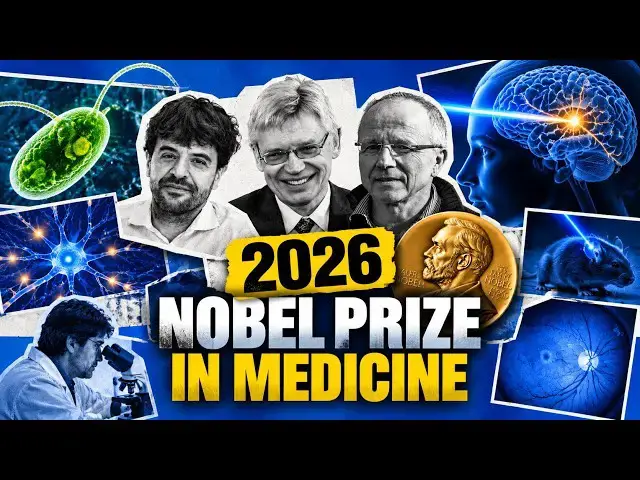

2026 Nobel Prize in Medicine — The Discovery That Gave Us a Switch for the Brain
Oct 6, 2026

The 2026 Nobel Prize in Physiology or Medicine honors Karl Deisseroth, Peter Hegemann, and Georg Nagel for discoveries that gave neuroscience something it had never had before: a way to switch selected brain cells on and off with light.
And remarkably, the story began with a microscopic green alga.
Peter Hegemann and Georg Nagel helped uncover how Chlamydomonas reinhardtii responds to light through proteins called channelrhodopsins — molecular switches that open when struck by light and allow charged ions to flow through a cell membrane.
Karl Deisseroth and his collaborators then helped transform that discovery into optogenetics, a revolutionary technique combining genetics and light to control selected neurons with millisecond precision.
In this documentary, we follow the extraordinary scientific journey from a single green cell, to frog eggs, to neurons in a dish, and eventually to the living brain.
You’ll discover how optogenetics gave researchers a new way to investigate the neural circuits involved in movement, sleep, fear, memory, addiction, Parkinson’s disease, epilepsy and more — and how related approaches are now being explored to restore aspects of vision.
On October 5, 2026, Karl Deisseroth, Peter Hegemann and Georg Nagel were awarded the Nobel Prize in Physiology or Medicine “for their discoveries concerning light-gated ion channels and optogenetics.”
A question about how a tiny alga finds sunlight ultimately gave neuroscience a new way to ask the brain how it works.
From algae → to light-sensitive proteins → to neurons → to the Nobel Prize.
Subscribe to IDiyas for documentaries exploring the inventors, scientists and discoveries that changed our world.
#NobelPrize #NobelPrize2026 #Optogenetics #Neuroscience #Medicine
Show More Show Less