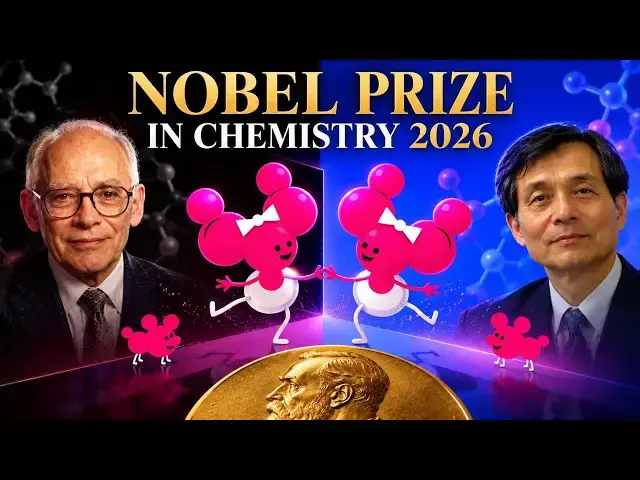

2026 Nobel Prize in Chemistry — Why Life Chose One Molecular Hand
Oct 7, 2026

2026 Nobel Prize in Chemistry — Why Life Chose One Molecular Hand
Why does life choose one molecular “hand” when chemistry can produce two?
That deceptively simple question became one of chemistry’s great mysteries — and the discoveries that helped solve it have earned Henri B. Kagan and Kensō Soai the 2026 Nobel Prize in Chemistry.
Many molecules can exist as two mirror-image forms known as enantiomers. They can contain the same atoms and appear nearly identical, yet interact very differently with biological systems.
Life, however, displays a remarkable preference for particular molecular handedness.
In this documentary, we explore how scientists tried to understand and control this asymmetry.
Henri Kagan discovered non-linear effects in asymmetric synthesis, demonstrating how a small initial molecular imbalance could become amplified.
Kensō Soai then discovered something even more remarkable: asymmetric autocatalysis, in which a chiral reaction product helps catalyze the production of more of itself.
Together, these discoveries demonstrated how tiny molecular asymmetries can grow dramatically — providing chemists with new insight into homochirality and one of the fundamental chemical questions surrounding the origins of life.
On October 7, 2026, Henri B. Kagan and Kensō Soai were awarded the Nobel Prize in Chemistry for “the discovery of non-linear effects and autocatalysis in asymmetric organic synthesis.”
Two mirror images.
One tiny imbalance.
One side eventually dominates.
And a century-old chemical mystery begins to make sense.
Subscribe to IDiyas for documentaries exploring the scientists, inventors and discoveries that changed our world.
#NobelPrize #NobelPrize2026 #Chemistry #Chirality #Kagan #Soai
Show More Show Less