Up next in 10


nowthis
nowthis world
world news
nowthis news
international news
atheist countries
which countries are atheist
the czech republic
china japan
japanese culture
chinese culture
religion in japan
religion in china
religion in the czech republic
is china the most atheist country
north korea
atheism
spiritual
agnosticism
aetheistic countries
Show More Show Less View Video Transcript
0:03
[Applause]
0:07
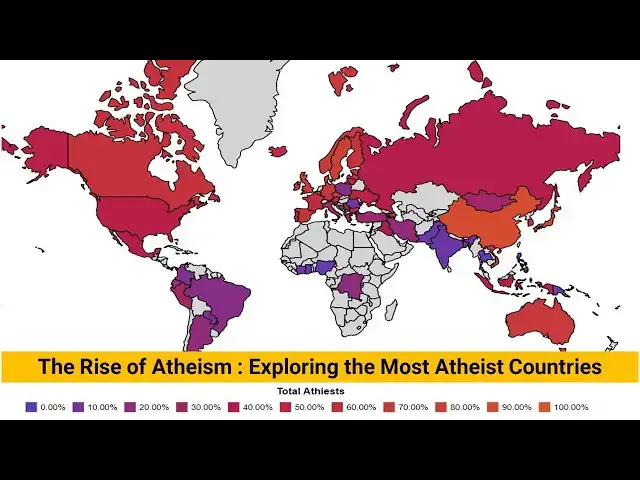
the rise of atheism exploring the most
0:10
atheist
0:12
countries in a world characterized by
0:14
diverse beliefs and religious practices
0:17
atheism has been steadily gaining ground
0:19
as an alternative worldview the 21st
0:21
century has witnessed a noticeable
0:23
increase in the number of people
0:24
identifying as atheists or
0:28
non-religious this shift has not been
0:30
limited to a particular region but has
0:32
manifested globally in this in-depth
0:35
exploration we will delve into the most
0:37
atheist countries around the world
0:39
analyzing the factors contributing to
0:41
the rise of atheism the implications it
0:43
carries and what this trend might
0:45
signify for the future of religion and
0:49
Society defining
0:51
atheism before we embark on our journey
0:54
to identify the most atheist countries
0:56
it's essential to understand what
0:58
atheism entails
1:00
atheism is a lack of belief in gods or
1:02
deities it can manifest as an active
1:05
rejection of religious claims or simply
1:07
a lack of religious conviction atheists
1:10
often base their beliefs on reason
1:12
science and empirical evidence rather
1:15
than Faith or
1:17
spirituality it's important to note that
1:19
atheism is a broad category that
1:21
includes various subgroups such as
1:23
secular humanists agnostics and
1:25
freethinkers each with nuanced beliefs
1:28
and perspectives
1:30
tracking atheism methodology measuring
1:33
atheism on a global scale is a complex
1:36
Endeavor it involves analyzing various
1:38
factors including self-identification
1:40
religious affiliation and the prevalence
1:43
of secular or atheist
1:45
organizations reliable data on religious
1:47
beliefs can be challenging to obtain as
1:50
it often depends on self-reporting and
1:52
social and cultural factors can
1:54
influence the accuracy of responses for
1:57
this analysis we rely on a combination
1:59
of sources our es including surveys
2:01
census data and research from
2:03
organizations specializing in religion
2:05
and Atheism China the epicenter of
2:08
atheism China stands out as one of the
2:11
most atheist countries in the world the
2:13
Chinese Communist party's rise to power
2:15
in 1949 brought with it a strict form of
2:18
atheism aligning with Marxist ideology
2:21
under this regime religious practices
2:23
were heavily discouraged and in some
2:25
cases actively suppressed consequently a
2:28
significant portion of the Chinese
2:30
population identifies as atheist or
2:33
non-religious however it's important to
2:35
note that China's atheism is complex
2:38
while many Chinese citizens may not
2:40
adhere to organized religion or believe
2:42
in Gods there are still Dee rooted
2:45
cultural and philosophical traditions
2:47
such as Confucianism and Daoism that
2:50
influence people's World Views
2:52
additionally China has experienced a
2:54
Resurgence of religious beliefs and
2:55
practices in recent years which
2:57
highlights the multifaceted nature of
2:59
belief in the country Japan a secular
3:03
society Japan is often cited as another
3:06
predominantly atheist country Shintoism
3:08
and Buddhism are the two major religions
3:10
in Japan but they are often practiced
3:13
more as a cultural tradition than a
3:15
deeply held belief system many Japanese
3:17
people may participate in religious
3:19
rituals without necessarily holding
3:21
strong religious convictions Japan's
3:24
unique approach to religion and
3:26
spirituality has created a secular
3:28
society where a a ISM is prevalent the
3:31
Japanese value a harmonious coexistence
3:34
of various belief systems and tend to be
3:36
tolerant of diverse World Views this
3:38
open-mindedness has contributed to a
3:40
society where atheism is accepted and
3:44
respected South Korea a rapid shift
3:47
towards
3:48
secularism South Korea once considered a
3:51
stronghold of conservative religious
3:52
beliefs has witnessed a significant
3:55
shift towards secularism and Atheism in
3:57
recent years historically South Korea
4:00
has been influenced by various religions
4:02
including Buddhism Confucianism and
4:04
Christianity Christianity in particular
4:07
has seen significant growth but it has
4:09
also faced criticism and skepticism from
4:12
a younger generation increasingly drawn
4:14
to secular values factors contributing
4:17
to this shift include a desire for
4:19
personal freedom and a response to
4:22
societal pressures associated with
4:24
conservative religious beliefs South
4:26
Korea's younger generation in particular
4:29
is more inclined towards atheism or
4:31
secularism seeking a departure from
4:33
traditional religious Norms Czech
4:35
Republic the heart of Europe's
4:38
secularism moving to Europe the Czech
4:40
Republic is often cited as one of the
4:42
most atheist countries on the continent
4:45
a historical Legacy of religious Strife
4:47
particularly between Catholics and
4:49
Protestants has contributed to a general
4:51
disillusionment with organized religion
4:54
in this context atheism and secularism
4:57
have thrived the Czech Republic
5:00
secularism is characterized by a strong
5:02
emphasis on individual freedom and a
5:04
separation of church and state many CS
5:07
identify as atheists or non-religious
5:10
and there is a low level of religious
5:11
observance this secular trend is not
5:14
limited to the Czech Republic but is
5:16
also observed in neighboring countries
5:18
in Central and Eastern Europe Sweden the
5:21
rise of secular humanism Sweden is often
5:24
held up as an example of a country where
5:26
secular humanism has become a dominant
5:28
worldview secular humanism emphasizes
5:31
reason ethics and human potential
5:33
without relying on religious doctrines
5:36
while Sweden has a historically strong
5:37
Lutheran tradition the influence of the
5:40
church has waned significantly over the
5:42
years Sweden's government policies
5:44
promote secularism and the country has
5:47
some of the highest rates of
5:48
non-religious or atheist citizens in
5:50
Europe the Swedish approach to religion
5:53
is characterized by a high level of
5:55
Tolerance and acceptance of diverse
5:57
beliefs including atheism France the
6:00
laite principle France is known for its
6:03
strict secularism enshrined in the
6:05
principle of laite this concept
6:08
emphasizes the complete separation of
6:10
religion from public life while France
6:13
has a significant Christian population
6:15
particularly in the form of Catholicism
6:18
religiosity has declined over the years
6:21
the French government has taken a
6:22
proactive role in maintaining secularism
6:25
even Banning religious symbols in public
6:27
spaces this emphasis on secularism has
6:30
contributed to a society where atheism
6:32
and secular values are prevalent
6:34
especially among the younger generation
6:37
Australia a secular society down under
6:40
Australia is another country where
6:42
atheism and secularism have gained
6:44
ground in recent decades while
6:46
Christianity particularly in its various
6:49
Protestant denominations Remains the
6:51
dominant religion the influence of
6:53
organized religion has declined many
6:56
Australians identify as non-religious or
6:58
atheist and religious observance is
7:01
relatively low Australia's secular
7:03
society is characterized by a respect
7:05
for diverse beliefs and a commitment to
7:08
secular governance public policies and
7:10
education prioritize a secular approach
7:13
contributing to the overall
7:14
secularization of the
7:17
country factors contributing to the rise
7:19
of atheism the rise of Atheism in these
7:22
countries can be attributed to a
7:24
combination of factors one education
7:28
countries with strong educ ation systems
7:30
tend to have higher rates of atheism
7:32
education promotes critical thinking and
7:34
access to scientific knowledge which can
7:37
lead individuals to question traditional
7:39
religious beliefs two secular governance
7:43
governments that emphasize secularism
7:45
and religious freedom tend to have
7:47
higher rates of atheism these policies
7:50
create an environment where people feel
7:51
free to express their nonreligious
7:53
beliefs three cultural shifts cultural
7:57
changes particularly among younger
7:59
Generations have contributed to the rise
8:01
of atheism young people often prioritize
8:05
personal freedom and individuality
8:07
leading them to question and reject
8:09
traditional religious Norms four
8:12
scientific advancements advances in
8:14
science and technology have provided
8:16
naturalistic explanations for many
8:18
phenomena that were once attributed to
8:20
the Divine this has reduced the need for
8:23
Supernatural explanations five reaction
8:27
to religious extremism in some cases the
8:29
rise of atheism can be a reaction to
8:31
religious extremism or Dogma people may
8:34
turn to atheism as a rejection of
8:36
oppressive or intolerant religious
8:38
practices implications of the rise of
8:42
atheism the increasing prevalence of
8:44
Atheism in these countries carries
8:46
several important
8:47
implications one religious freedom the
8:51
rise of atheism underscores the
8:52
importance of religious freedom and
8:54
tolerance in countries where atheism is
8:57
on the ascent there is often a strong
8:59
strong emphasis on protecting the rights
9:00
of individuals to hold diverse beliefs
9:03
this is a positive development that
9:05
promotes inclusivity and social cohesion
9:08
two secular governance as atheism
9:11
becomes more widespread governments are
9:13
increasingly adopting secular policies
9:15
and separating religion from public
9:17
affairs this separation can help ensure
9:20
that public policies are not influenced
9:22
by religious Dogma promoting a fair and
9:25
Equitable Society for all citizens three
9:28
cultural shifts the cultural shifts
9:31
associated with the rise of atheism
9:33
highlight changing values and priorities
9:35
particularly among younger Generations
9:38
these shifts encourage open dialogue
9:40
about the role of religion in society
9:42
and contribute to the evolution of
9:44
societal Norms four religious revival
9:48
interestingly in some countries where
9:50
atheism has become more prevalent there
9:53
is also a Resurgence of interest in
9:55
spirituality and alternative belief
9:57
systems people who reject traditional
9:59
religious institutions May explore
10:01
spirituality in a more individualistic
10:04
and eclectic manner five challenges to
10:07
traditional religions traditional
10:10
religious institutions face challenges
10:12
in retaining and attracting followers in
10:14
countries with Rising atheism this often
10:17
leads to religious organizations
10:18
re-evaluating their approaches and
10:20
messages to remain relevant in a
10:22
changing
10:23
Society six ethical Frameworks with the
10:27
decline of religious influence there is
10:29
a growing need for secular ethical
10:31
Frameworks atheists and secular
10:33
humanists often seek to build moral
10:35
systems based on reason empathy and the
10:38
well-being of humanity contributing to
10:40
the development of ethical standards
10:42
that are not tied to religious
10:44
Dogma seven scientific advancements the
10:47
rise of atheism is closely tied to
10:49
advancements in science and rational
10:51
inquiry this emphasis on evidence-based
10:54
thinking can lead to Greater support for
10:56
scientific research and Innovation which
10:58
benefits societ society as a whole eight
11:01
Global impact the global impact of the
11:04
rise of atheism extends Beyond
11:06
individual countries as more countries
11:08
Embrace secularism and Atheism
11:11
International norms and conversations
11:13
about human rights ethics and governance
11:15
May evolve to reflect these changing
11:17
beliefs the future of
11:20
atheism while atheism is on the rise in
11:22
many countries it is important to
11:24
recognize that the world's religious
11:26
landscape is highly diverse there are
11:29
still regions where religious beliefs
11:30
remain deeply entrenched and religious
11:33
institutions continue to wield
11:35
significant influence Additionally the
11:37
future of atheism is shaped by ongoing
11:40
social political and cultural
11:42
developments one key aspect to watch is
11:44
the continued impact of globalization
11:47
and digital
11:48
communication as people from different
11:50
cultures and belief systems interact
11:52
more closely there is potential for the
11:54
exchange of ideas and the spread of
11:56
atheistic or secular perspectives
11:59
conversely globalization can also lead
12:01
to the preservation and spread of
12:03
traditional religious beliefs
12:05
furthermore the role of Atheism in
12:07
public discourse and policymaking will
12:10
likely continue to evolve advocates for
12:13
secularism and Atheism will likely push
12:15
for greater separation between religion
12:17
and government while religious groups
12:19
May seek to maintain or expand their
12:22
influence conclusion the rise of Atheism
12:25
in various countries represents a
12:27
complex and multifaceted phenomenon it
12:30
reflects changing cultural values
12:32
advancements in science and education
12:35
and evolving attitudes towards religion
12:37
while atheism is not a monolithic belief
12:39
system it often emphasizes reason
12:42
skepticism and
12:44
secularism the implications of the
12:46
increasing prevalence of atheism include
12:48
a greater emphasis on religious freedom
12:50
secular governance and the development
12:52
of secular ethical Frameworks however it
12:56
is essential to recognize that the world
12:58
remains diverse in terms of religious
13:00
beliefs and the future of atheism will
13:02
be shaped by ongoing global social and
13:05
cultural Dynamics as we continue to
13:08
navigate the complex interplay of
13:10
religious and non-religious worldviews
13:12
it is crucial to Foster respectful
13:14
dialogue and understanding among people
13:16
of different beliefs promoting a more
13:19
inclusive and tolerant Society where
13:21
diverse perspectives are valued and
13:27
protected
13:30
la
#Religion & Belief
#Social Issues & Advocacy
#World News