Up next in 10



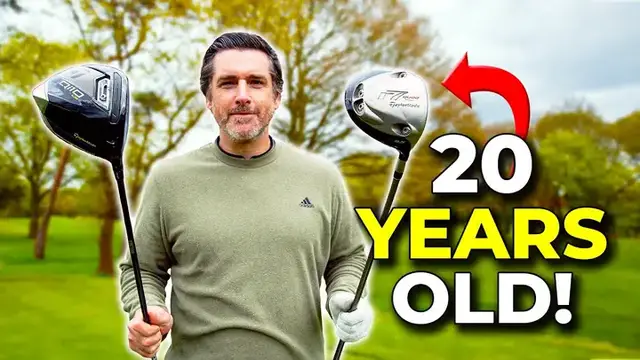
The TaylorMade R7 Quad was a game-changer with its adjustable weights. But does this iconic driver still hold up today? We put it head-to-head with the 2024 TaylorMade Qi10 LS, comparing ball speed, spin, and carry distance to see if vintage tech can match modern performance.
Show More Show Less View Video Transcript
0:00
Retro review time and I've got an absolute cracker for you today. I'm going to take you
0:03
back to 2004. A young Mark Zuckerberg has just released a little website called Facebook
0:09
J.Lo and Ben Affleck split up for the first time and the TaylorMate R7 Quad Driver was
0:15
released. We've teamed up with Golf Clubs for Cash, one of the leading retailers with pre-loved
0:20
equipment and they've given us some absolute gems to test. So please check them out in
0:23
the description below. Now to the best of our knowledge this was the first ever driver
0:27
with adjustable weights. These four weight ports have got two wide at the front here
0:32
two close together at the back, and they housed a couple of two-gram weights
0:35
and a couple of 10-gram weights, and the idea was you could move these around
0:39
in whatever area you wanted in the club to create different flight preferences
0:43
through moving that CG. Now, people used to do this with lead tape
0:47
for years and years on tour, and this driver negated the needs of that
0:50
and you tend to see it in almost every modern-day driver now
0:54
Now, we picked this up for the bargain price of $31.99, So we'd better go and see how it performs
1:00
So I've come down to the fifth hole at the beautiful Stoke Park Golf Club because I wanted to get some baseline data
1:05
I brought them in my full swing kit launch monitor. I just want to get a flavour for what it's doing from a spin and launch perspective
1:12
Now down behind the ball, it's actually a really interesting look. It looks really small, but it's 410cc, which isn't actually that small
1:20
Most modern day drivers max out at 460cc. but because the face is so very very deep there wasn't enough spare mass to
1:28
push it back and wide to give a larger footprint like some of the modern drivers so it's actually a deceptive look so let's hit a couple of ways see
1:35
what data I can get okay it a good hit turned over a bit decent club head speed 165 on the ball Full speed 2 of spin and 2 in total Not too bad Expect a little bit more yardage out of it maybe Let go again
2:07
Okay, slightly better struck, a little bit more on line. Ball speed at 1.65
2:12
Spins popped up a bit there, nearly 3,500 revs and 274 in carry distance
2:19
So, quite pleased with that for $31.99. That's not bad at all
2:23
So let's put it up against the modern-day equivalent and see what we get. To see if that R7 quad can still perform, I've put it up against one of the latest and greatest from TaylorMade, the QI10
2:33
And I've got the LS model because it's the most adjustable of that family
2:37
So I'm going to do the same, I'm going to hit a couple away, get some baseline numbers, and let's see how it gets on
2:42
Right here, a little bit left, much higher on the ball speed, so into the 170s there
2:52
spins right down at 2.1, and that's carried at 2.83. So there's more yardage in it
2:57
Let's hit another one away. Yeah, it's noticeably quicker off the face, but launched at a similar height, but yeah
3:06
ball speed up again in 170s. a little bit more spin that time near 3000, 290 on the carry
3:13
So there's definitely more in this from a speed point of view, in a raw ball data point of view
3:18
But that's not what this is about. This is all about adjustability. So we're going to start moving some weights around
3:23
and see how much we can manipulate that ball flight with each of these drivers
3:28
So I want to highlight the adjustability and how much you can maneuver the ball flight with these weights
3:32
these two 10 grams and these two 2 grams. I'm going to show you how to adjust the head
3:36
to put them into a draw setting first, but there is one rather big problem
3:51
As you can see that was very very slow and not that easy to do now it not the end of the world
3:56
you're not going to be moving these weights around all the time and obviously you can't
3:59
during the course of a round but it is something to note it is quite a cumbersome process but we're
4:04
in the draw setting now so let's hit one away and see if we can get it moving Well that was a nice high draw
4:14
Started just at the bunker on the right, turning over into the middle of the fairway and I felt I put a very very similar swing on that
4:19
So the CG change really does seem to have done what it's supposed to do there
4:24
So you're going to have to bear with me a second when I change these over into the fade setting
4:28
Let's see if it can do it on a left to right shot
4:33
Okay, that's a beautiful little fade that started hugging the trees on the left-hand
4:41
side just drifting right centre of the cut. So that's doing exactly what it's supposed to do
4:47
Let's see if the modern equivalent can do the same. So we've got the Qi10 LS now and I want you to pay close attention to how much easier
4:55
it is to get this in the drawer setting. I've got one screw, loosen that, push the weight all across
5:03
tighten it up, job done. We're in the draw setting, let's see if it works
5:13
Okay that's doing what it's supposed to do, started a bit straight just turning
5:17
down the left-hand side very similar level of curvature to the R7 quad there
5:21
so that's really interesting, it is doing what it's supposed to do. Now we've got
5:25
18 grams of adjustable weight on the QI10 LS here as opposed to the 24 grams of
5:31
adjustability with the R7 quad. So let's shift it all the way across the fade now
5:36
and see if it does what it supposed to do there So we in full fade setting now let see if that does what it supposed to do Okay so it doing its job started left side fading perfectly back into the middle
5:51
And that's really interesting, between those two drivers, essentially they're both doing what
5:55
they're supposed to do. When I move them into the fade setting, they're both fading in pretty
5:59
similar amounts. I'd say there was five or six yard curvature on both of the fades. Similar with
6:04
the draw again when you're both in the draw setting five or six yards of curvature so not
6:09
much to choose between the two heads there in terms of adjustability so from a driver that's
6:14
30 pounds essentially and 20 years old that's pretty impressive so if you're struggling with
6:19
a certain shot shape and you want to influence it with the CG you can do that without having to
6:24
spend 500 pounds by the looks of things from a raw ball data point of view I think it's tough to
6:29
argue that the qi10ls is a superior driver i was getting more ball speed i was getting a higher
6:36
carry number everything i look for in a driver in this day and age was here with the qi10ls
6:41
but from an adjustability point of view and that's kind of what i really wanted to see between these
6:45
two drivers there really wasn't much in it in the draw settings they both drew and a very similar
6:51
amount of curvature and in the fade setting they both did what they were supposed to do there
6:55
arguably there's very very similar levels of adjustability I've got 24 grams I can shift
7:00
around in the R7 quad versus 18 grams I can shift around here admittedly the R7 quad was in the pre
7:07
loft sleeve era so I've got a bit more adjustability in terms of face angle and base loft with the QI10
7:13
LS again but in summary if you're someone who's looking for a cut price option and you've got a
7:19
specific ball flight you want to dial in or even avoid and you're not going to move those weights
7:24
around too much because that's another point you saw how slow and cumbersome it was to move
7:28
these weights around. If you're not someone who's going to shift those around a lot, the R7 quad for $31.99 could be a really great option
sports