Up next in 10


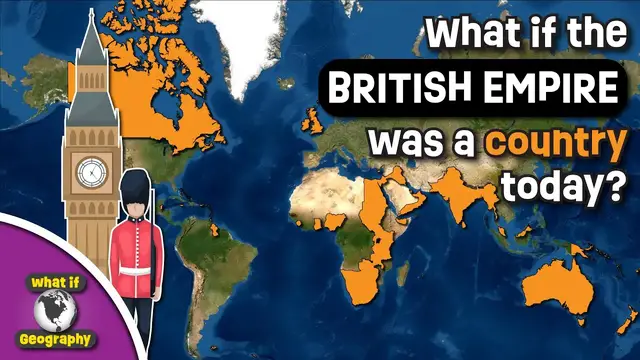
The British Empire was truly massive during its height. At one point in time, the Empire comprised 23% of the world's total population and 24% of the world's total land area. It's for this reason that the Empire acquired its motto: "The empire on which the sun never sets." Despite its incredible power and wealth, the British Empire formally broke itself up in the mid to late 1900s. But what if the British Empire was a country today?
Show More Show Less View Video Transcript
0:00
The sun never sets on the British Empire was an empirically true statement at its height
0:05
The British were notorious colonizers from the 1500s all the way through to the late 1900s
0:10
Today, the British Empire really isn't an empire at all, but rather just a single nation off the
0:15
coast of mainland Europe. But what if the British Empire was a country today
0:20
Today's episode is sponsored by Babbel, one of the top language learning apps in the world
0:25
Now, ich kann ein bisschen Deutsch sprechen, but it's actually been quite hard for me to keep up with the language
0:30
because I live in Portland, a decidedly un-German city. As you can imagine, there's not a lot of German-speaking opportunities in my everyday life
0:38
But Babbel has been able to help me stay connected to the language that I've been learning since I was 12 years old
0:43
Now, I love Babbel because the lessons are short. Making all these videos keeps me pretty busy
0:48
But with just 10 minutes a day, Babbel has not only helped me maintain my German
0:52
but expand on. And this is because the app is powered by award-winning technology that is scientifically proven to help you speak better
0:59
Don't believe me? Babbel is backed by a 20-day money-back guarantee. So if it doesn't work for you, you don't pay a dime
1:06
Plus, as part of this sponsorship, Babbel is offering my viewers 60% off their subscription
1:11
Click the link in the description below to get access to this deal. So, what language do you want to learn
1:22
Hello, and welcome to What If Geography, where we try and answer the great geographic what-if
1:29
questions of the world. I'm your host, Jeff Gibson, and today we're going to talk about
1:33
the British Empire as a country today. It wasn't all that long ago that the British Empire was the
1:39
de facto ruler of the world, and there's a very good reason for how that happened
1:44
But before we dive into today's episode, consider following me on Twitter and Instagram to find
1:48
more of my geographical content. Links are in the description below. The British Empire was truly massive. At its height, it was the largest empire in history and
2:02
for over a century, was the foremost global power. By 1913, the British Empire held sway over 412
2:08
million people, 23% of the world's population at the time. And by 1920, it covered 13,700,000 square
2:15
miles, about 24% of the earth's total land area. As a result, its constitutional, legal, linguistic
2:22
and cultural legacy is widespread. At the peak of its power, it was described as the empire in which
2:27
the sun never sets, as the sun was always shining on at least one of its territories. But while the
2:33
British Empire was truly massive at its height, as with all things, the empire had relatively humble
2:38
beginnings. The heart of the British Empire has always been England, not the United Kingdom as a
2:43
but England very specifically. Keep that in mind because England's lust for power
2:47
and dominion extended first to its closest neighbors. And before we can talk about England's
2:51
first colonial efforts, we need to first talk a little bit about how England
2:55
came to be, well, England. England as a country did not really exist
2:59
before the year 1000. Instead the country we know today was divided into seven kingdoms East Anglia Mercia Northumbria Kent Essex Sussex and Wessex After lots of petty wars between the kingdoms
3:13
and multiple Viking incursions, invasions, and settlements, the kingdoms were forcefully unified
3:18
under a single king for the very first time. But this still doesn't get us to the England we know today
3:23
One more event had to transpire, the conquering of England by William I
3:27
also known as William the Conqueror. We don't need to get too far into the details
3:31
but to summarize, the former King Edward the Confessor died childless, leaving the throne to his brother-in-law, King Harold
3:38
William, however, was cousin to the king and immediately claimed the throne instead
3:42
This all culminated in the Normandy invasions and, eventually, the Battle of Hastings
3:47
where King Harold was killed and, essentially, William won. While William didn't actually invade and conquer the rest of the British islands himself
3:54
he really set in motion the administrative unionization of England that would push far beyond its relatively minor borders
4:01
From that point on, England began its territorial expansion, first with Wales and then with Scotland and Ireland
4:07
Ireland deserves a special note here because they were brutally colonized by England for a very long time
4:12
And it's for this reason that Ireland, to this day, stands firmly against colonial
4:16
and neocolonial efforts around the world. But while England's colonial efforts began with its near neighbors
4:22
it was really the discovery of North and South America by Europe that pushed it into overdrive
4:26
By the year 1700, England had established colonies and laid territorial claims to much of the eastern seaboard of the current United States and Canada
4:33
many islands of the Caribbean, a sliver of modern-day Guyana, a small enclave in Africa, mostly to feed the global slave trade
4:41
and bits and pieces of India and Indonesia. And from here, it basically spread far and wide
4:47
Of course, the British Empire wasn't always growing. In fact, it shrank considerably when, in 1776
4:53
13 colonies in North America formally declared independence and won a war against the might of the entire British military
4:59
with the help of France, of course. Those colonies would later go on to form the current United States
5:04
the point being that the British Empire, while big and expansive, was also ever-evolving
5:09
The British Empire is no longer a thing today. As of the mid-1900s, most of the lands and colonies claimed by the United Kingdom
5:17
have been given the right of self-determination. But make no mistake, the British Empire was absolutely brutal in its rule over its colonies
5:25
This video is not intended to glamorize colonization, but rather to highlight just how massive a power
5:31
the British Empire was at its height. Sometimes for better, but oftentimes for far, far worse
5:38
But before we get into what the British Empire would look like as a country today, if you're enjoying this video
5:43
now would be a great time to subscribe. More fun what-if country videos are just a single click away
5:53
In order to figure out what our British Empire would look like as a country today, we need to first determine exactly what stage of empire we're going to use
6:00
For our British Empire country, we're going to go back in time to 1921
6:04
which was the absolute peak of the British Empire. This would mean that our British Empire country would include the following countries The United Kingdom of course Antigua and Barbuda Australia Bahamas Bahrain Barbados Belize Botswana Brunei Canada Cyprus Dominica Egypt Fiji the Gambia
6:29
Ghana, Grenada, India, Iraq, Ireland, Jamaica, Jordan, Kenya, Kiribati, Kuwait, Lesotho, Malawi
6:42
Malaysia, Maldives, Malta, Mauritius, Myanmar, Nauru, New Zealand, Nigeria, Pakistan, Qatar
6:52
St. Lucia, St. Kits and Nevis, St. Vincent and the Grenadines, Seychelles, Sierra Leone
7:00
Solomon Islands, South Africa, Sri Lanka, Sudan, South Sudan, Swaziland, Tanzania, Tonga, Trinidad
7:10
and Tobago, Tuvalu, Uganda, United Arab Emirates, Ben Watu, Yemen, Zambia, and Zimbabwe. That's a lot
7:21
of countries. But of course, there are two notable countries missing from this list
7:24
The first is the United States, which revolted and won its independence in the late 1700s
7:29
The second is Afghanistan. The British Empire originally extended its domain into Afghanistan
7:34
in the mid-1800s. But after a series of wars and revolts, Afghanistan won its independence in 1919
7:41
Afghanistan is very interesting here because the country has successfully fought off the British
7:45
Empire, the Soviet Union, and now today the United States. All told, the British Empire as a country
7:51
today would comprise of 59 states that are literally spread all around the world. Of course
7:56
the borders of these countries would likely have minor additions or subtractions compared to the
8:01
borders of 100 or 200 years ago. But for our British Empire country, we're going to assume
8:05
a similar path to territorial domain for each state. Not to mention, it makes it far easier
8:11
to estimate the population of our British Empire. Speaking of population, the British Empire today would be an absolute behemoth of a country
8:22
All told, across all 59 states in our global country, there would be 2.6 billion people
8:27
This would far surpass the current population leader of the world, China, which has a relative scant 1.4 billion people
8:33
But this population is absolutely not spread across the world equally. In fact, if we break it down by continent
8:39
both Asia and Africa hold the overwhelming amount of population within the British Empire
8:44
and it's not even close. All told, Asia has the most people with nearly 1.8 billion people
8:49
followed by Africa with about 670 million people. In a very distant third is Europe with 73 million people
8:55
It's worth highlighting here that Europe is where the heart of the British Empire lives, the United Kingdom
9:00
Up next is North America with about 43 million people. And bringing up the rear is Oceania with roughly 32 million people
9:07
And while we can't get into demographics with any degree of specificity, due to each of these 59 countries having their own standards for counting and categorizing
9:14
the British empire as a country would absolutely not be a majority white or European country As illustrated above the vast majority of these people would be from either the Indian subcontinent or southeastern Asia and a large amount would also be black or African What we can determine however is the primary language spoken within the British Empire
9:32
Now, obviously, there are lots of different languages spoken, despite what the primary
9:35
language is. So take this data at a high level. With that said, as a primary state language
9:41
the most spoken within our British Empire would be Hindi at 1.4 billion speakers
9:46
Next is English with about 500 million speakers. English is also the most cultural notable export of the United Kingdom and British Empire
9:54
Arabic comes in third with 240 million speakers, Urdu in fourth, followed by Swahili
10:00
Burmese, Malay, Tamil, Shone, French, Greek, Devehi, Maltese, Tongan, and Tuvaluan. And it bears repeating
10:09
There are hundreds of more languages that are not considered the primary language, but are still spoken within each of these countries
10:16
Interestingly, while the British Empire as a country today would have the most amount of people
10:24
and the largest amount of land area, it would not be the largest economy in the world
10:29
All told, the GDP of all 59 states that would make up the British Empire country today
10:33
would have a combined GDP of just under 13 trillion US dollars. That's a huge economy for
10:39
sure, but it would still trail China by about 1.5 trillion US dollars and is dwarfed by the United
10:45
States at nearly 21 trillion US dollars. This might seem surprising given that the British
10:50
Empire's population is nearly eight times the size of the United States, but really it shows
10:55
just how incredibly unequal the British Empire was at its height. Within the British Empire as a
10:59
country, the United Kingdom with just 66 million people would have the largest economy by far with
11:05
a GDP of 2.8 trillion US dollars, which is more than all of the British Empire's African states
11:10
combined. It's also more than India's 2.6 trillion US dollar GDP, despite India having nearly 23 times
11:17
the population of the United Kingdom. On a per capita basis, how successful your country is
11:22
largely depends on where it lies. If you're in Africa, Asia, or a small island country
11:27
you're likely not doing so well. If you're in Europe, or otherwise are a developed westernized
11:32
country, you're sitting near the top. It's for this reason that you can kind of see why the
11:37
British Empire no longer exists today. The vast inequality between what would be fellow countrymen
11:42
is entirely unsustainable. If the British Empire were a country today, it would absolutely need
11:47
to figure out how to spread its vast amount of wealth more equally. The British Empire would be
11:52
an absolutely massive country, but one that is entirely unsustainable given current economic
11:58
conditions. So it's really no surprise then, beginning in the mid-1900s, the British Empire
12:03
began to break itself up. Today, the British Empire is really just the United Kingdom and some
12:09
small minor islands scattered around the globe. But at one point, the sun truly did never set on
12:16
the British Empire. I hope you enjoyed today's episode. If you did, please subscribe to my
12:20
channel. And if you want to watch more of my What If Country videos, you can do so here
12:25
Thanks for watching. See you next time
education