Up next in 10



Follow me on Twitter: https://twitter.com/GKonYoutube
Join the Discord Server: https://discord.gg/5rgQTJk5wp
Become a member on Patreon & get exclusive content! https://www.patreon.com/generalknowledge
Special mention to my patrons: Richard, Jeseenya, Francis, Edward, Stephen, MiFE, Rpgkillerspace, Wilhelm, Roland, Rami, Juan, Bruno, Albert, Lastmatix, Kalvin, Francisco, Tom, 43rpak, Chet, Ryan Keith, ou_lyss, Borton, Ryan McMurry, Pete, Cesar, Hendrick.
Business Contact: [email protected]
Thanks for watching, remember to subscribe to catch future videos!
Show More Show Less View Video Transcript
0:00
Federalism. A federation, also known as a federal state, is a political entity characterized by a
0:09
union of partially self-governing provinces, states, or other regions under a central federal
0:16
government. Federated states do not have standing as entities in the international community. They
0:22
aren't a country, they're part of a country. So what's the difference? In what way is the state
0:27
of California in the U.S., different from the district of Lisbon in Portugal. In federal systems
0:33
political authority is divided between two autonomous sets of governments, one national
0:38
and the other subnational. While a district or region of a country that isn't a federal state
0:44
doesn't possess this same amount of self-governance and shared power at a local level
0:49
countries that aren't federal are called unitary, which is a state governed as a single entity in
0:55
which the central government is ultimately supreme. Both have pros and cons and the best
1:00
regime for one country might not necessarily be the best for another. For instance, larger countries
1:05
tend to be federal to better manage their overwhelming territory, like Russia or Australia
1:11
something that might not make sense for smaller nations. Unitary states have the advantages of
1:16
being able to act quickly because decisions are made by one single body and they can be less
1:21
costly, not having multiple levels of bureaucracy, while federal states have a better grasp on local
1:27
needs because power is closer to the people and it might discourage abuse of power because that
1:33
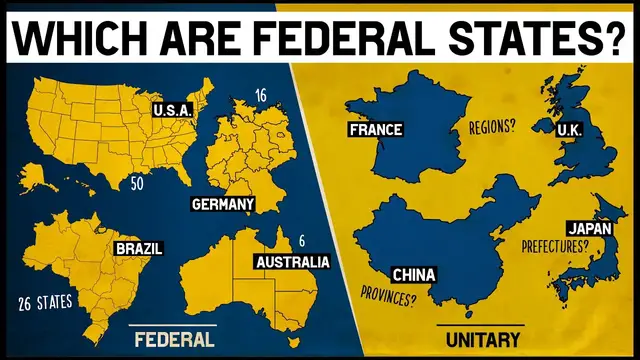
same power is distributed amongst more ruling bodies. Worldwide, this is how countries divide
1:39
themselves, between federations and unitary countries. In yellow, the federations and in blue
1:44
the unitary. Of the eight largest countries in the world by area, seven, Russia, Canada
1:50
the United States, Brazil, Australia, India and Argentina are organized on a federal basis. Only
1:56
China, the third largest, is a unitary state. The concepts used to define these different regimes
2:01
are a little confusing, so let's clarify. A country that uses federalism is known as a federation
2:06
or federal state, composed by self-governing provinces, states or regions who are federated
2:12
under a central federal government with whom they share power. A country that uses a unitary
2:17
government style is known as such. It also has provinces, districts or regions, but they aren't
2:22
self-governing and the vast majority of power is concentrated within the central government. But
2:27
it's not black or white. There are shades of grey. A country doesn't need to be a full federation or
2:32
a full unitary state. There's a spectrum that ranges from increased separation to increased
2:38
integration. At one end is a large unitary state and at the other, many small separate states under
2:44
a union, but mostly with their own sovereignty. Unitarism, decentralization, devolution, federalism, confederalism, international organization, and a gathering of many small
2:54
separate states are different options. And in fact, all of them, other than full-on unitary
3:00
have some degree of larger autonomy, like the UK, which is somewhat of an example of devolution
3:06
in which the central UK government has devolved some of its powers to local authorities
3:12
such as the ones in Scotland or Wales. And even within each of these, there's a subspectrum. For
3:18
instance, in this map of Europe, we can see which states are unitary and which are federal, but
3:23
within the unitary ones, some are fully centralized like Portugal or Ireland, some are unitary but
3:29
decentralized like Slovenia or the Nordic countries, and some are unitary but regionalized
3:35
like Spain, France or the UK as well, where the central government is the main holder of power
3:39
if you will, but has started sharing it further with regional administrations. Whether this is a
3:45
sign of moving towards federalism or if they'll choose to leave it at this is something that might
3:49
vary from country to country. The European Union as a whole is a really interesting example. It's
3:54
composed of many large, mostly unitary states and some federal ones, but the EU itself would be seen
4:01
as a gathering of separate states at the other end of the spectrum, but also somewhat of a
4:06
federation, and many people want it to be a full-on federation. However, this isn't what this video is about
4:11
I not going to get into each of these different forms of government and respective political systems What I want to do is simple Since we already gotten a general idea of how federal states are different than unitary ones and how both of them generally work I want to go
4:26
through the world and describe which countries are in fact federations and how they specifically
4:31
work, at least in very broad terms. When it comes to the numbers, here's how it is. Of the 193 member
4:37
countries of the UN, 27 are federations. The rest are unitary states, although as we just saw with
4:43
Europe's example, they vary in how unitary they are. But let's focus on the federations. I want to
4:49
go from the biggest to the smallest, not in terms of size, but in terms of their federal subdivisions
4:55
The biggest federal country in the world is Russia. It divides its territory into many different types
5:00
of federated units. 46 oblasts, which are provinces, 22 republics, 9 krais, which are territories
5:07
4 Okrugs, which are regions with substantial ethnic groups, 3 federal cities and 1 autonomous
5:14
oblast. In this map, we can see them separated by color, ranging from the small but still very
5:19
important federal cities of Moscow, St. Petersburg and Sevastopol in red to the gigantic republics
5:26
and provinces of Siberia in orange and green. A total of 85 federated units. Every federal subject
5:33
has its own head, a parliament, a constitutional court, as well as its own constitution and
5:39
legislation. In the majority of cases of federal countries, this is what happens. The next biggest
5:43
one are the United States of America, which have 50 states, plus a federal district and 16 territories
5:49
When it comes to the states, they're more equal in size, at least the difference isn't as major
5:54
as Russia's, and they have a uniform approach to the divisions. Sure, you still have the federal
5:59
district and the territories, but it's mostly just the states existing as equals. Like Russia and
6:04
many others, there's a federal head, in this case the governor of each state, and then a state
6:09
legislator and also state constitutions. In fact, interestingly, American state constitutions tend
6:15
to be much longer than the national one, which is around 4,500 words long. Most state constitutions
6:21
are over 8,500 words, almost twice the size, because they have to be more detailed regarding
6:27
the day-to-day relationship between government and the people. The shortest is Vermont's with
6:32
8294 words and the longest is Alabama's which has 345,000 words. This seems kind of impossible but
6:41
everywhere that I looked it up on said that this was the case. Interestingly as well, the US also
6:46
have a rule that the United States shall guarantee to every state in this union a republic form of
6:52
government. So Hawaii couldn't suddenly decide, hey let's be a monarchy again but stay in the US
6:57
something that isn't the case for all federal countries, as we'll see ahead
7:02
One that I had no idea was a federation is Nigeria, having 36 states and a federal district
7:07
Nigeria has a gigantic population of over 200 million people. This might be just me
7:13
but I feel like we don't pay enough attention to these gigantic African countries. It's
7:17
interesting because they started with only three states in 1960, then going to four
7:22
12, 19, 21, 30 and finally 36, further dividing their land as they developed its administration
7:29
Mexico, officially the United Mexican States, comes next, with 31 states and the capital of
7:35
Mexico City. When Mexico got its independence from the Spanish, it was first an empire. After
7:39
the fall of the empire, it became a federal republic. The founding plan of the republic was
7:44
enacted and in its sixth article it says, the component parts of the republic are free
7:50
sovereign and independent states, in that which touches internal administration and government
7:55
All the free states were invited to the union and formed the federation, except for the former
8:00
captaincy general of Guatemala, which formed their own country, also a federation. India is also a
8:05
federal country, counting with 28 states and 8 union territories, one of which is the national
8:10
capital territory of Delhi, I assume somewhat of a federal district. They are divided into six
8:15
regions, northern, western, southern, central, eastern, and northeastern. But as far as I could
8:19
find out, these aren't an administrative level. There's no regional governor or something. They're
8:24
just a way of organizing the areas the 28 states are in, which do in fact have their own local
8:30
administrations, as is the case with their neighbor, Pakistan. Although they organize their territory in
8:35
a smaller number of units four provinces as well as two autonomous territories and one capital The provinces of Balokistan Punjab Sindh Kiber Bakhtunkhwa and the federally administered
8:46
Islamabad capital territory. They then have the two autonomous territories in the disputed territory of Kashmir, which
8:52
India also administers in their side, and Gilgit-Baltistan. Prior and during the times of British colonialism, the British Raj, which included India and Pakistan
9:01
amongst other regions, had a lot of princely states. states with internal autonomy but under British rule and with no autonomy in external affairs
9:10
Now, I really don't know if this is the case, but it makes sense that it might have paved the way
9:15
for the current federal system in both countries, as the people were used to and there was a
9:19
tradition of separate smaller states having internal autonomy within a larger country
9:24
Brazil follows just behind, with 26 states and a federal district as well. In the style of India
9:30
the country is divided into regions, five in this case, north, northeast, central, west
9:35
southeast, and south. But again, the level at which local administrations first come in is the state
9:40
Brazil's territorial evolution is very interesting, as is most countries. If you want
9:45
I can start making videos about that topic. When the Portuguese arrived in 1534, they established
9:50
colonial captaincies, straight, horizontal, and vertical lines which make Africa's colonial borders seemed like they were carefully studied. As Brazil grew, first as a colony and then as its
10:00
own country, more territorial divisions came to be, in order to better organize and rule over the
10:05
vast territory. Back in Europe, Switzerland is, as far as I know, the only confederation in the
10:11
world. It doesn't have states, but cantons, 26 of them. It evolved from the historical Swiss
10:16
Confederacy, which existed from 1300 to 1798, with some exceptions in between. They started off as
10:22
only 13, each of them as former sovereign states. They then expanded to 19 in 1803, 22 in 1815
10:29
and kept increasing the number until 1999, in which they grew to the current 26. Argentina
10:35
Venezuela, Iraq, Somalia, and both Sudans are also federal countries, with the number of states that
10:41
we see on screen, although some of them refer to the federal units as provinces or regions
10:46
Argentina has an autonomous city in the capital of Buenos Aires, as does Venezuela with its federal
10:51
district and a federal dependency, which encompasses most of its offshore islands
10:56
Iraq has 18 provinces, known as governorates. Somalia has 18 regions, some of which are separatists, mainly Somaliland
11:03
North Sudan has 18 states and South Sudan, 10. The most well-known federal country of Europe, at least for me, is Germany, which has 16
11:11
states when you include the city-states of Berlin, Hamburg and Bremen. These city-states are known as Stadstaten
11:18
The remaining 13 ones are called Flachenlander, which roughly means area states
11:24
Germany, I would say, has a history of existing in some type of union of smaller states
11:29
All we need to do is look at the absolute territorial organization mess that was the
11:34
Holy Roman Empire. After the Congress of Vienna in 1815, 39 states formed the New German Confederation
11:40
The following North German Confederation and German Empire also had a similar type of
11:45
territorial organization. And even after the land losses of the Treaty of Versailles after World War I, the remaining
11:51
states continued as republics of a new German federation. Austria shares the same HRE and German confederation past, which perhaps explains, following a
12:01
federal model today as well. In addition, their existence as leaders of the Austro-Hungarian Empire, which was also
12:07
subdivided into administrative regions, although not semi-autonomous states in most cases. Today, Austria is a federal republic made up of nine states
12:16
Another interesting example in Europe is Bosnia. The political divisions of Bosnia and Herzegovina
12:21
were created by the Dayton Agreement, which recognized a second tier of government in the
12:26
country, comprising two entities. The Federation of Bosnia and Herzegovina itself, with mostly
12:32
Bosniaks and Croats, and the Republic Sprzka, which has mostly Serbs, each governing roughly
12:38
one half of the state's territory. The Federation of Bosnia itself has a federal structure and
12:43
consists of 10 autonomous cantons. Still in Europe, Belgium is a federal constitutional
12:49
monarchy. It's divided into three highly autonomous regions. Flanders, Vellonia, and Brussels It interesting how the logic behind federal systems can be different Many of them choose it because of the vastness of their territory and others like Belgium choose it due to the significant cultural differences between parts of their territory and population Russia for instance would I think be an example of a
13:12
combination of both. In Belgium, both Flanders and Wallonia have significant independence movements
13:17
which might eventually lead to a separation of the country. Choosing a federal system that grants
13:22
semi-independence through autonomy might be a way to avoid that. All the way back in America
13:26
Canada has 10 provinces and 3 territories. In 1867, 3 provinces of British North America, New Brunswick, Nova Scotia and the province
13:35
of Canada, which included Ontario and Quebec, were united to form a 4 provinces federated
13:40
colony, the Canadian Confederation. Over its history, the number of provinces has grown from the original 4 to 10
13:46
The major difference between a Canadian province and a territory is that provinces receive
13:51
their power and authority from the Constitution Act of 1867, whereas the territorial governments
13:57
have powers delegated to them by the Parliament of Canada. So essentially a change to the division
14:03
of powers between the federal government and the provinces requires a constitutional amendment
14:07
and a similar change affecting the territories can just be performed unilaterally by the Parliament
14:12
of Canada. Pretty much the provinces have their autonomy guaranteed and territories not so much
14:18
The same goes for Australia, which has six states as well as three internal territories
14:23
and seven external, which aren't self-governing, so don't really matter for this. New South Wales
14:27
Queensland, South Australia, Tasmania, Victoria, and Western Australia are the states, and the Capital Territory, the Jervis Bay Territory, and the Northern Territory are
14:36
the internal territories. Each state of Australia is a successor to an historical Australian colony
14:41
under British governance. The Capital Territory and Northern Territory, for the most part
14:46
operate indistinguishably from states despite their different status. Moving to Asia, Malaysia
14:51
which consists of 13 states and 3 federal territories. Malaysia is first divided into
14:56
two areas, west and east separated by water. Within each of the areas are various states
15:01
which all have equal autonomy. Although East Malaysia in the island of Borneo only has 2
15:06
large states, while West Malaysia has 11 smaller ones. Oddly, 9 of the 13 states are monarchies
15:12
of their own, 8 of which having a Sultan and one a Raja. Showing us that federations are a good solution when a region is full of historically divided
15:21
regions like we saw with Germany, kind of. The three federal territories are Kuala Lumpur, Labuan and Putrajaya
15:27
A fun fact, Singapore used to be a state within the Malaysian Federation, leaving in 1965
15:33
and Brunei has been invited to join but so far has refused
15:37
And in Africa, Ethiopia, having 10 regions and 2 chartered cities. The basis for Ethiopia's divisions are apparently ethnolinguistic criteria rather than the physical
15:47
geography of the territory or its history, something that's really smart and should
15:51
probably be taken into account for territorial reformations throughout most of Africa, trying
15:56
to make up for the mistakes made by the Europeans when dividing the continent during colonial times
16:01
The two cities are the country's capital of Addis Ababa and Deirdawa
16:05
Other smaller nations like Nepal, the UAE, Micronesia, Comoros, Kitsunevis are also federal
16:11
countries with smaller divisions, each divided into a few states, islands, communities, etc
16:16
Nepal has seven provinces, the UAE have seven emirates, Micronesia has four states, Comoros
16:22
three islands, and Saint-Kitsenevas two islands. Essentially units that represent and directly rule
16:27
a specific region of the country, sharing power with the national government. And so
16:31
those are the federal states of the world. Meaning the countries in which the central
16:35
government shares a significant part of the ruling power with its local authorities
16:40
having a greater deal of autonomy and usually serving as a tool to solve some type of problem
16:45
be it the administration of a very large territory by allowing it to be somewhat separately ruled in
16:50
more detail or by offering people of different cultures with significant differences the
16:55
opportunity to have more autonomy within a united country. From the most well-known cases of the
17:00
USA, Canada, Mexico, Brazil, Germany, Russia, India, or Australia to the lesser-known cases of
17:06
Ethiopia, Bosnia, Belgium, or Switzerland amongst many more. If I forgot any other federal countries
17:12
just let me know in the comments. Thanks so much for watching this video, subscribe if you want and I'll see you next time for more general knowledge
#Hobbies & Leisure
#education
#Law & Government
#Government
#Social Sciences
#Political Science
#Other