Up next in 10



Go to our sponsor https://betterhelp.com/generalknowledge for 10% off your first month of therapy with BetterHelp and get matched with a therapist who will listen and help.
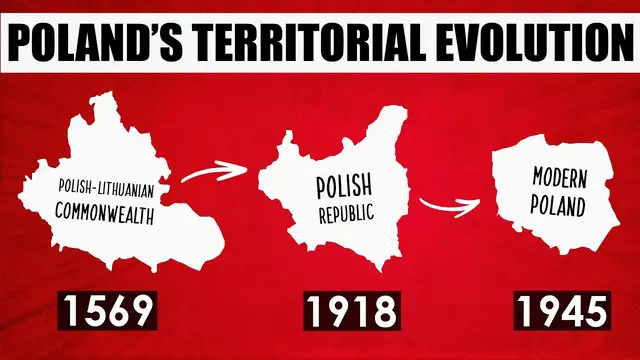
In this video I talk about The Territorial Evolution Of POLAND (& How It Moved Throughout History)
TIMESTAMPS:
00:00 Intro
01:15 Tribe of the Polans (9th Century)
02:13 Duchy of Poland (960)
04:49 Kingdom of Poland (1025)
06:14 Temporary Return to a Duchy (1039)
06:46 Restoration of the Kingom (1102)
07:16 Fragmentation into Principalities (1138)
08:11 Arrival of the Teutonic Order
08:40 Extinction of the First Dynasty (1370)
09:56 Temporary Union with Hungary
10:10 First Union with Lithuania (1385)
10:51 Personal & Dynastic Union with Lithuania (1385 to 1569)
12:03 Polish-Lithuanian Commonwealth (1569)
13:12 Swedish & Russian Invasions (1655)
14:28 Collapse of the Commonwealth & Partitions of Poland (1772)
Show More Show Less View Video Transcript
0:00
Poland. Today we all know Poland as this country in central eastern Europe and the reality is it
0:06
always existed there, sort of, and the sort of part is pretty important because throughout history
0:12
since its very first establishment, Poland's territory has moved around quite a lot. It's not
0:18
like the examples we saw in a previous video about countries that moved with Bulgarians or
0:23
Hungarians straight up moving their nation from one place to the other. No, Poland's case is more
0:29
one of a series of gradual shifts. So to understand how Poland's territory has evolved, how its
0:35
borders have changed, and how its location has effectively moved, we're going to do the following
0:41
Take a trip through Poland's history from the moment of its creation to its various key moments
0:46
throughout time, most of them being connected to territorial changes. Understanding these moments
0:52
of change and what caused them throughout Poland's many forms of existence, tribe, duchy, kingdom
0:58
Commonwealth and Republic all the way up to today's modern territory and borders. Let's jump right into it
1:15
Poland's existence throughout time is complicated as we'll see ahead It's very much on and off being a valuable territory
1:22
It was coveted by its neighbors namely the powers that would one day become Germany, Austria, and Russia
1:27
and so for long periods of history a sovereign Polish state did not exist
1:32
But I'm getting ahead of myself, let's get back to the start. The first instance of a Polish sovereignty can be the tribe of the Polans
1:40
The Polans were in the 9th and 10th centuries a tribe of West Slavic people
1:45
They existed here in much of what is today modern Poland and they
1:50
neighboring other tribes that were the historical predecessors of their future neighboring countries
1:55
The Velleti, the Vistulans, the Moravians and the Czechs among others. It's interesting how we can actually read an excerpt from a medieval religious text
2:03
that says across the Otter River are the Polans. The Otter River today is one of the borders between Poland and Germany
2:10
It's interesting how it was a natural border even back then. Taking up a leading role at the time
2:16
the Polans were able to unite several groups under the rule of the House of Piast
2:20
the first ruling dynasty of the nation. And so, expanding their territorial control
2:24
they founded the first duchy of Poland in the year 960, taking its name from the leading tribe
2:30
and being ruled by Miejsko I. And Miejsko achieved two additional things that contributed
2:36
to the expansion of Poland's territory at this time. First, he united most of the Lakitic tribes
2:42
here the red line shows the Polish border in the year 992, at the time of Miejsko's death
2:48
and it was significantly larger than it had been a few decades before. It's really impressive how
2:54
much it grew. In Dark Red is the duchy's initial area of control, the North, Pomors, Mazors and
3:01
Leziani were annexed by 980, while the South was just at the end of his reign, and the territory
3:08
they controlled wasn't that far off what modern Poland is. The viability of the emerging state
3:13
was assured by their persistent territorial expansion, beginning with a very small area
3:18
around Miezno before the town itself even existed. And second, he began the nation's conversion
3:24
into Christianity, one of the first to do it this far east into Europe at the time. This conversion
3:30
was determinant because it allowed his son and successor, Bozlau I, to turn the duchy into a
3:36
kingdom, the kingdom of Poland. But first, let's take a minute to thank BetterHelp for sponsoring
3:42
this video. BetterHelp is the world's largest therapy service and it's 100% online. With BetterHelp
3:48
you can access a network of over 25,000 licensed and experienced therapists who can help you with
3:55
a wide range of issues. Starting therapy can be hard, but with BetterHelp, it becomes a little
4:00
easier. To get started, you just answer a few questions about your needs and preferences in
4:05
therapy, and that way, BetterHelp can match you with the right therapist from their network
4:09
But you can still switch them at any time with no additional charge. Then you can talk to your
4:15
therapist however you feel comfortable whether it's via text chat phone or video call you can
4:22
message them at any time and schedule live sessions when it's convenient for you with better help you
4:27
get the same professionalism and quality you expect from in-office therapy but with a therapist who
4:32
is custom picked for you more scheduling flexibility and at a more affordable price you can get 10
4:39
off your first month at betterhelp.com slash general knowledge and I've also linked them
4:45
below in the video description Now back to the video And it interesting because Bosla was key to maintaining a unified Poland He was his father oldest son from his first wife and wasn meant to inherit the crown
5:00
Miesko instead intended his younger sons from his second wife to divide the duchy amongst them
5:06
Bozla was able to push them aside and inherit full control of the crown, keeping the territories together
5:12
He began a series of military campaigns towards the surrounding territories. He moved into Moravia, Czechia, Russia, Prussia, and even Germany
5:21
contradicting his father's policy of establishing good relations with the Holy Roman Empire
5:26
Despite risky, these incursions meant the expansion of Poland's territory even more
5:31
In this map, we can see the red border, which depicts Poland's territory at the time of
5:36
Polslau's death in 1025. In darker red are the territories he inherited from his father
5:41
in lighter red are the lands he annexed throughout his reign such as Moravia in 1003
5:47
Luzis and Milsko in 1002, Pomerania in 1015 and Grody-Kzervinski in 1018
5:55
I'm gonna mispronounce a lot of Polish names in this video. Czechia, Bohemia and Slovakia were temporarily controlled but not annexed
6:02
and even Russia was temporarily dependent on Poland. With all these new lands, just before dying in 1025, he was given permission by the Pope
6:11
to be crowned king and establish the kingdom of Poland. However, things were about to go wrong for the first of many times in Poland's history
6:19
Bozlau's sons fought amongst themselves and then they all died, which led to various internal turmoils and foreign invasions
6:26
In 1039, there was a Bohemian invasion and losing territories, the first kingdom collapsed, going back to being a duchy
6:33
Three rulers after that did a good job at building back Poland, Poland, starting with Kazimir the Restorer, then Bozlau II and Wladyslau I, these were
6:42
able to regain territories and re-establish the kingdom in 1076. By 1102, Bozlau III rose to power and Poland looked much like it did at the time of its
6:52
first ruler, Miesko. At the start of his reign, Poland controlled this area here in darker red, annexing the
6:58
remaining shades throughout his reign and reaching even more territory by the time of
7:02
his death in 1138. With Poland now reaching into Pomerania and expanding its Baltic Sea coast, conquering
7:09
for instance the important location of Gdansk which would prove symbolic in Poland's history
7:14
far into the future. When in 1138, Boslau III died, the kingdom was fragmented
7:21
Dividing it into five principalities, Silesia, Greater Poland, Mazovia, Sandomiers and Krakow
7:27
the first four provinces were given to his four sons, who became independent rulers
7:32
The fifth province, Krakow, was to be added to one of them who would be elected by the
7:37
others as the representative of all of Poland. Of course, this didn't work
7:41
They just fought among themselves over who got to be in charge and the kingdom split
7:45
up, eventually leading to the end of the Piast dynasty's rule over a united Poland
7:50
This map shows us that fragmentation. Because of these internal conflicts, none of the princes was able to secure the external borders
7:58
Borderlands either declared independence or were annexed to neighboring states. The emergence of a new regional power such as the Teutonic Knights brought unbalance
8:07
which was aggravated by foreign invasions such as that of the Mongols
8:10
It's interesting that the Teutonic Order actually arrived by invitation of one of the Polish princes
8:16
Konrad I of Mazovia, to fight off pagans in Old Prussia. However, they soon overstepped their authority and established their own monastic state
8:25
moving against Poland itself. Attempts at reunification were made, but all were unsuccessful in the long run
8:32
one of which even saw a foreign king rule much of Poland for some time
8:36
Wenceslau II of Bohemia, this was in 1301. There was a final attempt of the Piaz dynasty to reform the united Polish kingdom
8:45
by King Wladyslau I and his son Kazimir III, but it was too late
8:50
A lot of the princes retained control of their lands and didn't join
8:54
in fact gravitating more towards Poland's neighbors. The kingdom lost Pomerania and Silesia
8:59
the most developed and economically important regions of the original Polish lands
9:04
which left half of the Polish population outside the kingdom's borders. To make up for it, Casimir III attempted to conquer lands to the east
9:12
but these were populated by other ethnicity, not Poles. Despite losing many territories, Poland was very prosperous during this time
9:20
and benefited much from the arrival of Jewish populations that were refugees from Western Europe
9:25
This long-lasting settlement would continue up to World War II. During the time of Casimir III's rule, Poland's first territorial shift took place with its
9:33
territory moving further east. In this map we can see it their borders at Casimir death in 1370 included many lands previously not under Polish control and excluded many of the ones previously united under the kingdom The North Prussia and Pomerania were lost to the Teutonic Order
9:51
Silesia was lost to the Kingdom of Bohemia, and the Grand Duchy of Lithuania expanded far into the East
9:57
When Casimir died without an heir, his nephew, Louis I, King of Hungary and Croatia
10:02
inherited the Polish throne with Casimir's sister as a regent. This was effectively the end of the P.S. dynasty's rule
10:10
The union with Hungary was short though. After Louis' death in 1382, a power struggle that resulted in the Great Polish Civil War
10:18
the Polish nobility decided that Jadwiga, Louis' youngest daughter, should become the next ruler
10:24
Jadwiga was soon married to the Grand Duke of Lithuania, Jogaila, in 1385
10:30
And this marked the start of a long period of union between Poland and Lithuania
10:35
Between 1385 and 1569, a series of events would take place to consolidate this union with Lithuania
10:43
and the arrival of a new ruling dynasty, the Jagiellonian, both of which would have serious impact on Poland's territorial evolution
10:52
In this map, we can see the borders of the two kingdoms together in 1434, as well as the dividing line between them
10:58
In dark red are Poland's possessions, in dark pink those of Lithuania, in light red are Poland's expansions
11:05
and in light pink Lithuania's. As we can see, Poland managed to regain some of its old territories
11:11
around Warsaw as well as Pomerania, plus they expanded into the area of Moldova, even reaching
11:17
the Black Sea coast. But these were not all territories they managed to keep for a long time
11:22
Moldova for instance was soon lost. And by 1526, the crown of Poland controlled only these
11:28
territories here in Beige, having successfully defeated the Teutonic order and established a
11:34
fiefdom over their territory of Prussia. Still, they were unified, and it seems this, at the time
11:39
still partial union with Lithuania, was proving highly beneficial. After all, they were secure in
11:45
their eastern border, and this allowed them to focus on the rest, not to mention the direct
11:50
military aid Lithuania could provide to as an ally. Much of old Poland's land was under their
11:55
control again, especially the areas surrounding major settlements such as Gdansk, Poznan
12:00
Warsaw, Krakow, Lublin or Lwów. By 1569, Poland's territorial control had grown even more. The
12:08
victory in the Livonian War against Russia saw them annex part of today's Latvia, keeping
12:13
Khorland as a fiefdom, not to mention the vast lands in the south whose control switched from
12:18
Lithuania to Poland itself within the Union. Why this change took place is something I couldn't find
12:23
out. This year, the Union of Lublin took place and the personal and then dynastic union between
12:28
the two states was made official and a single unified state was created, the Polish-Lithuanian Commonwealth
12:35
The Commonwealth was one of the biggest countries in Europe at the time and was ruled by a single
12:39
elected monarch who carried both the duties of King of Poland and Grand Duke of Lithuania
12:45
They took up territories today part of Poland, Russia, Belarus, Ukraine, Lithuania, Latvia
12:50
and Estonia, a gigantic country. By 1582, it was 800,000 square kilometers, raising that up to 1 million square kilometers
12:59
by 1618. There were many territorial changes throughout its existence, but for a while the territory
13:04
maintained itself, only growing slightly. At its greatest extent in 1619, this is what the Commonwealth looked like
13:12
But from there onwards, they began losing land. First in Prussia that same year
13:17
In 1626, they lost much of Livonia to Sweden. In 1655, Sweden invaded the Commonwealth itself in what became known as the Deluge
13:27
The campaign was disastrous for the Polish and Lithuanians, having been weakened by wars
13:31
in the south against the Ottomans and Cossacks and with Russia joining in the invasion as well
13:37
The crown's control was reduced to this small area here in the south that we see in yellow
13:42
The Swedish siege of Krakow can be seen here as well. During the wars, the Commonwealth lost approximately one third of its population as well as its
13:50
status as a great power. Some claim the destruction suffered here was even greater than that of World
13:56
War II. Warsaw, the capital, was destroyed by the Swedes and out of a pre-war population of 20,000
14:02
only 2,000 remained. According to an estimate made by the Polish government in 2012, 188 cities and
14:08
towns, 186 villages, 136 churches, 89 palaces and 81 castles were completely destroyed in the
14:17
invasion. The decline of the Commonwealth began and even after the war having survived it, their territory was less and their power
14:25
vastly reduced both economically and militarily The second era of Poland saw more and more losses of territory mostly to Prussia in the west and Russia in the east as well as some to the Cossacks and or Ottomans in the southeast Still the territory remained reasonably stable in size from 1672 to 1772 for almost 100 years
14:45
but then the partitions began. There were three of them, each a result of a conflict with its neighbors of Prussia, Austria, and Russia
14:52
and each of those three took parts of Poland and Lithuania every time, until it was wiped off the map
14:58
The first one took place in 1772, the second in 1793, after which Poland was briefly a republic, seeing its territory very reduced, and the third removed Poland completely from the map only two years later in 1795
15:12
1795. After this, they would not exist as a sovereign entity for 123 years, with only a brief exception when they existed in
15:21
1807 as the Duchy of Warsaw, a Napoleonic State, as well as Congress Poland in 1815, but neither of them lasted
15:29
After World War 1, with the defeat of Austria-Hungary and Germany as the Central Powers, and with the collapse of the Russian Empire with the Bolshevik
15:36
revolution, a second Polish Republic was created, taking up this territory, closely resembling
15:42
its previous territory during its early days as a kingdom and also during the commonwealth
15:47
with Lithuania, with special relevance to their taking of part of Pomerania and Poznan
15:52
as well as part of Silesia from Germany and Gdansk, all four of which had been German for
15:58
quite some time and had a lot of German populations. They existed from 1918 to 1939, year when Germany invaded them again, in agreement with
16:06
the Soviet Union to attempt to wipe them off the map once more
16:10
Germany took most of it, fully annexing part and establishing a general government protectorate
16:14
and the rest, bringing havoc and destruction everywhere, the Soviet Union in turn annexed
16:19
the eastern provinces. Once again, Poland was destroyed and its sovereignty disappeared at the hands of Germany and Russia
16:26
Thankfully, Germany was again defeated and after the end of the war, the sovereignty of
16:30
Poland was restored but again with different borders, shifting significantly to the west
16:35
this time and taking up even more Germanized areas. However, taking up borders that are the closest they had been in a long time to the first
16:43
Polish Kingdom of Bozlau I in the year 1025. That first map we saw shows us this as well
16:49
And I think the explanation, although seemingly inexistent or at least confusing at first
16:54
has become more clear in our travel throughout Poland's history of territorial changes
16:59
They first existed as a small tribe of the Polans, they confederated those tribes and
17:03
were able to expand their territory further, becoming a duchy and eventually a kingdom
17:08
taking up this vast territory. Eventually, countless conquests and defeats took place
17:13
all the way to the point of the Polish-Lithuanian Commonwealth, the territory in gold on this map
17:18
After its destruction and disappearance for 123 years, the country came back
17:22
and the chosen borders were the closest they could be to those of the Commonwealth
17:27
reflecting Poland's previous expansion into Eastern Europe as a way of compensation for
17:32
their further previous losses in the West. When they disappeared again, a different decision was made upon the remaking of the state
17:38
First, the Soviet Union's temporary alliance with the Allied forces against Germany led
17:43
to the fact that they couldn't lose territory on a war that they won
17:46
This caused an inability to give Poland its eastern territories back. Second, the desire to better match the original Polish lands from the times of its creation
17:55
also perhaps adding territories to the West to make up for the fact that they couldn't
17:59
get the eastern ones back, paired with an additional desire to weaken Germany after
18:04
the war. This gif shows us a comparison between post-WW1 and post-WW2 Poland, as well as the border
18:11
changes of other European countries and we can really tell that it was a significant
18:16
shift in territory. By 1952, Poland fell into the sphere of influence of the Soviet Union and despite not being
18:23
a part of the USSR directly, it was almost a Russian puppet for this period
18:28
a part of the Warsaw Pact, the Soviets' version of NATO at the time, and being stuck
18:32
behind the famous Iron Curtain of Europe. However, during this time no territorial changes took place
18:38
By 1989, Poland was one of the first countries to break free from Soviet control, and with
18:43
the collapse of the USSR altogether, their sovereignty was fully restored once again
18:48
So that is the territorial evolution of Poland, and the explanation of how and why it moved
18:54
around in territory throughout time. Did you notice any mistakes or do you have any additional information about this topic
19:00
Let me know in the comments. Thanks so much for watching this video, subscribe if you want to catch future ones and make
19:05
sure to check out my Patreon for exclusive additional content in the form of my podcast
19:11
as well as behind the scenes looks and head of time releases for as little as 1 euro or
19:15
1 dollar a month. I will see you next time for more general knowledge
19:26
Thank you
#Hobbies & Leisure
#education