Up next in 10

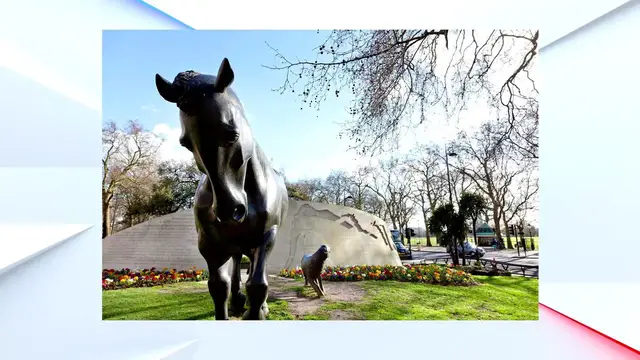
WATCH: Angela Rippon honours animals who ‘saved lives’ in war at Hyde Park memorial
Nov 7, 2025


Veteran broadcaster Angela Rippon has paid tribute to the millions of animals who served alongside soldiers in wartime as she delivered an address at the Animals in War Memorial in Hyde Park.She told GB News that during the First World War alone, eight million horses, donkeys and mules were killed in service. Angela said animals continued to play a vital role in modern warfare, with dogs saving lives by detecting explosives. She added: “They didn’t volunteer, they served because we asked them to. This is our way of recognising and honouring them.”WATCH THE CLIP ABOVE FOR MORE
Show More Show Less View Video Transcript
0:00
It's interesting, isn't it
0:01
Because when you look at the scale of the use of animals in warfare, and yet, today at least, we often don't recognise it
0:10
And yet we are still using animals. I mean, there will be servicemen and women now
0:14
who will be going to work today, particularly with canine patrols. And so many people within the armed services now
0:24
can say that they owe their lives if they were, shall we say, were in the Middle East, in Afghanistan, in Iraq before that, actually owe their lives to the fact
0:32
that it was dogs that they sent out to see whether or not there were explosives in a building
0:38
whether they were going through a minefield or whatever. So I think we were just talking previously
0:43
of course, Hannibal used his elephants. There has not been a single year since the end of the Second
0:50
World War when we have not had a conflict of some sort and animals are still being used
0:56
We don't have horses used in the same way, obviously. We still had the cavalry, which is why 8 million horses were lost
1:02
Horses, donkeys and mules were lost in the First World War. But they weren't just the cavalry horses
1:07
They were the horses that were pulling the guns, that were delivering the armaments, that were carrying out the wounded
1:12
And what is interesting is today in the 21st century in Ukraine who are leading the way in using drones in modern warfare
1:24
they are doing what they did in the First World War and they're using horses, donkeys and mules to take the wounded out
1:29
to bring things in because I suppose they're watching their budget and it's a lot easier to have horses and donkeys and mules
1:36
carrying things rather than sending in armoured vehicles or tanks. But, I mean, the wonderful memorial that we have on Park Lane
1:45
which I'm sure many of your viewers will be aware of, when you come to London, you can't miss it
1:49
It's that beautiful memorial right in the middle of Park Lane, which, interestingly, Jilly Cooper was one of the people
1:56
who led the appeal for that particular memorial. it's there and it recognises that it was horses, dogs, donkeys, mules
2:07
because they have individual statues of them but if you actually look at the memorial itself
2:14
you will see pigeons, dolphins I mean we know that dolphins are being used
2:19
as human beings we share this planet with millions of other animals
2:25
and for centuries we have used certain animals and abused them used them and abused them and got them into service with us during there is part of that memorial They stand beside us and I think that they
2:43
Certainly in the First and Second World War, they were still using the cavalry. Why don't we recognise them in the same way
2:49
I mean, I know there is the Dickin Medal, which has been given. It goes to animals
2:53
You know the first animal to get the Dickin Medal? Was it a cat? No, it was a pigeon
2:57
Oh, was it? Because in the Second World War, we were using pigeons to carry vital information, homing pigeons
3:05
And it was a pigeon, I think I'm right, I could be wrong, but I think I'm right in saying that the pigeon
3:09
that got the Dickin Medal was injured, but managed to get back home carrying vital information
3:16
before D-Day, that means. No, and I think this, you know, it's not being sentimental
3:21
it's not being sort of saccharine about this. They played a vital role
3:25
And they worked hard alongside us. Animals did. Animals did. And, you know, my father was a Royal Marine, and so every Remembrance Sunday, my dad would make his way to the memorial that they have for Royal Marines in Plymouth, which is where he was based, so that he could pay his respects
3:43
But also as a humanitarian, he recognised the importance of animals. And I think that all we are doing with what I going to do today and what we by recognising them and by having that memorial there is saying that as human beings we recognise the role that animals Because they didn volunteer They were Yes yeah yeah
4:01
..that animals have played beside mankind, beside servicemen and women, saving lives and serving our country
4:10
And it's our way of recognising that and honouring it. And actually, they do, just briefly
4:15
they do actually show a tremendous amount of loyalty, these animals. Do you know what's wonderful
4:20
I think if you talk to anybody in any of the canine units particularly, but also in the cavalry units that we still have
4:26
where they get very, very attached to their horses, of course, but we don't send horses into war anymore
4:30
But we do send dogs into areas, to the arena of war
4:37
They are not just important because of the bond they make with the people with whom they work
4:42
so the servicemen and women in the canine units. After the war, so many dogs now are being used
4:48
to help servicemen and women who are suffering from post-traumatic stress. We have animals that continue to serve
4:55
and continue to do something very positive to help human beings, whether it's at war or at peace
5:02
And I think it's wonderful that we have an opportunity to recognise that
5:06
and to honour them alongside the work that we will also be recognising
5:11
and the sacrifice we will be recognising on November the 11th
#news
#Pets & Animals
#Wildlife