Up next in 10



Think that hero always wins without consequence? Think again. This video breaks down popular movie endings that are far more tragic than they appear, from worldwide casualties to stolen identities and fractured realities.
Show More Show Less View Video Transcript
0:00
Hillmongers doesn't love a happy ending. As long as it feels earned and appropriate for the story
0:06
it's great to see the heroes triumph over the villain, which in turn sends popcorn-gobbling
0:12
audiences home with a smile on their faces. But sometimes things aren't quite that simple
0:18
and what's framed as a happy ending with jaunty music and a fanfare celebration
0:22
is actually anything but. There are even some cases where a sad ending can be made
0:28
even darker the more time you spend thinking about it. So with that said, let's get sad
0:34
shall we? I'm Ewan, you're watching WhatCulture, and here are movie endings way darker than you
0:39
realize. Valentine's Signal Killed Millions Worldwide. Kingsman, The Secret Service. The villain of the first Kingsman movie, Samuel L. Jackson's Richmond Valentine
0:52
plans to control the world by giving free sim cards to every human being on Earth
0:57
The catch? Well, he can transmit a signal that turns anyone with one of those sim cards murderously violent, all in an attempt to control overpopulation and prevent global warming
1:08
And indeed, Valentine activates the signal for a brief period during the movie's third act, with director Matthew Vaughn briefly showing scenes of chaos unfolding around the world as people suddenly start killing each other
1:21
Yet after Valentine is killed at film's end, the masses of human carnage which unfolded while the signal was active are oddly glossed over
1:30
It's reasonable to assume that millions of people, especially the young, elderly, and physically vulnerable, would have died in droves, severely impacting the population of the next generation in particular
1:42
And this is without even considering that numerous world leaders in Ballantyne's employ
1:47
had their heads exploded in the climax, likely grading at least a couple of teeny tiny power
1:53
vacuums in countries around the world. Colter hijacked a guy's body, Source Code
2:16
A surface-level reading of Source Code's ending says that it's a happy one
2:20
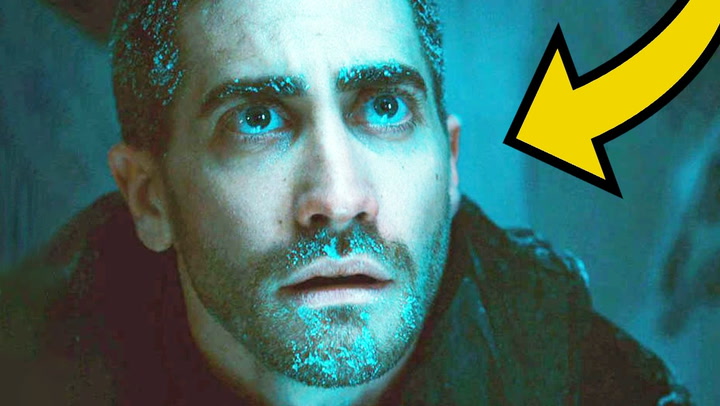
at least for protagonist, Captain Colter Stevens, played in the film by Jake Gyllenhaal, who we all dearly love
2:27
Stevens eventually learns that he was gravely wounded in action and is being kept on life support to test out the experimental
2:35
past-reconstructuring Source Code tech. At the end of the film, however, one of the officers overseeing the quote-unquote simulation
2:42
Captain Goodwin agrees to terminate his life support after one final trip back into the
2:48
source code. While the termination seemingly freezes Coulter in time with his love interest Christina a moment later the scene unfreezes revealing that the source code wasn generating simulations but actually creating parallel universes
3:03
And so Coulter is free to live a full life with Christina in this newly created reality
3:08
with a fully functioning body no less. Except it's important to remember that anytime Coulter entered the source code
3:16
he was inserted into the body of a school teacher named Sean Fentress
3:20
effectively hijacking it. And so, though this outcome is a fortuitous one for Coulter
3:26
he's basically stolen the body of another human being, a fact we're slightly reminded of in the
3:33
ending when Sean's reflection can be seen in front of Coulter. As if Sean's consciousness
3:39
being obliterated wasn't bad enough, his family and friends will have to deal with him having no
3:45
memory of them whatsoever. Marty's brain struggles to accept his new past, Back to the Future
3:52
Back to the Future's ending sees Marty McFly ensure that his parents do indeed get together
3:57
in 1955, thereby securing his own existence. However, doing so also ends up changing his
4:04
present of 1985. At the start of Robert Zemeckis' film, Marty's father George is cowardly and timid
4:12
his mother Lorraine is not doing great, and his siblings have really failed to do anything with
4:18
their lives. But at the end, their fates have been changed. George is a successful sci-fi author and
4:24
an assertive human being. Lorraine is happy and healthy, and his siblings are doing well for
4:30
themselves too. Basically, Marty's entire life up to this point has been fundamentally altered
4:36
and while the film keeps it ambiguous precisely how Marty's memories will now work
4:41
There are basically two options we have to work with here. 1. Marty either has no memory of his present and has to awkwardly wing it the rest of his life
4:50
2. His older memories will slowly fade in over time given that the movie confirms the aspects
4:57
of the present will slowly update after the past is changed, like with Marty's photo of his family
5:03
Either way, it's going to be a tough period of adjustment. Having no memory of a childhood the
5:08
rest of his family vividly remembers or having to experience his memories being gradually reshaped
5:14
over time which kind of sounds like a bit of a nightmare the whole movie is walker's dying dream
5:20
point blank let's look at story one of ewan's fave movies entry here john borman's point blank
5:26
was the director's 1967 masterpiece an ethereal dreamlike descent into the california underworld
5:33
with a career best Lee Marvin as our guide. The film was adapted from Richard Stark's
5:39
slash Donald Westlake's Parker novels, namely The Hunter. Side note if you enjoy comics
5:45
too the late great Darwin Cook adapted Stark Parker novels in the 2010s and they are all gorgeous and well worth checking out But yeah point blank and spoiler alert of course if you have not seen the film
5:56
already, and please do go do that if you haven't because it's amazing. The film stars Marvin as
6:02
Walker, a wronged professional criminal with a ruthless mean streak who sets out to take revenge
6:07
on those who double-crossed him and stole his score. Marvin's character drifts through California
6:12
ran through a pop art lens, systematically taking down those who wanted him to stay dead
6:18
The film ends with Walker at the same place he was originally left for dead at, Alcatraz Island
6:23
fading into the darkness to avoid one final double cross. It's also possible that Walker
6:29
could be fading out of existence altogether. Several reads of Point Blank, the most notable
6:34
posited by critic David Thompson, have suggested that the film is really Walker's dying fantasy
6:40
A series of visions promising revenge before he succumbs to his wounds on Alcatraz in the encounter we see at the beginning of the film
6:48
It's also possible to look at Walker as something of a specter. While point-blank supernatural elements aren't explicitly telegraphed
6:56
and it's perfectly acceptable to read the film more literally as Walker's actual revenge
7:01
Borman himself did say that it's possible for Walker to be seen as a quote, ghost or shadow
7:06
Whichever read you have a point blank, it's ending is still devastatingly good
7:11
Ewoks eat the stormtroopers. Star Wars Episode 6, Return of the Jedi
7:16
Much as Episode 6 of Star Wars ends the original trilogy on a triumphant note
7:21
the galaxy-wide celebration is hampered somewhat by the sly implication of human eating
7:27
Return of the Jedi introduced fans to the adorable fuzzy Ewoks, who are nevertheless
7:32
shown to be carnivorous given that they very nearly end up eating Luke, Han, and Chewbacca
7:37
upon first crossing past with them. And while they ultimately all worked together to fight the Empire
7:42
and celebrate it in unison at the end, the Ewoks almost certainly didn't afford the same quarter
7:47
to the stormtroopers they captured during the battle of Endor. But yeah, given that we can even
7:52
see an Ewok drumming on some stormtrooper helmets right at the end of the film, it seems pretty cut
7:57
and dried that they spit roasted and ate their defeated foes. Barry is trapped in the Schumacher
8:03
verse. The Flash. The Flash delivers one of the most genuinely surprising WTF endings in recent
8:09
memory, when Barry Allen seemingly returns to the presence, only to meet up with Bruce Wayne and
8:14
discover that he's not played by Ben Affleck, but by George Clooney. Ooh, what a zinger. While on the
8:20
face of it, this might seem like a mere goofy, nonsensical gag on which to end the film
8:25
a head scratching closing moment to set up a sequel that will never arrive. Good going
8:31
in again Warner Bros. It's actually a sort of twisted ironic fate for this incarnation
8:37
of the flash Just think about it Barry has effectively been banished to the Schumacher verse of Batman Forever and Batman and Robin I will go on the record multiple times to defend those movies but that is not where Barry belongs His timeline is still balked in short and he must now
8:54
presumably annoy yet another incarnation of Batman in a bid to fix what he's broken. Here's hoping
9:00
that Arnie's Mr. Freeze iced him in like 5 seconds flat. Kong's corpse becomes an attraction. King
9:06
Kong No matter which version of King Kong you watch, they typically end with the death of Kong
9:11
at the hands of the military. And while the story seemingly ends there, Joe DeVito's sequel novel
9:17
King of Skull Island, released shortly before Peter Jackson's 2005 remake, reveals a bleak postscript addendum to Kong's demise. The novel's most disturbing revelation
9:30
Well, after Kong was shot by the military and fell to his death, his gigantic corpse was collected
9:36
and became an exhibit at the Museum of Natural History, with patrons paying top dollar to view
9:42
his skeleton posed exonically in combat with a dinosaur. There's a tragic irony to this outcome
9:49
for Kong that even in death the world wasn't done with him. His remains were commodified
9:55
long after he was gone. Gentrification still wins. Batteries not included You have to give the filmmakers behind batteries not included some credit. Back in 1987 they managed
10:06
to address the issue of gentrification in a film aimed squarely at kids. The plot centers around an
10:12
impoverished New York neighborhood where an apartment building and cafe operated by the
10:16
Riley's is under threat of demolition by nasty property developers. With the Riley's and some
10:21
of their tenants refusing to move, the developers ramp up their threats, until they are visited by
10:26
mechanical creatures resembling flying saucers dubbed the Fix-It's which promptly start repairing
10:33
the run down building. All the same, an arson attack causes the building to be destroyed near
10:38
the film's end before a fleet of the fixits returns and rebuilds the entire apartment block
10:44
to a better state than ever before. This results in the building being spared by the developers
10:50
with the final shot taking place years later and showing the block nestled safely between
10:55
the developers new fancy high rises. Though the cafe is said to benefit from the influx of new
11:01
people to the area, everything we know about gentrification says this won't be a good thing
11:06
for the Rileys, their tenants, or really any non-rich person living in the vicinity
11:12
The property developments would end up raising the value of the surrounding area enough that it
11:17
would almost certainly price the Rileys and their tenants out of the area on a long enough timeline
11:22
The Rileys would have to pay more property tax, likely forcing them to raise their tenants' rent
11:27
the cost of everything in the area would also skyrocket, ensuring that affordable living quickly
11:34
became anything but. As a closing shot, it's a triumphant image of defiance
11:39
but one grimly undone by cold, hard reality