Up next in 10


A major maritime confrontation is emerging between Russia and the West.
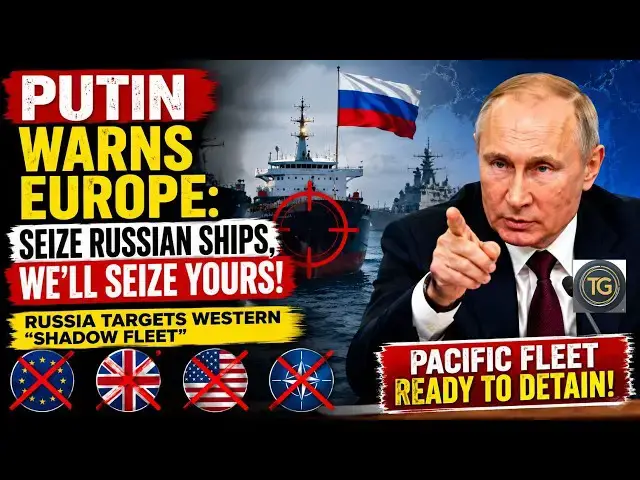
Russian President Vladimir Putin has threatened to respond to European seizures of Russian commercial vessels by seizing European ships in return. Putin described Western action against Russian vessels as unacceptable and warned that Russia could respond wherever it considers necessary.
The warning came during Putin’s visit to Russia’s Pacific Fleet, where Admiral Viktor Liina outlined the fleet’s ability to inspect and detain vessels belonging to states Moscow considers “unfriendly.”
That makes the Pacific strategically important to the new confrontation.
According to Liina, more than 1,000 vessels passed through Russia’s exclusive economic zone between April 24 and August 6, 2026, including 379 vessels sailing under flags of countries Russia classifies as “unfriendly.”
But there is an important distinction surrounding Moscow’s use of the term “Western shadow fleet.” Liina presented the concept as a mirror image of the Western characterization of Russia’s own shadow fleet, arguing that Western countries use vessels flying third-country flags for their commercial interests. The uploaded source explicitly notes that this was a political and rhetorical framing, not vessel-by-vessel evidence that all 379 ships belong to such a fleet.
The bigger story is therefore not simply the number of ships Russia is tracking.
It is the possibility of reciprocal maritime seizures.
Europe has been targeting Russian-linked vessels associated with the shadow-fleet network, while Moscow is now warning that Western commercial shipping could become a target for retaliation. Reuters reports that Putin said Russia would respond “in kind” if European countries began seizing Russian merchant vessels.
That raises a potentially dangerous question: could the Pacific become a new arena in the Russia-West maritime confrontation?
The Russian Pacific Fleet's growing surveillance of commercial traffic gives Moscow the ability to identify vessels moving through its maritime approaches. Whether that capability will actually be used for detention or seizure remains a separate question—but Putin's warning makes clear that Russia is publicly considering reciprocal action.
This is no longer simply a story about sanctions, oil tankers or shipping flags.
It is becoming a story about maritime power, retaliation and the possibility of commercial vessels becoming instruments in a wider geopolitical confrontation.
#Putin #Russia #RussianNavy #PacificFleet #ShadowFleet #RussiaUkraine #Europe #EuropeanUnion #WesternShips #MaritimeSecurity #Geopolitics #RussiaNews #WorldNews #MilitaryNews #PacificOcean #AsiaPacific #Shipping #Tanker #Sanctions #GlobalTrade
Show More Show Less View Video Transcript
0:03
Welcome to Terran Av's geopolitics
0:06
channel.
0:07
In today's video, we are breaking down a
0:09
massive update straight out of the
0:10
Russian Far East that could reshape how
0:12
global shipping operates in the Pacific.
0:15
Moscow has just launched a sweeping
0:17
naval tracking operation, placing over
0:20
1,000 foreign ships under direct
0:22
military surveillance in a critical
0:23
maritime corridor.
0:25
Over the next 20 minutes, we'll analyze
0:28
why President Putin personally ordered
0:29
this mission, why almost 400 of these
0:32
ships are being flagged as unfriendly,
0:34
and how Russia's controversial move to
0:36
identify a Western shadow fleet might
0:38
spark a dangerous new precedent for
0:40
international trade routes.
0:42
Make sure you watch till the very end
0:45
because the operational shift we're
0:46
covering at the conclusion of this video
0:48
changes the calculus for every major
0:50
power in the Indo-Pacific.
0:54
Russia is intensifying its surveillance
0:56
of maritime traffic in the Asia-Pacific
0:58
region.
0:59
The Russian Pacific Fleet is monitoring
1:01
commercial and other vessels that are
1:03
transiting waters in close proximity to
1:05
the country's Far Eastern coastline.
1:08
Admiral Lina confirmed that he is
1:10
conducting the mission in accordance
1:11
with the directives of President
1:12
Vladimir Putin.
1:14
The disclosure suggests that Moscow has
1:16
shifted its focus from routine naval
1:18
surveillance to direct strategic
1:20
attention on maritime traffic
1:21
monitoring.
1:23
>> European Union decisions that took place
1:25
with
1:29
We have observed that the governing
1:31
authorities of certain nations are
1:34
actively and blatantly violating
1:36
international maritime rules by
1:39
attempting to curtail the movement of
1:41
vessels owned by our hardworking
1:43
citizens,
1:45
all while contemplating measures to
1:47
confiscate our assets and sell off
1:50
appropriated goods to their own benefit.
1:54
Of course, this is nothing more than
1:56
piracy and division.
1:59
If this starts to be put into practice,
2:01
we will need to respond in kind and
2:03
possibly even mirror the actions.
2:07
Not limited to operations in planned
2:08
areas, but also potentially extending
2:10
beyond these waters.
2:14
We will act wherever we find it
2:16
necessary and strategically beneficial.
2:22
Including in the area of responsible
2:23
networks of Curpians.
2:26
I would ask you to pay attention to
2:28
this.
2:29
They know that such an order from the
2:31
Ministry of Defense has been conveyed to
2:33
the team of Curpians.
2:38
I would kindly request a detailed
2:40
proposal regarding this matter.
2:42
To conclude, I want to reiterate that
2:45
Russia continues to bolster its overall
2:48
security in a comprehensive way.
2:52
Within the department, there is an
2:55
unwavering commitment to fostering
2:57
mutually beneficial compromises with all
3:00
neighboring countries and partners.
3:04
And we are ready to do this ourselves,
3:05
but we are also surprised.
3:10
It's easier to leave the
3:11
commander-in-chief.
3:12
The forces and troops of the Sakha and
3:14
fleet are in constant combat readiness,
3:16
performing tasks according to their
3:18
intended purpose.
3:20
Are unable to ensure the security of the
3:21
Russian Federation in the Asia-Pacific
3:23
region.
3:25
The military-political situation in the
3:27
region is tense and has a steady
3:29
tendency to become more complicated.
3:33
The main factors in the growth of
3:35
military and political tensions are the
3:37
destructive activities of Western
3:39
countries to override the security
3:41
system of the VTR, their increased and
3:44
advanced military presence, as well as
3:46
the creation of Western-controlled
3:50
new political and military alliances.
3:53
We are talking about the block structure
3:55
of all tourism and the triple alliance.
3:59
At present, new alliances such as JAF
4:02
Squad and Argus are being actively
4:04
forged and gaining prominence.
4:07
In essence, these alliances of military
4:09
political factions connected to NATO,
4:11
albeit under a different guise.
4:14
They regularly conduct joint combat
4:17
training operations with both their
4:18
frequency and scale showing a consistent
4:21
increase over time.
4:24
There appears to be a clear trend of
4:26
integrating NATO's military political
4:28
capacities into the regional strategies
4:30
of the VTR.
4:34
The aggravation of the situation in the
4:36
operational area of the fleet is also
4:38
confirmed by the increasingly aggressive
4:40
activities of the military political
4:42
leadership of Japan.
4:44
Thus, on July 4th, a white paper was
4:46
published which determined the course of
4:48
the military political leadership on
4:51
open militarization.
4:54
Russia is identified as one of Japan's
4:56
reset.
4:57
It also indicated an increase in
4:59
spending on military needs to 2%.
5:03
The Japanese Defense Minister has boldly
5:05
proposed scrapping the three
5:07
nuclear-free principles, a significant
5:10
and concerning proposition for our
5:12
region.
5:14
Simultaneously, discussions on revising
5:17
Article 9 of the Constitution are
5:19
underway.
5:21
And the formation of armed services.
5:25
An important issue is the threat of the
5:27
West blocking Russia's maritime trade in
5:30
order to inflict maximum economic damage
5:32
on it.
5:34
Additionally, as part of the 21st
5:37
package of anti-Russian sanctions, the
5:39
EU has lifted the prohibition on the
5:41
sale of Russian hydrocarbons within its
5:44
member states.
5:46
Thus, the countries of the
5:48
are granted the right at the national
5:50
level to adopt
5:52
legislative decision on the possibility
5:54
of selling hydrocarbons from detained
5:57
ships of the so-called Russian shadow
5:59
move. Thereby, the European Union seeks
6:02
to legally justify its actions in
6:05
contradiction with the international new
6:07
In accordance with your comrade the
6:09
Supreme Commander-in-Chief's order, we
6:11
have conducted a detailed analysis of
6:14
the maritime traffic carried out by the
6:17
VTR. We know the routes that they are
6:20
carrying and whose ships they are.
6:24
Only in the exclusive economic zone of
6:26
the Russian Federation along the islands
6:29
of the South Kuril Greater from April
6:31
24th to August 6th, 2026, 1,001 trials
6:35
took place.
6:37
Among these vessels, 379 are registered
6:40
under the flags of adversarial nations,
6:42
including 273 dry cargo ships and 71
6:46
tankers, with 26 hailing from Britain
6:48
and nine from France.
6:52
At the same time, the Western state
6:54
actively attracts ships flying under the
6:56
flags of third countries to transport
6:59
goods in their interest. In fact, this
7:01
is their shadow fleet. Forces for
7:04
inspecting and detaining ships of
7:06
non-compliant states in their shadow
7:08
fleet, we have organized
7:10
interdisciplinary interaction and are
7:12
ready to begin solving these problems.
7:14
The report has been concluded. Thank
7:17
you.
7:21
>> The operation provides Russia with a
7:23
more comprehensive understanding of the
7:24
shipping movements in one of its most
7:26
strategically significant maritime
7:28
regions.
7:29
This is where commercial traffic
7:31
intersects with military activity and
7:33
the importance of international trade
7:34
routes is on the rise.
7:37
Now, when you look at the sheer scale of
7:39
what's happening out on the water right
7:41
now, the numbers are pretty
7:42
mind-boggling.
7:44
The volume of traffic under surveillance
7:46
is huge.
7:48
The figures provided by Admiral Victor
7:50
Lina indicate that over 1,000 vessels
7:52
traversed Russia's exclusive economic
7:54
zone between April 24th and August 6th,
7:57
2026.
7:59
Of these, 379 vessels were operating
8:02
under the flags of countries that Russia
8:04
categorizes as unfriendly states.
8:08
The figures offer a glimpse of the
8:10
ferocious maritime activity that
8:12
surrounds Russia's far eastern
8:13
approaches.
8:14
Despite the geopolitical conflict
8:16
between Moscow and Western nations, they
8:19
also demonstrate the close connection
8:21
between Russian waters and international
8:23
shipping networks.
8:25
Right around here, it's critical to
8:27
remember that Terenov's analysis is
8:29
showing us a classic power projection
8:31
move that completely redefines regional
8:33
security.
8:34
Moscow does not have unrestricted
8:36
control over foreign shipping in the
8:38
Russian EEZ as it extends beyond its
8:40
territorial waters.
8:42
The littoral state has specific rights
8:44
regarding resources and certain other
8:46
activities, while vessels generally
8:48
retain freedom of navigation through an
8:50
EEZ under international maritime law.
8:54
As a result, Russia's interest is less
8:56
in the physical control of every vessel
8:58
and more in the understanding of the
8:59
entities that are transiting the
9:00
maritime space that surrounds the
9:02
country.
9:04
This brings us directly to why those 379
9:07
unfriendly vessels matter so much to
9:09
naval strategists.
9:11
From the Russian perspective, the figure
9:13
of 379 vessels is of particular
9:16
importance.
9:18
Moscow has maintained a list of
9:20
countries it deems unfriendly since the
9:22
escalation of tensions with the West.
9:25
This includes nations that have
9:26
implemented sanctions or implemented
9:28
other measures against Russia.
9:31
Tracking vessels associated with these
9:33
nations can offer Russian naval planners
9:35
additional information regarding the
9:37
commercial and strategic activities of
9:39
the region.
9:40
A ship's flag just doesn't tell you who
9:42
actually owns the boat anymore because
9:44
modern maritime legal loopholes are a
9:46
total mess.
9:48
A vessel may be registered in one
9:49
country while being owned, chartered,
9:52
insured, or commercially controlled by
9:54
other jurisdictions.
9:56
Its cargo may also originate in one
9:58
country and ultimately be delivered to a
10:00
completely different market.
10:03
This complexity has become increasingly
10:05
important as a result of the disruption
10:06
of established patterns of Russian
10:08
commodity trade by Western sanctions.
10:12
That setup leads us into how Russia
10:13
views what it calls the Western shadow
10:15
fleet.
10:17
According to Admiral Lina's own framing,
10:19
Russia's concept of a Western shadow
10:21
fleet is a deliberate mirror image of
10:23
how Western governments use the term
10:25
against Russia.
10:26
In his words to Putin, Western states
10:28
use vessels flying third country flags
10:31
to move cargo in their own commercial
10:32
interests, and in Moscow's assessment,
10:35
that arrangement itself constitutes a
10:37
Western shadow fleet.
10:40
From this perspective, a ship's flag is
10:42
treated as unreliable evidence of who
10:44
the voyage actually serves.
10:46
A vessel could fly the flag of a country
10:48
with no political dispute with Russia
10:50
while still, in Moscow's view, forming
10:53
part of a commercial chain tied to
10:54
European buyers or trade networks.
10:57
On that logic, flag of convenience
10:59
registration, third-party chartering, or
11:02
opaque ownership structures become
11:04
grounds for suspicion rather than
11:05
routine shipping practice.
11:08
It's worth being clear about what this
11:10
actually is, a political and rhetorical
11:12
framing announced alongside a policy
11:14
decision, not a technical or evidentiary
11:16
finding.
11:18
Lina did not present vessel-by-vessel
11:20
evidence connecting any of the 379
11:22
flagged ships to sanction-sensitive
11:24
European trade. The statement was a
11:26
general assertion used to justify a new
11:28
posture that the Pacific Fleet now has
11:30
the forces and interagency coordination
11:32
in place to inspect and detain vessels
11:34
of unfriendly states it deems part of
11:36
this shadow fleet.
11:39
That distinction matters because the
11:40
announcement follows and is widely read
11:42
as a response to Western seizures of
11:44
Russian-linked tankers, nine vessels
11:46
carrying Russian oil detained by the UK
11:49
and EU since the start of 2026.
11:52
Framing Western-flagged commercial
11:54
shipping as a reciprocal shadow fleet
11:56
gives Moscow a symmetrical justification
11:58
for boarding and detention regardless of
12:01
whether the underlying commercial facts
12:02
support that label in any given case.
12:06
Don't go anywhere just yet because at
12:08
this exact moment, Terranov's analysis
12:10
is highlighting a massive tactical
12:12
escalation that could disrupt global
12:14
supply chains overnight.
12:16
A caveat on terminology, not every
12:19
foreign-flagged vessel is a shadow fleet
12:21
vessel by any standard definition.
12:24
International shipping routinely relies
12:26
on foreign flags, chartering
12:27
arrangements, and layered ownership for
12:30
entirely ordinary commercial reasons.
12:32
The term is generally reserved,
12:34
including in Western usage against
12:36
Russian oil exports, for vessels and
12:38
networks specifically built to route
12:40
around sanctions, insurance
12:42
restrictions, or financial controls.
12:45
Whether Russia's application of the term
12:47
to the 379 vessels meets that bar is, at
12:50
this point, an assertion by Russian
12:52
military leadership.
12:55
All of this stems from how shipping
12:56
networks have grown dramatically more
12:58
complicated.
13:00
The complexity of maritime trading
13:01
networks has been exacerbated by Western
13:04
sanctions and restrictions on Russian
13:05
commodities.
13:07
Ownership, registration, or management
13:10
arrangements of vessels may undergo
13:12
modifications.
13:13
Chartering and insurance may involve
13:15
entities that are not part of the
13:16
conventional European and North American
13:18
maritime system, and cargoes may transit
13:21
intermediary countries.
13:23
Consequently, Russia can obtain more
13:26
comprehensive information regarding
13:27
vessel traffic by monitoring these
13:29
movements.
13:31
It can assist authorities in
13:32
understanding the impact of sanctions on
13:34
trade routes, the movement of Russian
13:36
commodities, and the evolution of
13:38
commercial networks that connect Russia
13:40
to international markets.
13:43
This is especially important in the
13:44
energy sector, where Russia continues to
13:47
be a significant exporter and where
13:48
shipping has become an increasingly
13:50
significant aspect of commerce during
13:52
the sanctions era.
13:54
Understanding these trade dynamics
13:56
brings us to why the Asia-Pacific region
13:58
is taking center stage.
14:00
The surveillance operation also serves
14:02
as an indicator of the increasing
14:04
strategic significance of the
14:05
Asia-Pacific region to Russia.
14:08
Moscow has shifted its focus to Asian
14:10
markets and partners as its economic
14:12
relationship with Europe has
14:14
deteriorated.
14:15
Southeast Asian and Middle Eastern
14:17
countries have also become significant
14:19
components of Russia's broader trading
14:21
network, while China and India have
14:23
become particularly significant
14:25
destinations for Russian commodities.
14:28
As a result, the significance of the
14:30
maritime routes that connect Russia's
14:32
Far East with the broader Indo-Pacific
14:34
region has gone up.
14:36
Consequently, the Pacific Fleet operates
14:38
in a context where commercial shipping,
14:40
energy transportation, naval activity,
14:43
and geopolitical competition are
14:45
becoming more interconnected.
14:47
But if you think this is just about
14:49
trade routes, stick around because what
14:51
the Pacific Fleet is building on the
14:53
operational side is where things get
14:55
truly tense.
14:57
Systematic surveillance of shipping can
14:58
offer the Russian Navy a critical
15:00
operational perspective.
15:03
Russian authorities are able to
15:04
establish a more detailed understanding
15:06
of the ships that are transiting the
15:08
country's exclusive economic zone by
15:10
monitoring over 1,000 vessels for a
15:12
period of slightly more than 3 months.
15:15
An additional category for Russian
15:17
authorities to monitor is the 379
15:20
vessels that are sailing under
15:21
unfriendly flags.
15:24
This does not inherently imply that each
15:26
vessel is regarded as a threat.
15:28
Rather, the information has the
15:30
potential to enhance a more
15:31
comprehensive understanding of maritime
15:33
situational awareness.
15:36
It is an essential operational
15:37
requirement for a navy that is
15:39
responsible for safeguarding one of the
15:41
world's longest coastlines to be aware
15:43
of the activities in the surrounding
15:44
waters.
15:46
This intelligence gathering is happening
15:48
right as strategic competition directly
15:50
confronts commercial traffic.
15:52
Additionally, the waters surrounding
15:54
Russia's Far East are becoming
15:56
increasingly congested from a strategic
15:58
standpoint.
16:00
The United States, China, Japan, South
16:03
Korea, and Russia all have significant
16:05
economic and military interests in the
16:07
broader Pacific and Northeast Asian
16:09
region.
16:11
Naval patrols, military exercises, and
16:14
other strategic activities are conducted
16:16
in conjunction with commercial vessels.
16:19
As we reach this critical turning point
16:21
in the region, Terenov's analysis is
16:23
pointing to one undeniable reality:
16:26
maritime intelligence is the new
16:27
ultimate battleground.
16:29
The maritime environment that has
16:31
resulted is becoming increasingly
16:33
critical in terms of surveillance.
16:35
A commercial ship may be just
16:37
transporting cargo. However, its
16:39
movement can also be a component of a
16:41
much larger trading network that spans
16:43
multiple countries and jurisdictions.
16:46
Moscow is increasingly recognizing the
16:48
significance of understanding this
16:50
network in its maritime awareness.
16:53
When you pull all these threads
16:54
together, you see a much broader
16:56
indicator of Russia's long-term maritime
16:58
strategy.
17:00
The figures provided by Admiral Lina are
17:02
just a snapshot, but they illustrate the
17:04
extent of the maritime environment that
17:06
Russia is monitoring.
17:09
The figures also underscore a changing
17:11
reality in international shipping. The
17:13
nationality displayed on a ship's stern
17:15
may no longer offer a comprehensive
17:17
understanding of the vessel's cargo,
17:18
ownership, or commercial interests.
17:22
The shadow fleet debate is particularly
17:24
pertinent to Russia, as ships that
17:26
operate under the flags of third
17:27
countries can continue to engage in
17:29
trade with European markets.
17:32
It is evident that Moscow is aiming to
17:34
obtain a comprehensive understanding of
17:36
maritime activity in the Pacific
17:38
approaches, as the surveillance mission
17:40
is being executed under Putin's
17:41
guidance.
17:43
In an Asia-Pacific region that is
17:45
becoming increasingly contested, the
17:47
ability to identify the movements of
17:49
ships, their registration locations, and
17:52
their connections to global trade
17:53
networks is becoming a strategic
17:55
capability in its own right. If you like
17:57
this podcast, please like, subscribe,
18:00
and share.
#News