0:04
Welcome back to Terranov's geopolitics
0:06
channel, where we break down the
0:07
high-stakes power plays shaping our
0:11
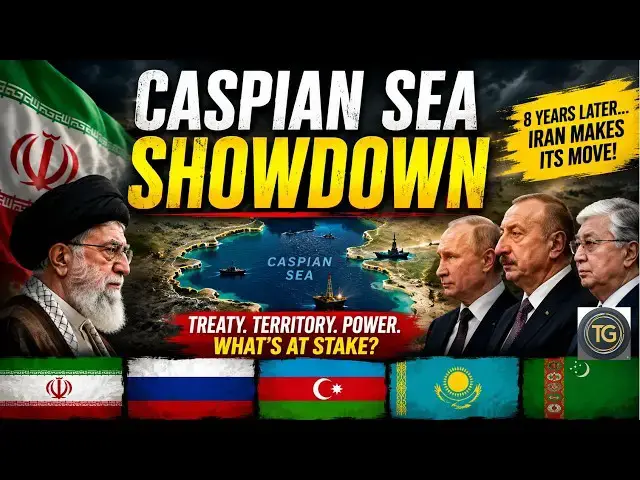
Iran is finally making an unprecedented
0:13
move on a disputed sea that could redraw
0:15
Eurasian trade and lock Western
0:17
militaries completely out of Central
0:19
But back home in Tehran, a fierce
0:21
political battle is raging that
0:23
threatens to blow the entire deal wide
0:27
In this video, we are diving straight
0:29
into why Tehran sat on this historic
0:31
Caspian Sea treaty for eight long years,
0:33
the exact economic and military
0:35
calculations forcing their hand right
0:37
now, and what this massive shift means
0:39
for global power balances.
0:41
Terranov's analysis is designed to give
0:43
you the real strategic picture behind
0:45
closed-door diplomacy, so make sure you
0:47
stay tuned all the way to the end as we
0:49
uncover every single moving piece of
0:51
this Eurasian showdown.
0:54
After eight years of signing the
0:56
historic agreement with Russia,
0:58
Azerbaijan, Kazakhstan, and
1:00
Turkmenistan, Iran has finally taken a
1:02
major move toward ratifying the
1:04
Convention on the Legal Status of the
1:08
The Iranian government has reintroduced
1:09
the long-delayed issue of ratification
1:11
to the forefront of the country's
1:13
domestic and regional politics by
1:15
submitting the convention to parliament.
1:17
The move raises a crucial question. Will
1:20
Iran actually ratify the Caspian
1:22
Convention, or will opposition inside
1:24
the country once again prevent the
1:25
agreement from taking effect?
1:29
To really understand where this all
1:30
began, we have to look at what unfolded
1:33
eight years after the Aktau agreement.
1:35
The leaders of the five Caspian littoral
1:37
states signed the Convention on the
1:39
Legal Status of the Caspian Sea in
1:41
Aktau, Kazakhstan, on August 12th, 2018.
1:46
The agreement was the result of over two
1:48
decades of negotiations that followed
1:50
the Soviet Union's disintegration and
1:52
the emergence of Azerbaijan, Kazakhstan,
1:54
and Turkmenistan as independent Caspian
1:58
The convention established a
1:59
comprehensive legal framework for
2:01
economic activity, environmental
2:03
preservation, security, fishing, and
2:06
navigation in the Caspian.
2:08
It also confirmed that the five littoral
2:10
states should resolve Caspian-related
2:12
issues and that the presence of external
2:14
military powers should be limited.
2:17
At the end of the day, a signature on
2:19
paper didn't just magically wipe away
2:21
decades of mistrust between these
2:24
The exact delimitation of the seabed
2:26
between the countries remains the
2:27
subject of separate agreements, which is
2:29
one of the most sensitive issues.
2:32
This has been of particular significance
2:34
to Iran, as Tehran has historically
2:36
harbored apprehensions regarding the
2:38
extent of its potential sector and its
2:39
access to offshore resources.
2:43
Now, if you are wondering why Iran
2:45
delayed ratification for so long, the
2:47
answer goes straight to domestic
2:50
Iran's hesitation has largely been
2:52
connected to the question of its share
2:56
For years, certain Iranian political
2:58
circles have maintained that Tehran
3:00
should be granted 20% of the Caspian
3:02
Sea, while others have gone further and
3:04
asserted that Iran historically held the
3:06
right to half of the sea.
3:08
Whenever the convention has been the
3:10
subject of discussion, those arguments
3:12
have been repeatedly brought up.
3:14
However, Iranian former diplomat Mohsen
3:16
Pakaeen has refuted the notion that Iran
3:19
has a documented legal claim to 50% of
3:23
He maintains that there is no historical
3:25
treaty that established such a division,
3:27
even during the Soviet era.
3:30
Now, don't go thinking this is just some
3:32
dry legal debate, because what happens
3:34
next completely flips the strategic game
3:36
board across all of Eurasia.
3:39
Taranov's analysis is built on
3:40
uncovering these exact turning points
3:42
before they hit mainstream headlines.
3:45
The convention does not just divide the
3:47
Caspian into five equal 20% sectors.
3:50
Rather, it establishes principles for
3:52
maritime zones and defers significant
3:55
seabed delimitation concerns to
3:56
agreements between the relevant states.
3:59
This distinction is essential because
4:01
the ultimate maritime boundaries of Iran
4:03
would not be automatically determined
4:07
This brings us directly to why Tehran is
4:09
moving right now with such sudden
4:12
The timing of Iran's decision is
4:16
Iranian officials have linked the move
4:18
to the changing security environment
4:21
Esmaeil Baghaei, the spokesperson for
4:23
the Foreign Ministry, has contended that
4:25
the ratification of the agreement would
4:27
establish a more transparent legal
4:29
framework among the five littoral states
4:31
and would prevent the influence of
4:35
Tehran has experienced an increase in
4:37
the significance of security concerns.
4:39
Iran is interested in the Caspian region
4:42
remaining a controlled regional space
4:43
that is free of military activity by
4:47
Ratification could therefore strengthen
4:49
Iran's legal position in a changing
4:51
regional security environment.
4:54
Additionally, it would eliminate the
4:55
most major remaining barrier to the
4:57
convention's implementation.
5:00
The agreement has been ratified by
5:01
Russia and the other Caspian republics.
5:05
In the ratification procedure, Iran has
5:07
remained the critical missing piece.
5:10
But let us be totally candid here.
5:12
Things are rarely ever smooth sailing
5:14
when Tehran's hardliners get stirred up
5:16
over national borders.
5:18
Opposition within Iran is mounting and
5:20
ratification is definitely not a
5:23
A campaign against the convention has
5:25
been initiated by hardline political
5:27
groups and certain Iranian commentators.
5:30
Their objections include concerns about
5:32
Iran's maritime rights, the unresolved
5:35
seabed question, possible future
5:37
pipelines across the Caspian seabed, and
5:39
the broader geopolitical consequences of
5:43
Some opponents contend that ratification
5:45
could erode Iran's bargaining power in
5:47
relation to Azerbaijan and Turkmenistan.
5:50
Others associate the matter with the
5:52
Zangezur corridor, Iran's apprehensions
5:54
regarding regional transportation
5:56
routes, and Azerbaijan's expanding
5:58
strategic partnership with Turkey.
6:01
The issue has therefore become much
6:03
larger than a technical maritime treaty.
6:06
It is associated with the country's
6:07
broader geopolitical position, relations
6:10
with Azerbaijan, and national
6:12
sovereignty for certain Iranian
6:15
The parliamentary debate is of
6:17
particular significance due to the
6:19
involvement of conservative and Islamic
6:21
Revolutionary Guard Corps-linked media.
6:24
Although the Iranian government may
6:25
endorse ratification, it must still
6:27
surmount domestic political opposition.
6:31
Stick around because this next part is
6:33
where the massive ripple effects will
6:34
hit trade corridors and global energy
6:38
What ratification would mean for the
6:39
Caspian is monumental.
6:42
If Parliament approves the convention,
6:44
the consequences could be significant.
6:47
First, it would provide the Caspian
6:48
states with a more complete legal
6:50
framework for cooperation.
6:53
Second, it would strengthen the
6:54
principle that the security arrangements
6:56
of the sea are determined by the five
6:58
littoral countries rather than external
7:02
Third, the ratification of the agreement
7:04
could foster a more extensive economic
7:06
partnership that encompasses energy,
7:08
transportation, ports, and shipping.
7:11
The Caspian is becoming increasingly
7:13
significant as a connection between the
7:15
South Caucasus, Central Asia, Iran, and
7:20
This could also serve as an additional
7:22
incentive for Iran to mitigate the
7:24
uncertainty that surrounds its northern
7:25
maritime frontier, thus complementing
7:28
the broader development of the
7:29
International North-South Transport
7:32
Simultaneously, ratification would not
7:35
resolve each territorial dispute in a
7:38
Seabed boundaries and offshore resources
7:41
may continue to be the subject of
7:42
separate negotiations.
7:45
Therefore, the ultimate question
7:46
remains, will Iran ratify it?
7:50
The response is becoming more likely to
7:52
be affirmative. However, it may not
7:54
occur without political controversy or
7:59
Tehran has transitioned the convention
8:01
from diplomatic discourse to the formal
8:02
parliamentary process, which is the most
8:05
compelling indication.
8:06
The government has publicly argued that
8:08
ratification is essential for Iran's and
8:11
regional interests and has granted the
8:15
This represents a major departure from
8:17
the 8-year period of uncertainty that
8:21
Pretty much everyone knows that when
8:22
domestic pride gets tangled up in
8:24
diplomacy, things get messy fast.
8:27
In Iran, the Caspian question is imbued
8:29
with significant symbolic significance
8:32
and any indication that Tehran is
8:34
seeding maritime territory could
8:35
potentially incite opposition.
8:38
Consequently, instead of immediate
8:40
approval, the most probable result is
8:42
the eventual ratification following a
8:44
vigorous political debate.
8:46
Tehran has compelling strategic reasons
8:48
to finalize the process. It would
8:50
integrate Iran into the legal framework
8:52
that governs the Caspian, fortify
8:54
regional security arrangements, and
8:56
eradicate the uncertainty that has
8:58
pervaded the convention since 2018.
9:01
Taranov's analysis is always tracking
9:03
where power actually shifts on the
9:05
ground, and right now, the ultimate
9:07
conflict will transpire directly within
9:12
8 years ago, the Caspian convention was
9:14
signed to resolve one of the most
9:16
enduring maritime disputes in Eurasia.
9:19
Tehran may now be prepared to convert
9:21
that diplomatic agreement into law as
9:23
evidenced by its decision to present it
9:26
Whether the Caspian receives the legal
9:28
framework envisioned at Aktau or enters
9:30
another chapter will depend entirely on
9:32
its ability to overcome domestic
9:34
opposition. If you like this podcast,
9:37
please like, subscribe, and share.