Up next in 10


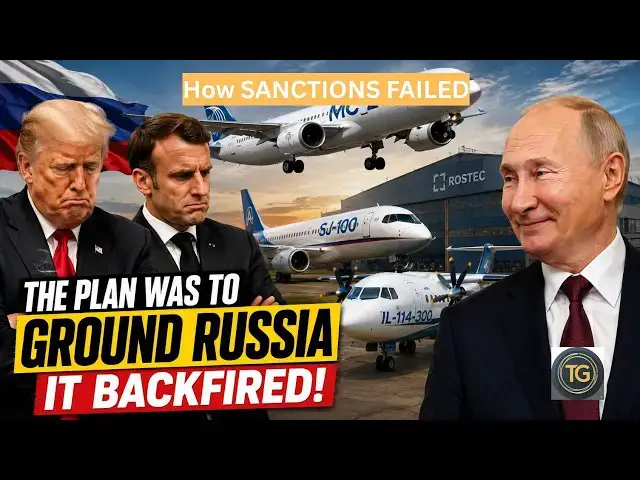
When Western governments imposed sweeping aviation sanctions on Russia in 2022, the expectation was clear: without Boeing, Airbus, spare parts, engineering support, and maintenance, Russia's commercial aviation sector would gradually grind to a halt.
But four years later, the outcome looks far more complicated.
In this video, we examine how Russia responded by accelerating domestic aircraft development through the SJ-100, MC-21, and Il-114-300 programs while expanding local production of engines, avionics, composites, and replacement parts. We also explore whether the sanctions achieved their original objective or instead triggered one of Russia's biggest industrial import-substitution drives since the Soviet era.
This video examines the industrial, economic, and geopolitical implications behind one of the most ambitious aviation transformations of recent years.
If you enjoy in-depth coverage of aviation, defense, technology, and geopolitics, subscribe for more analysis.
#Russia #Aviation #Sanctions #MC21 #SJ100 #IL114 #Boeing #Airbus #Geopolitics #Aircraft #CivilAviation #Technology #Engineering #ImportSubstitution #Aerospace
Show More Show Less View Video Transcript
0:03
When the United States, the European
0:05
Union, and their allies hit Russia with
0:07
sweeping aviation sanctions back in
0:09
2022, the goal went way beyond just
0:12
stopping new aircraft sales.
0:14
The real target was every single layer
0:16
of Russia's civil aviation ecosystem.
0:21
Welcome to Terranauts geopolitics
0:23
channel.
0:25
In today's video, we are breaking down
0:27
the massive economic war waged in the
0:29
skies, examining how Western giants like
0:32
Boeing and Airbus completely cut off
0:34
Russia from parts, engineering, and
0:36
maintenance support.
0:37
We will uncover why Western planners
0:39
thought Russia's commercial fleet would
0:41
be grounded within months, how Moscow
0:43
responded with a massive Soviet-style
0:45
industrial pivot, and what this means
0:47
for the future of global aviation.
0:50
Stick around and watch till the very end
0:52
because the numbers and industrial
0:54
realities we are going to look at will
0:55
completely change how you view Western
0:57
sanctions.
0:59
Back when this all started, Boeing and
1:01
Airbus cut off aircraft deliveries,
1:03
spare parts, engineering help, and
1:06
routine repair services, while strict
1:08
export controls banned the shipping of
1:10
high-tech aerospace parts.
1:12
The thinking behind this was dead
1:14
simple. Take away the jets, the spare
1:16
parts, and the technical support, and
1:18
Russia's commercial aviation system will
1:20
eventually stop working altogether.
1:23
Western leaders made no secret about
1:25
what they wanted to happen.
1:27
In March 2022, the United States
1:30
Department of Commerce came right out
1:31
and said that cutting off parts,
1:33
maintenance, and technical help would
1:35
leave Russian-operated Boeing and Airbus
1:37
planes effectively grounded.
1:39
It was a super direct admission that
1:41
sanctions were not just meant to make
1:43
life annoying for Russian airlines, but
1:45
to downright crush the country's civil
1:47
aviation strength.
1:49
Fast forward four years, and while
1:51
Russia's aviation industry has
1:53
definitely taken some heavy hits, it is
1:55
far from destroyed.
1:57
Sure, factory schedules slipped, testing
2:00
programs ran late, and airlines faced
2:02
daily headaches trying to keep things
2:04
running.
2:05
That big bold prediction that Russian
2:07
aviation was going to totally crash and
2:09
burn.
2:11
Yeah, that just did not happen.
2:13
Instead, these restrictions triggered
2:15
one of the largest self-reliance
2:17
industrial pushes the country has seen
2:19
since the end of the Soviet Union,
2:21
bringing three major homegrown passenger
2:23
jets toward mass production. The MC-21,
2:26
the SJ-100, and the IL-114-300.
2:31
Now, Taranov's analysis is crucial here
2:33
because to understand where things stand
2:35
today, we first have to look at how the
2:37
original Western plan was designed to
2:39
stop Russia from flying altogether.
2:42
Before all these restrictions hit,
2:44
Russian commercial flight was completely
2:46
tied to Western factories and supply
2:48
routes.
2:49
Hundreds of American Boeing and European
2:51
Airbus planes carried Russian passengers
2:54
every single day, while Russia's own
2:56
domestic plane programs relied heavily
2:58
on foreign tech.
3:00
The trade bans did not just stop new
3:02
plane sales, though.
3:04
They completely cut off spare parts,
3:06
repair work, software updates,
3:08
engineering manuals, official technical
3:11
docs, and component safety
3:13
certifications.
3:14
Western leasing firms tried to snatch
3:16
back their fleets, while factory
3:18
engineers pulled out the tech support
3:20
that local airlines needed to keep
3:22
planes safe in the sky.
3:24
A lot of foreign experts figured that
3:26
even if Russian carriers kept flying for
3:28
a few months on old stock, running out
3:30
of official parts and maintenance would
3:32
force most of their fleet to sit on the
3:33
tarmac.
3:35
At the exact same time, Russia's own
3:37
domestic plane projects looked super
3:39
vulnerable because they relied so
3:41
heavily on imported engines, cockpit
3:43
screens, composite materials, and
3:45
computer controls.
3:48
Stay tuned because in just a moment we
3:50
are going to look at how one specific
3:52
regional jet was supposed to be the
3:53
first major casualty of these bans and
3:56
how Moscow tried to flip the script.
3:59
That brings us directly to the Superjet,
4:01
which Western officials were convinced
4:03
was going to become an immediate
4:04
casualty of the sanctions war.
4:07
The original Sukhoi Superjet was
4:09
probably the ultimate example of this
4:11
foreign dependence.
4:13
Even though workers put the jet together
4:15
inside Russia, a massive chunk of its
4:17
parts came from abroad.
4:19
Its SAM 146 engine was built alongside
4:22
France's Safran, while its electronics,
4:25
power systems, hydraulics, and cabin
4:27
gear came straight out of European and
4:29
American factories.
4:32
When Western sanctions sliced those
4:33
supply lines clean off, most outside
4:36
observers figured the Superjet was
4:38
pretty much done for good.
4:40
But instead of just throwing in the
4:42
towel, Russian engineers decided to
4:44
rebuild the entire plane almost
4:46
completely from scratch.
4:48
What came out of that redesign effort is
4:50
the brand new SJ-100.
4:53
Instead of using imported gear, the
4:55
plane was fitted with locally made
4:57
electronics, electrical power units,
5:00
hydraulic setups, backup power systems,
5:03
and dozens of key components.
5:05
The old French-Russian engine setup was
5:07
tossed out for the local PD-8 engine
5:09
project, which got rushed into fast
5:11
production because sanctions left zero
5:13
other options.
5:15
The SJ-100 turned into way more than
5:18
just a tweaked regional plane. It became
5:20
the poster child for Russia's push to
5:22
break free from Western aerospace
5:23
suppliers once and for all.
5:26
Taranov's analysis is focused on
5:28
identifying key inflection points, and
5:30
this brings us to an even bigger target.
5:33
Why Western analysts fully expected the
5:35
MC-21 program to die on the vine.
5:39
The exact same doom predictions were
5:40
slapped onto the MC-21 airliner.
5:44
This jet was built from day one to be
5:46
Russia's direct rival to the Boeing 737
5:49
Max and the Airbus A320 Neo.
5:52
But early prototypes were stacked with
5:54
Western hardware.
5:55
American company Pratt & Whitney
5:57
supplied the engines. Advanced wing
5:59
materials came from the United States
6:01
and Japan, and key onboard systems were
6:03
imported right from Western vendors.
6:07
When sanctions slammed the door on those
6:09
high-tech components, plenty of Western
6:11
analysts claimed the project had
6:12
virtually zero chance of survival.
6:16
But again, Russian manufacturing
6:18
launched a massive, unprecedented effort
6:20
to replace every single foreign part
6:22
with local builds.
6:24
Local factories developed homegrown
6:26
carbon composites after foreign imports
6:28
dried up completely.
6:30
Russian firms localized the cockpit
6:32
electronics, automatic flight controls,
6:35
power boxes, and dozens of imported part
6:37
setups.
6:39
Meanwhile, the original American engine
6:41
option was swapped out for the locally
6:43
built PD-14 turbofan.
6:46
Now, stick around because what happened
6:48
during the latest flight tests of this
6:50
aircraft reveals something surprising
6:52
about where this industrial war is
6:54
heading next.
6:56
The newest model, the MC-21-310,
6:59
recently completed another successful
7:01
test flight using almost entirely
7:03
Russian-made parts, showing just how far
7:05
this local manufacturing drive has
7:07
pushed forward.
7:09
The importance of this plane goes way
7:11
past basic technical stats.
7:13
It stands as Russia's main bid to stop
7:16
relying on imported narrow-body jets and
7:18
replace them with a domestic workhorse
7:19
that can carry the load for the nation's
7:21
biggest airlines.
7:23
Beyond big intercity airliners,
7:26
short-haul regional flights were facing
7:28
their own massive crisis that
7:29
desperately needed a local fix.
7:32
Sanctions highlighted a huge weak spot
7:34
in Russia's regional travel network.
7:38
For decades, airlines everywhere used
7:40
Western regional turboprops like the ATR
7:42
series for short flights between smaller
7:44
cities.
7:46
With sanctions blocking access to future
7:48
Western planes, replacement parts, and
7:50
maintenance backing, Moscow faced real
7:53
trouble keeping remote towns connected
7:55
across its massive landmass.
7:58
The solution they settled on was the
7:59
IL-114-300.
8:02
Instead of depending on foreign
8:04
short-haul planes, Russia speed-tracked
8:06
the production of a homegrown turboprop
8:08
powered by Russian engines and fitted
8:10
with local equipment throughout.
8:13
The IL-114-300
8:14
isn't just designed to fly routes to
8:16
far-off villages. It is built to cut off
8:19
future dependence on foreign makers in a
8:20
market segment Western companies
8:22
dominated for years.
8:25
Here is where things get really
8:26
interesting because while building
8:28
complete airplanes grabs all the big
8:30
headlines, the real gritty war was being
8:32
fought over tiny spare parts behind
8:34
closed doors.
8:37
What most observers missed in this
8:38
sanctions push was the massive battle
8:40
taking place over everyday maintenance
8:42
parts.
8:44
Western regulators did not just stop at
8:46
banning full planes.
8:48
They tried to block Russia from getting
8:49
the thousands of small repair pieces
8:51
needed over a plane's multi-year
8:53
lifetime.
8:54
Landing gear assemblies, hydraulic
8:56
lines, computer chips, compass sensors,
8:59
software updates, and basic certified
9:02
replacement parts suddenly became
9:03
ridiculously hard to source.
9:06
Boeing cut off all engineering help,
9:09
repair support, technical advice, and
9:11
spare parts orders.
9:13
Airbus did the exact same thing right
9:15
alongside them.
9:17
Without those manufacturers' service
9:19
networks, almost everyone believed
9:21
Russia's commercial airline fleet would
9:22
slowly break down and stop flying.
9:26
But Russia shifted gears into building
9:28
up maintenance capabilities that have
9:29
been mostly ignored for years.
9:32
Domestic factories ramped up output for
9:34
flight parts that used to be bought from
9:36
overseas.
9:38
Local repair hangers and overhaul hubs
9:40
built up way more independence from
9:42
Western technical crews.
9:44
Companies spent heavily to make original
9:46
replacement parts, certify local machine
9:48
shops, and set up new legal pathways to
9:51
sign off on locally produced aviation
9:53
gear.
9:55
So, instead of just swapping out
9:56
individual parts one by one, sanctions
9:59
ended up forcing the creation of entire
10:01
new industrial operations built solely
10:03
to keep civil planes in the air.
10:06
Keep watching because as we look at the
10:08
bigger picture, Teranov's analysis is
10:10
clear. What started as a quick fix for
10:13
broken parts has transformed into a
10:14
total overhaul of the nation's entire
10:16
industrial framework.
10:19
Those three passenger jets are really
10:21
just the visible surface of a much
10:22
deeper, hidden industrial shift.
10:26
Behind those planes sits a rapidly
10:28
growing manufacturing network producing
10:30
engines, carbon composites, flight
10:32
computers, wiring, hydraulic pumps,
10:35
software programs, and heavy frame parts
10:37
that Russia used to import from Western
10:39
factories.
10:41
Companies that used to just put together
10:43
imported parts kits are turning into
10:45
full-fledged equipment makers on their
10:46
own, while new suppliers are popping up
10:49
across the country to fill the demand
10:50
created by import substitution mandates.
10:54
This industrial pivot stretches way
10:56
beyond just assembling airplanes.
10:58
It represents a concentrated effort to
11:00
build an aviation sector capable of
11:02
designing, building, and servicing
11:04
passenger aircraft with far less
11:06
reliance on Western hardware and
11:08
technology.
11:10
All of this brings us to the ultimate
11:12
question of whether this strategy
11:13
produced the outcome the West originally
11:15
expected.
11:17
Now, none of this means sanctions had
11:20
zero impact or completely failed.
11:23
Russia still wrestles with factory
11:25
bottlenecks, safety certification
11:27
delays, huge funding gaps, and the super
11:29
tough challenge of scaling up to full
11:31
factory output.
11:33
Boeing and Airbus are still the
11:35
undisputed giants of world aviation with
11:37
massive factory outputs and global
11:39
service networks that nobody else comes
11:41
close to matching.
11:43
But that main goal announced during the
11:45
opening months of the sanctions
11:46
campaign, that Russian civil aviation
11:49
would be grounded by taking away planes,
11:51
parts, and service access, simply has
11:53
not played out the way Western planners
11:55
claimed it would.
11:57
Instead of abandoning its commercial
11:59
flight ambitions, Russia accelerated
12:01
local development across every tier of
12:03
civil aviation.
12:05
The SJ-100 stepped in to replace a
12:07
regional jet that used to depend on
12:09
Western tech.
12:11
The MC-21 was transformed into a
12:13
localized narrow-body jet after foreign
12:15
engines, wings, and systems were pulled.
12:18
And the IL-114-300
12:20
became Moscow's answer to keeping
12:22
regional routes open without buying
12:24
foreign turboprops.
12:27
What we are seeing today is not just
12:28
three new jet models hitting the runway.
12:31
It is the emergence of a far more
12:33
self-reliant aerospace sector built
12:35
under intense external pressure.
12:37
Whether this domestic industry can ever
12:39
compete on the global stage remains a
12:41
huge open question, but one thing is
12:43
already pretty clear. The campaign
12:45
designed to ground Russian aviation
12:47
ended up being the exact spark that
12:49
rebuilt its homegrown aircraft industry.
12:51
If you like this podcast, please like,
12:54
subscribe, and share.
#News